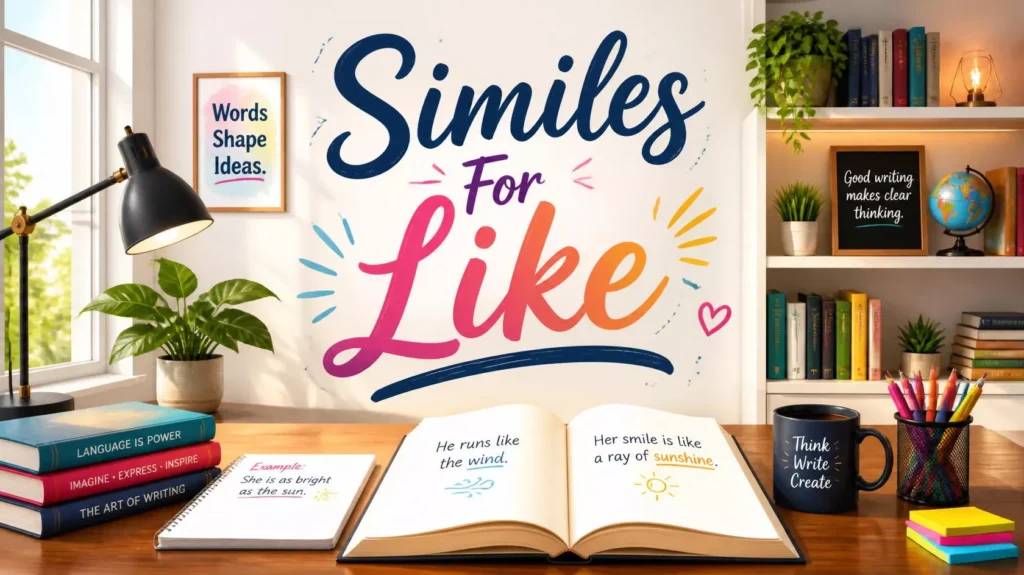
Similes are a powerful way to bring clarity and imagination into your writing. By using the word “like,” you can draw quick, vivid comparisons that help readers instantly understand a feeling, action, or image. Instead of simply saying someone is nervous, you might say they feel “like a leaf trembling in the wind,” creating a stronger emotional picture. These comparisons turn ordinary descriptions into something memorable and expressive. Whether you’re writing a story, speaking in everyday conversation, or trying to explain a complex feeling, similes with “like” make your language more colorful and relatable.
What Does Like Mean in Similes?
In similes, the word “like” is used to compare two different things in a clear and direct way. It shows that one thing is similar to another in a specific quality, such as appearance, behavior, or feeling. For example, when you say “as quiet like a mouse” or “runs like the wind,” you’re not saying they are the same, you’re simply highlighting a shared trait. Using “like” helps make descriptions more vivid, relatable, and easy to understand for the reader.
Everyday & Common Similes for Like
- Like a lion – very brave
Example: He stood up to the bully like a lion. - Like a cheetah – very fast
Example: She ran like a cheetah to catch the bus. - Like a feather – very light
Example: The pillow felt like a feather in my hands. - Like a rock – very strong or firm
Example: He remained calm like a rock during the crisis. - Like the wind – extremely fast
Example: The car sped away like the wind. - Like a baby – innocent or carefree
Example: He slept like a baby after the long journey. - Like a fish – swims very well
Example: She swims like a fish in the pool. - Like a mouse – very quiet
Example: He entered the room like a mouse. - Like a bee – very busy
Example: She worked like a bee all day. - Like ice – very cold
Example: His hands were like ice in the winter. - Like fire – very hot or intense
Example: The desert sun burned like fire. - Like glass – very clear
Example: The water looked like glass. - Like gold – very valuable
Example: Her advice was like gold to me. - Like a dream – wonderful or unreal
Example: The vacation felt like a dream. - Like a storm – very powerful
Example: He entered the room like a storm. - Like a shadow – always following
Example: The dog followed him like a shadow. - Like a child – playful or innocent
Example: She laughed like a child. - Like a clock – very punctual
Example: He works like a clock every day. - Like magic – happens quickly or mysteriously
Example: The problem disappeared like magic. - Like silk – very smooth
Example: Her hair felt like silk. - Like a snake – sneaky
Example: He moved like a snake through the crowd. - Like thunder – very loud
Example: His voice boomed like thunder. - Like lightning – extremely fast
Example: The answer came like lightning. - Like a mirror – reflects clearly
Example: The lake was like a mirror. - Like a sponge – absorbs quickly
Example: Kids learn like a sponge. - Like a torch – shining brightly
Example: Her smile was like a torch in the dark. - Like a wave – flowing or moving smoothly
Example: Her hair moved like a wave. - Like a doll – very pretty
Example: The baby looked like a doll. - Like a king – in a royal manner
Example: He lived like a king. - Like a clown – very funny
Example: He acted like a clown at the party. - Like a soldier – disciplined
Example: She followed rules like a soldier. - Like a fox – very clever
Example: He solved the puzzle like a fox. - Like a book – easy to read or understand
Example: His emotions were like a book. - Like a mountain – very strong or steady
Example: Her faith stood like a mountain. - Like a river – flowing continuously
Example: Time passed like a river. - Like a candle – slowly fading
Example: His energy burned like a candle. - Like a ghost – very pale or quiet
Example: He appeared like a ghost. - Like a drum – beating loudly
Example: My heart pounded like a drum. - Like a puzzle – confusing
Example: The situation felt like a puzzle. - Like a rainbow – colorful and beautiful
Example: Her dress looked like a rainbow.
You May Also Like: Similes For Sad
Rare Poetic & Literary Like Similes
- Like a fading echo – slowly disappearing
Example: His voice lingered like a fading echo. - Like autumn leaves – gently falling or ending
Example: Her thoughts drifted like autumn leaves. - Like a silver thread – delicate and shining
Example: The river flowed like a silver thread. - Like a distant star – far yet visible
Example: His dream felt like a distant star. - Like whispered secrets – soft and quiet
Example: The wind moved like whispered secrets. - Like a broken melody – incomplete or sad
Example: Her laughter sounded like a broken melody. - Like a shadowed dream – unclear or mysterious
Example: The memory felt like a shadowed dream. - Like moonlight on water – soft and glowing
Example: Her smile shimmered like moonlight on water. - Like a silent prayer – deeply felt but unspoken
Example: His hope remained like a silent prayer. - Like a drifting cloud – aimless or free
Example: He wandered like a drifting cloud. - Like a forgotten tale – lost in time
Example: The story faded like a forgotten tale. - Like a burning ember – quietly intense
Example: Her anger glowed like a burning ember. - Like frost on glass – delicate and temporary
Example: The design appeared like frost on glass. - Like a lonely road – empty and quiet
Example: The night stretched like a lonely road. - Like a shattered mirror – broken into pieces
Example: His thoughts scattered like a shattered mirror.
Soft & Gentle Similes for Like
- Like a feather – very soft
Example: The blanket felt like a feather. - Like a lullaby – calming and soothing
Example: Her voice was like a lullaby. - Like a breeze – light and refreshing
Example: His touch was like a breeze. - Like a cloud – soft and fluffy
Example: The pillow felt like a cloud. - Like a petal – delicate and gentle
Example: Her skin was like a petal. - Like a whisper – very soft
Example: He spoke like a whisper. - Like warm milk – comforting
Example: The drink felt like warm milk. - Like sunlight – warm and pleasant
Example: Her smile was like sunlight. - Like silk – smooth and soft
Example: The fabric felt like silk. - Like a hug – comforting
Example: The moment felt like a hug. - Like a melody – sweet and pleasing
Example: Her laughter sounded like a melody. - Like falling snow – calm and peaceful
Example: The scene was like falling snow. - Like morning dew – fresh and pure
Example: Her thoughts were like morning dew. - Like a kitten – gentle and soft
Example: He handled it like a kitten. - Like a calm sea – peaceful
Example: His mind was like a calm sea
Funny & Lighthearted Like Similes
- Like a chicken without a head – acting crazy
Example: He ran around like a chicken without a head. - Like a couch potato – very lazy
Example: He sat like a couch potato all day. - Like a monkey – playful and silly
Example: The kids acted like monkeys. - Like a clown – funny or goofy
Example: He behaved like a clown. - Like a snail – very slow
Example: The line moved like a snail. - Like a parrot – repeating things
Example: She talked like a parrot. - Like a pig – messy eater
Example: He ate like a pig. - Like a popcorn machine – very noisy
Example: The class sounded like a popcorn machine. - Like a bouncing ball – full of energy
Example: The child moved like a bouncing ball. - Like a cat in water – uncomfortable
Example: He looked like a cat in water. - Like a broken record – repeating again and again
Example: He sounded like a broken record. - Like jelly – shaky
Example: His legs were like jelly. - Like a balloon – easily excited
Example: She reacted like a balloon ready to pop. - Like a goat – stubborn
Example: He argued like a goat. - Like spaghetti – all tangled
Example: My thoughts felt like spaghetti.
Alternative Words And Their Meaning
| Word | Meaning |
|---|---|
| As | used to compare equality |
| Similar to | showing resemblance |
| Resembling | having a similar appearance |
| Comparable to | able to be compared |
| In the manner of | in a similar way |
| Equivalent to | equal in value or meaning |
| Akin to | closely related or similar |
| Reminiscent of | bringing to mind something similar |
| Parallel to | similar in direction or purpose |
| In the style of | following the same pattern or form |
You May Also Like: Similes For Confusion
How to Create Your Own Like Similes
- Focus on one clear quality
Choose a specific trait like speed, softness, or brightness. - Pick a familiar comparison
Use objects or ideas people easily recognize. - Keep it simple
Avoid overly complex or confusing comparisons. - Be creative
Try unique or unexpected pairings for stronger impact. - Match the tone
Make sure your simile fits the mood (funny, serious, gentle, etc.).
Common Mistakes To Avoid While Using Like Similes
- Using clichés too often
Overused similes can make writing dull. - Making unclear comparisons
If the connection isn’t obvious, it confuses readers. - Overloading sentences
Too many similes in one place can feel heavy. - Mixing meanings
Comparing unrelated traits weakens the effect. - Using the wrong tone
A funny simile in a serious context can feel out of place.
You May Also Like: Similes For Crying
Test Yourself Like Similes
- Which simile shows speed?
A. Like a snail
B. Like the wind
C. Like a rock
D. Like a pillow
Answer: B - Which simile shows softness?
A. Like a feather
B. Like thunder
C. Like steel
D. Like a storm
Answer: A - Which simile shows loudness?
A. Like a mouse
B. Like a whisper
C. Like thunder
D. Like a shadow
Answer: C - Which simile shows quietness?
A. Like a drum
B. Like a mouse
C. Like lightning
D. Like fire
Answer: B - Which simile shows strength?
A. Like glass
B. Like a rock
C. Like a cloud
D. Like a leaf
Answer: B - Which simile shows nervousness?
A. Like a cat on a hot tin roof
B. Like a king
C. Like a feather
D. Like a mirror
Answer: A - Which simile shows happiness?
A. Like a storm
B. Like sunshine
C. Like ice
D. Like a shadow
Answer: B - Which simile shows confusion?
A. Like a puzzle
B. Like a clock
C. Like a ruler
D. Like a soldier
Answer: A - Which simile shows smoothness?
A. Like sand
B. Like silk
C. Like stone
D. Like wood
Answer: B - Which simile shows brightness?
A. Like a cave
B. Like a torch
C. Like a hole
D. Like smoke
Answer: B
FAQs
Conclusion
Similes with “like” are one of the simplest yet most powerful tools in writing. They help turn ordinary sentences into vivid and memorable expressions by drawing clear comparisons that readers instantly understand. Whether you’re describing emotions, actions, or appearances, using “like” allows you to paint a more detailed picture with just a few words. From everyday phrases to creative and poetic expressions, these similes make communication more engaging, relatable, and expressive. By practicing regularly and avoiding common mistakes, you can easily master the art of creating your own similes and bring more color and depth to your writing.