

Verbs are the heartbeat of any sentence because they show action, express feelings, and connect ideas in meaningful ways. Among them, verbs that start with the letter “L” bring a lively and expressive touch to language, from simple everyday actions like laugh and look to more descriptive words like learn, lead, and listen. Whether you’re a student building vocabulary, a teacher guiding young learners, or a writer searching for the perfect word, exploring “L” verbs opens up new possibilities for clear and creative communication.
Understanding Verbs That Start With Letter L
Verbs that start with the letter “L” are action or state words that help describe what someone or something does, feels, or experiences. These verbs can show movement (like “leap” or “lift”), thinking (like “learn”), or emotions (like “love” or “like”). Some “L” verbs are very common in everyday language, making them easy to learn and use, especially for beginners. By understanding these verbs, you can improve your vocabulary, make clearer sentences, and express ideas more effectively in both speaking and writing.
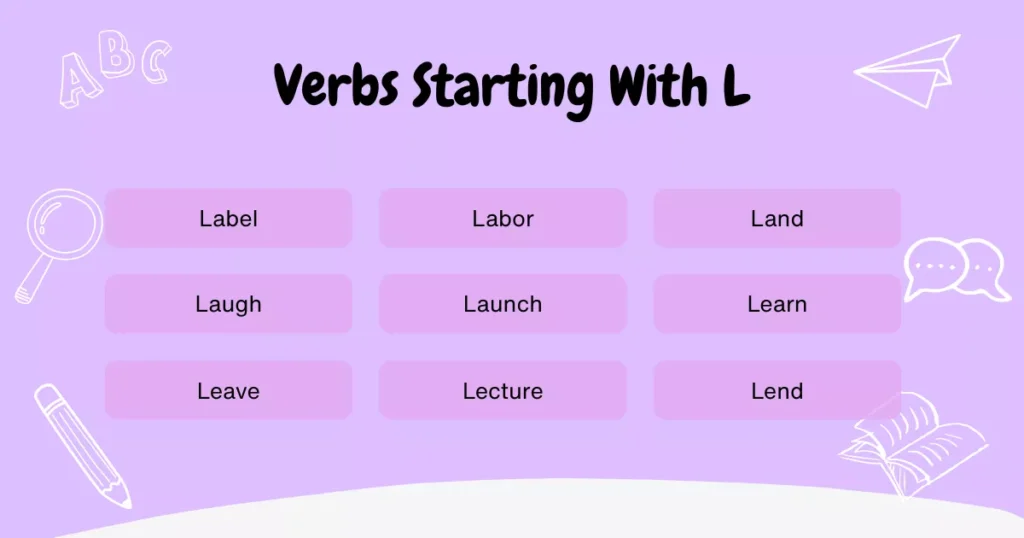
List of Common Verbs Starting With L
- Laugh – to express happiness with sound
Example: She laughed at the funny joke. - Learn – to gain knowledge
Example: I learn new words every day. - Listen – to pay attention to sound
Example: Please listen carefully. - Look – to see or observe
Example: Look at the sky! - Love – to feel deep affection
Example: They love their parents. - Like – to enjoy or prefer
Example: I like ice cream. - Live – to exist or stay
Example: They live in a small house. - Leave – to go away
Example: He will leave soon. - Lend – to give temporarily
Example: Can you lend me a pen? - Lift – to raise something
Example: She lifted the box. - Lead – to guide
Example: He leads the team. - Lose – to misplace or fail to win
Example: Don’t lose your keys. - Lay – to put something down
Example: Lay the book on the table. - Lie – to rest or not tell truth
Example: He lies on the bed. - Lock – to secure something
Example: Lock the door. - Load – to put items into something
Example: Load the truck. - Launch – to start or introduce
Example: They launched a new product. - Link – to connect
Example: Link the ideas together. - Light – to make something bright
Example: Light the candle. - List – to write items one by one
Example: List your tasks. - Label – to tag or name
Example: Label the boxes. - Limit – to restrict
Example: Limit your screen time. - Lick – to touch with tongue
Example: The dog licked my hand. - Lean – to bend or rest
Example: Lean against the wall. - Last – to continue
Example: The movie lasted two hours. - Linger – to stay longer
Example: She lingered after class. - Lure – to attract
Example: The smell lured customers. - Locate – to find
Example: Locate the missing file. - Lower – to move down
Example: Lower your voice. - Laugh off – to dismiss casually
Example: He laughed off the mistake.
You May Also Like: Verbs That Start With I
Action Verbs That Start With L
- Leap – to jump
Example: The cat leaped over the fence. - Lift – to raise
Example: Lift the bag carefully. - Launch – to send off
Example: They launched the rocket. - Load – to fill
Example: Load the dishwasher. - Lock – to secure
Example: Lock the gate. - Look – to see
Example: Look outside. - Listen – to hear attentively
Example: Listen to music. - Lend – to give temporarily
Example: Lend me your book. - Leave – to go away
Example: Leave the room. - Lay – to place
Example: Lay the cloth. - Light – to ignite
Example: Light the lamp. - Lick – to taste
Example: The child licked the candy. - Lean – to tilt
Example: Lean forward. - Loop – to form a circle
Example: Loop the rope. - Lower – to bring down
Example: Lower the flag. - Lash – to strike
Example: Waves lashed the shore. - Lunge – to move suddenly
Example: The dog lunged forward. - Lift up – to raise higher
Example: Lift up the box. - Look after – to take care of
Example: She looks after her brother. - Log in – to access a system
Example: Log in to your account.
Positive and Motivational Verbs With L
- Learn – to gain knowledge
Example: Always learn new skills. - Lead – to guide others
Example: Lead with confidence. - Love – to care deeply
Example: Love what you do. - Lift – to encourage
Example: Lift others up. - Listen – to understand
Example: Listen to others’ ideas. - Laugh – to stay happy
Example: Laugh every day. - Look forward – to expect positively
Example: Look forward to success. - Level up – to improve
Example: Level up your skills. - Launch – to start something new
Example: Launch your dreams. - Light up – to brighten
Example: Your smile lights up the room. - Live – to enjoy life
Example: Live your best life. - Let go – to release negativity
Example: Let go of stress. - Lead on – to encourage progress
Example: Lead on with hope. - Link – to connect ideas
Example: Link your goals. - Leverage – to use effectively
Example: Leverage your strengths. - Learn from – to improve through mistakes
Example: Learn from failure. - Lift off – to begin successfully
Example: Your career will lift off soon. - Look up – to stay hopeful
Example: Things will look up. - Love oneself – to respect yourself
Example: Love yourself first. - Lighten – to make better
Example: Lighten your mood.
Regular and Irregular Verbs Starting With L
- Laugh – laughed
Example: She laughed loudly. - Learn – learned
Example: He learned English. - Listen – listened
Example: She listened carefully. - Look – looked
Example: I looked around. - Love – loved
Example: They loved the movie. - Lock – locked
Example: He locked the door. - Load – loaded
Example: She loaded the truck. - Launch – launched
Example: They launched a product. - Link – linked
Example: The ideas were linked. - Label – labeled
Example: She labeled the files. - Limit – limited
Example: They limited access. - Lick – licked
Example: The dog licked my hand. - Lean – leaned
Example: He leaned forward. - Linger – lingered
Example: She lingered outside. - Locate – located
Example: They located the house. - Lead – led
Example: He led the team. - Leave – left
Example: She left early. - Lose – lost
Example: They lost the match. - Lend – lent
Example: I lent him money. - Lie (rest) – lay / lain
Example: He lay on the bed. - Lay – laid
Example: She laid the book down. - Light – lit/lighted
Example: He lit the candle. - Let – let
Example: She let him go. - Leap – leapt/leaped
Example: The cat leapt high. - Learn (BrE) – learnt
Example: He learnt French. - Lean (BrE) – leant
Example: She leant on the wall. - Lend (alt. form) – lent
Example: He lent his car. - Lose (alt. usage) – lost
Example: She lost her keys. - Leave (alt. usage) – left
Example: They left the building. - Light (alt.) – lit
Example: She lit the lamp.
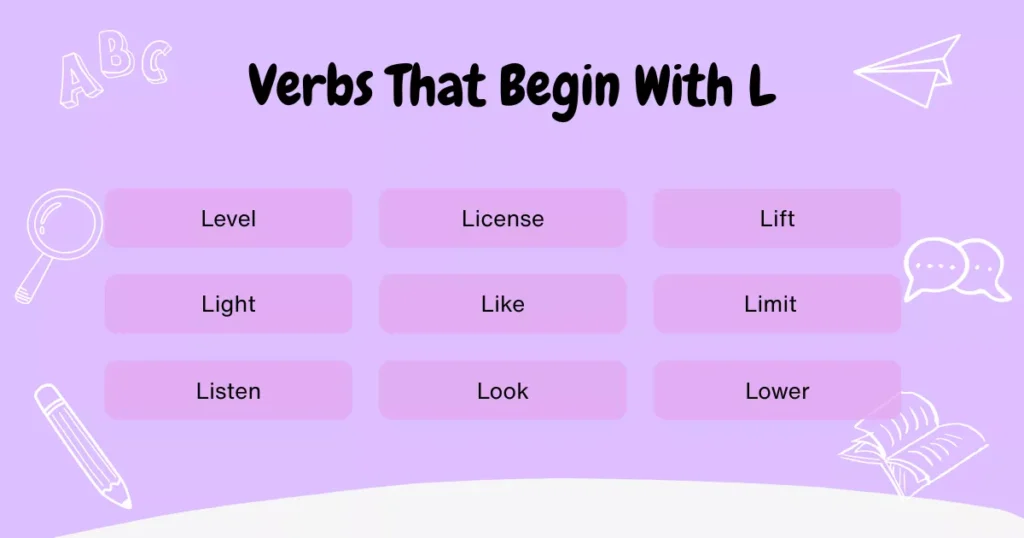
Phrasal Verbs That Start With L
| Verb | Meaning | Example |
|---|---|---|
| Look after | take care of | She looks after her younger sister. |
| Look for | try to find | I am looking for my keys. |
| Look into | investigate | The police will look into the case. |
| Look up | search for information | Look up the word in the dictionary. |
| Look down on | consider inferior | He looks down on others. |
| Look forward to | feel excited about | I look forward to the holidays. |
| Look out | be careful | Look out! A car is coming. |
| Look over | examine quickly | Please look over this report. |
| Look through | read or check | She looked through the documents. |
| Look up to | admire | I look up to my teacher. |
| Live up to | meet expectations | He lived up to his promises. |
| Leave out | omit | Don’t leave out any details. |
| Leave behind | forget or abandon | She left her bag behind. |
| Let down | disappoint | He let his team down. |
| Let in | allow entry | Please let me in. |
| Let out | release | They let the dog out. |
| Lay off | stop employing | The company laid off workers. |
| Lay out | arrange | She laid out the clothes. |
| Line up | arrange in order | Students lined up outside. |
| Log in | access a system | Log in to your account. |
| Log out | exit a system | Don’t forget to log out. |
| Light up | brighten | Her face lit up with joy. |
| Level off | become stable | Prices leveled off. |
| Link up | connect | The teams linked up. |
| Latch onto | grasp or understand | He quickly latched onto the idea. |
You May Also Like: Verbs That Start With J
Professional, Academic, and Technical L Verbs
- Analyze (UK: Analyse) – examine in detail
Example: Researchers analyze data carefully. - List – present items
Example: List your references clearly. - Locate – find exact position
Example: The system locates errors. - Link – connect ideas
Example: Link theory with practice. - Launch – introduce officially
Example: They launched a new software. - Leverage – use effectively
Example: Leverage your resources wisely. - Lead – guide or manage
Example: She leads the research team. - Log – record information
Example: Log all activities. - Load – input data
Example: Load the file into the system. - Limit – set boundaries
Example: Limit the scope of research. - Label – categorize
Example: Label the variables. - Liaise – communicate professionally
Example: Liaise with the department. - Legitimize – make lawful
Example: The law legitimizes the process. - Liquidate – convert assets
Example: The firm liquidated assets. - Localize – adapt to region
Example: Localize the content. - Linearize – simplify into linear form
Example: Linearize the equation. - Loop – repeat a process
Example: The program loops continuously. - Logically deduce – conclude using logic
Example: Logically deduce the answer. - List out – detail items
Example: List out all requirements. - Link back – refer again
Example: Link back to your hypothesis. - Load balance – distribute workload
Example: Servers load balance traffic. - License – grant permission
Example: The company licensed the software. - Lessen – reduce
Example: This method lessens errors. - Level – make even or standard
Example: Level the performance metrics. - Layout – arrange structure
Example: Layout the design clearly.
Emotional, Creative, and Descriptive L Verbs
- Love – feel deep affection
Example: She loves her family. - Like – enjoy
Example: I like this song. - Long – strongly desire
Example: He longs for success. - Lament – express sorrow
Example: She lamented her loss. - Laugh – show happiness
Example: They laughed loudly. - Linger – stay longer
Example: Memories linger. - Liven – make lively
Example: Music livened the party. - Lighten – reduce sadness
Example: Her words lightened my mood. - Lift – inspire
Example: The speech lifted spirits. - Lull – calm or soothe
Example: The music lulled him to sleep. - Laud – praise highly
Example: The teacher lauded her work. - Lash out – express anger
Example: He lashed out in frustration. - Lose oneself – become absorbed
Example: She lost herself in art. - Look back – remember
Example: He looked back on his childhood. - Look ahead – think about future
Example: Look ahead with hope. - Lace – add creatively
Example: She laced her story with humor. - Layer – arrange in levels
Example: Layer the colors beautifully. - Lure – attract
Example: The design lured customers. - Lust – strongly desire
Example: He lusted for power. - Loathe – strongly dislike
Example: She loathes dishonesty. - Laugh off – dismiss lightly
Example: He laughed off criticism. - Lean toward – show preference
Example: I lean toward this option. - Light up – show joy
Example: Her eyes lit up. - Live through – experience
Example: They lived through tough times. - Leave a mark – create impact
Example: Her work left a mark.
Rare, Unique, and Advanced Verbs That Start With L
- Lacerate – tear deeply
Example: The glass lacerated his hand. - Lambaste – criticize harshly
Example: The critic lambasted the film. - Languish – weaken or suffer
Example: He languished in prison. - Latentize – make hidden
Example: The effect was latentized. - Legislate – make laws
Example: The government legislates policies. - Levitate – rise without support
Example: The object levitated mysteriously. - Lucubrate – write or study intensely
Example: She lucubrated all night. - Lustrate – purify
Example: The ritual lustrated the space. - Loll – sit lazily
Example: He lolled on the couch. - Limpidize – make clear
Example: The process limpidized the solution. - Lixiviate – extract by washing
Example: Chemists lixiviate minerals. - Lobotomize – remove part of brain (historical)
Example: The doctor lobotomized the patient. - Lacquering – coat with polish
Example: They lacquered the wood. - Lactate – produce milk
Example: The animal lactates naturally. - Limp – walk unevenly
Example: He limped after injury. - Lustrify – make bright or pure
Example: The polish lustrified the metal. - Ligate – bind or tie
Example: Doctors ligate blood vessels. - Labilize – make unstable
Example: The chemical labilized the compound. - Lave – wash
Example: Waves laved the shore. - Lethargize – make sluggish
Example: The heat lethargized him. - Lignify – turn into wood
Example: Plants lignify over time. - Luminate – give light
Example: Stars luminate the sky. - Lacer – tear
Example: Sharp edges lacer skin. - Lallygag – waste time
Example: Stop lallygagging and work. - Luxate – dislocate
Example: He luxated his shoulder.
You May Also Like: Verbs That Start With K
Common Mistakes When Using L Verbs
- Confusing “Lay” and “Lie”
Mistake: “I will lay down for a while.”
Correct: “I will lie down for a while.”
Tip: Lay = needs an object, Lie = no object - Mixing “Lose” and “Loose”
Mistake: “Don’t loose your keys.”
Correct: “Don’t lose your keys.”
Tip: Lose = misplace, Loose = not tight - Wrong Past Forms of Irregular Verbs
Mistake: “He leaved early.”
Correct: “He left early.”
Tip: Memorize irregular forms like leave → left, lead → led - Overusing Simple Verbs Like “Look” or “Like”
Mistake: Using only basic verbs repeatedly
Better: Use variety like observe, admire, prefer - Incorrect Use of Phrasal Verbs
Mistake: “I look forward you.”
Correct: “I look forward to you.”
Tip: Always learn phrasal verbs with their full structure
Fun Facts About Verbs That Begin With L
- “L” Verbs Often Express Emotions
Words like love, like, long, loathe show strong feelings. - Many “L” Verbs Are Everyday Essentials
Verbs like look, listen, learn, live are used constantly in daily speech. - “L” Verbs Can Be Both Simple and Advanced
From laugh (basic) to lucubrate (advanced), they cover all levels. - Some “L” Verbs Have Multiple Meanings
Example: “light” can mean to brighten or not heavy. - Phrasal Verbs with “Look” Are Extremely Common
Look after, look into, look up are widely used in English.
FAQs
Conclusion
Verbs that start with the letter “L” bring life, clarity, and expression to the English language. From simple everyday actions like look and learn to more advanced and descriptive verbs, they help us communicate ideas, emotions, and experiences effectively. By understanding their meanings, correct usage, and common mistakes, you can greatly improve both your speaking and writing skills. Whether you are a beginner, student, or advanced learner, mastering “L” verbs will make your language more powerful, natural, and engaging.