Are you ready to expand your English vocabulary in a simple and engaging way? Learning verbs that start with the letter F is a powerful step toward improving both your speaking and writing skills. Verbs are action words that help you express what you do, feel, and experience in everyday life. From common choices like find, feel, and follow to more expressive words like flourish and foster, F-verbs add flexibility, clarity, and impact to your communication. Whether you’re a beginner, a student, or helping kids build strong language foundations, this guide is designed to make learning easy and enjoyable.
Understanding Verbs That Start With Letter F
Verbs that start with the letter F are action or state words used to describe what someone does, feels, or experiences. These verbs cover a wide range of meanings from physical actions like fall and fix to mental or emotional processes like feel and fear. Some F-verbs are commonly used in everyday conversations, while others appear more often in formal or descriptive writing. Learning these verbs helps improve sentence variety, clarity, and expression. It also allows you to communicate ideas more precisely, whether you’re speaking, writing, or reading.
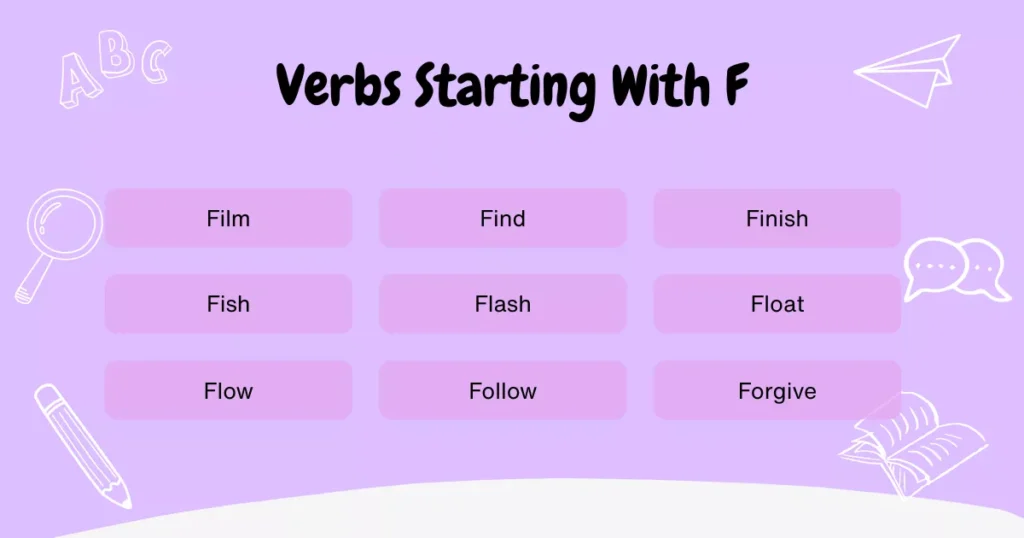
List of Common Verbs Starting With F
- Face – to confront something
Example: She faced her fears bravely. - Fail – to not succeed
Example: He failed the test but tried again. - Fall – to move downward
Example: Leaves fall in autumn. - Fasten – to attach or secure
Example: Please fasten your seatbelt. - Feed – to give food
Example: She feeds the cat every morning. - Feel – to experience emotion
Example: I feel happy today. - Fight – to struggle or battle
Example: They fight for their rights. - Fill – to make full
Example: Fill the glass with water. - Find – to discover
Example: I found my keys under the table. - Finish – to complete
Example: He finished his homework early. - Fix – to repair
Example: She fixed the broken chair. - Follow – to go after
Example: Follow me to the classroom. - Force – to make someone do something
Example: They forced him to apologize. - Forget – to fail to remember
Example: Don’t forget your bag. - Forgive – to stop feeling angry
Example: Please forgive my mistake. - Form – to create or shape
Example: Clouds form in the sky. - Free – to release
Example: They freed the bird. - Freeze – to become very cold
Example: Water freezes at 0°C. - Fry – to cook in oil
Example: She fried some eggs. - Furnish – to provide furniture
Example: They furnished the house beautifully. - Focus – to concentrate
Example: Focus on your goals. - Function – to work properly
Example: The machine functions well. - Fade – to lose brightness
Example: The color faded over time. - Flash – to shine suddenly
Example: Lightning flashed in the sky. - Float – to stay on water
Example: The boat floats easily. - Flow – to move like liquid
Example: The river flows gently. - Fold – to bend something
Example: Fold the paper neatly. - Fool – to trick someone
Example: He fooled his friends. - Frame – to build or structure
Example: They framed the picture. - Flee – to run away
Example: The thief fled quickly.
You May Also Like: Verbs That Start With C
Action Verbs That Start With F
- Fetch – to go and bring back
Example: Please fetch me a glass of water. - Flip – to turn over
Example: He flipped the pancake. - Fling – to throw forcefully
Example: She flung the ball across the yard. - Fly – to move in the air
Example: Birds fly in the sky. - Force – to push strongly
Example: He forced the door open. - Fight – to battle
Example: They fight bravely. - Fasten – to secure
Example: Fasten your shoes. - Fix – to repair
Example: She fixed the bike. - Fold – to bend
Example: Fold your clothes. - Fill – to make full
Example: Fill the bottle. - Fry – to cook
Example: He fried the fish. - Feed – to give food
Example: Feed the baby. - Follow – to go after
Example: Follow the leader. - Flick – to move quickly
Example: He flicked the switch. - Fan – to blow air
Example: She fanned herself. - Forge – to shape metal
Example: They forged a sword. - Frame – to construct
Example: Workers framed the house. - Furnish – to equip
Example: They furnished the room. - Fumigate – to disinfect with gas
Example: They fumigated the house. - Fast-track – to speed up
Example: They fast-tracked the project.
Positive and Motivational Verbs With F
- Flourish – to grow successfully
Example: Her business flourished. - Foster – to encourage growth
Example: Parents foster good habits. - Focus – to concentrate
Example: Focus on your dreams. - Forgive – to let go of anger
Example: Forgive and move forward. - Fuel – to energize
Example: Passion fuels success. - Fulfill – to achieve goals
Example: She fulfilled her dreams. - Free – to release
Example: Free your mind from doubt. - Fortify – to strengthen
Example: Exercise fortifies the body. - Forward – to advance
Example: Forward your ideas boldly. - Fix – to improve
Example: Fix your mistakes and learn. - Fire up – to inspire
Example: The speech fired up the crowd. - Fascinate – to attract strongly
Example: Science fascinates him. - Feature – to highlight
Example: The event features young talent. - Facilitate – to make easier
Example: Teachers facilitate learning. - Fellowship – to connect socially
Example: They fellowship with others. - Fasten (to goals) – to commit firmly
Example: Fasten your mind to success. - Firm up – to strengthen plans
Example: Firm up your strategy. - Fine-tune – to improve details
Example: Fine-tune your skills daily. - Fan (enthusiasm) – to increase excitement
Example: The win fanned their motivation. - Flower – to develop beautifully
Example: Creativity flowers with practice.
Regular and Irregular Verbs Starting With F
- Fall (Irregular) – to drop down
Example: Leaves fall in autumn. - Feed (Irregular) – to give food
Example: She fed the dog. - Feel (Irregular) – to sense emotion
Example: I felt happy. - Fight (Irregular) – to battle
Example: They fought bravely. - Find (Irregular) – to discover
Example: He found a wallet. - Fly (Irregular) – to move in air
Example: Birds flew away. - Forget (Irregular) – to not remember
Example: She forgot her keys. - Forgive (Irregular) – to pardon
Example: He forgave his friend. - Freeze (Irregular) – to become ice
Example: Water froze overnight. - Flee (Irregular) – to run away
Example: They fled the scene. - Face (Regular) – to confront
Example: She faced the problem. - Fail (Regular) – to not succeed
Example: He failed the exam. - Fasten (Regular) – to secure
Example: She fastened her seatbelt. - Fetch (Regular) – to bring
Example: He fetched water. - Fill (Regular) – to make full
Example: She filled the glass. - Finish (Regular) – to complete
Example: He finished his work. - Fix (Regular) – to repair
Example: She fixed the car. - Follow (Regular) – to go after
Example: They followed the guide. - Force (Regular) – to compel
Example: He forced the door. - Form (Regular) – to create
Example: They formed a group. - Fry (Regular) – to cook
Example: She fried potatoes. - Furnish (Regular) – to provide
Example: They furnished the house. - Fade (Regular) – to lose color
Example: The paint faded. - Flash (Regular) – to shine suddenly
Example: Lightning flashed. - Float (Regular) – to stay on water
Example: The boat floated. - Flow (Regular) – to move smoothly
Example: The river flowed. - Fold (Regular) – to bend
Example: She folded clothes. - Fool (Regular) – to trick
Example: He fooled them. - Frame (Regular) – to build
Example: They framed the picture. - Flick (Regular) – to move quickly
Example: He flicked the light switch.
You May Also Like: Verbs That Start With D
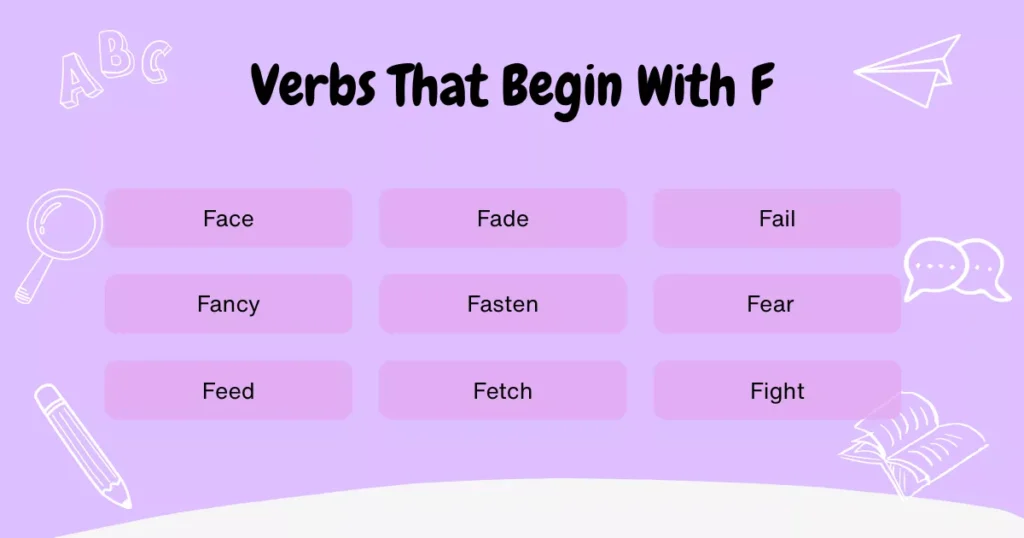
Phrasal Verbs That Start With F
| Verb | Meaning | Example |
|---|---|---|
| Face up to | to accept and deal | She faced up to her fears. |
| Fall apart | to break into pieces or fail | The plan fell apart quickly. |
| Fall back on | to rely on something | He fell back on his savings. |
| Fall behind | to lag or be late | She fell behind in class. |
| Fall for | to be tricked or fall in love | He fell for the joke. |
| Fall out | to argue and stop being friends | They fell out over money. |
| Fall through | to fail to happen | The deal fell through. |
| Fan out | to spread out | The crowd fanned out. |
| Farm out | to give work to others | They farmed out the project. |
| Faze out | to gradually remove | Old rules were phased out. |
| Feed on | to grow stronger from something | Fear feeds on doubt. |
| Feel for | to sympathize | I feel for her situation. |
| Feel out | to test someone’s opinion | He felt out the audience. |
| Figure out | to understand | She figured out the problem. |
| Fill in | to complete or substitute | Please fill in the form. |
| Fill out | to complete fully | Fill out this application. |
| Fill up | to become full | The tank filled up. |
| Filter out | to remove unwanted parts | The system filters out noise. |
| Find out | to discover | I found out the truth. |
| Finish off | to complete something | He finished off the task. |
| Fix up | to repair or arrange | They fixed up the house. |
| Focus on | to concentrate | Focus on your goals. |
| Follow up | to continue or check | She followed up the email. |
| Fork out | to pay reluctantly | He forked out extra money. |
| Frown upon | to disapprove | That behavior is frowned upon. |
Professional, Academic, and Technical F Verbs
- Facilitate – to make easier
Example: The teacher facilitates discussion. - Formulate – to create systematically
Example: They formulated a plan. - Function – to operate
Example: The system functions properly. - Forecast – to predict
Example: Experts forecast growth. - Frame – to structure ideas
Example: She framed the argument well. - Fund – to provide money
Example: The project was funded. - Furnish – to provide
Example: They furnished the data. - Factor – to include in calculation
Example: We must factor in risks. - Filter – to remove unwanted parts
Example: The tool filters data. - Focus – to concentrate
Example: Focus on key points. - Formalize – to make official
Example: They formalized the agreement. - File – to submit documents
Example: He filed a report. - Fixate – to focus intensely
Example: She fixated on details. - Foster – to encourage growth
Example: Programs foster innovation. - Flag – to mark for attention
Example: The system flagged errors. - Fine-tune – to improve details
Example: They fine-tuned the model. - Forecasting – predicting future trends
Example: Forecasting helps planning. - Fabricate – to create artificially
Example: They fabricated materials. - Fortify – to strengthen
Example: Measures fortify security. - Fast-track – to speed up
Example: They fast-tracked approval. - Familiarize – to make aware
Example: Familiarize yourself with rules. - Filter down – to pass gradually
Example: Information filters down. - Follow through – to complete fully
Example: He followed through on plans. - Frontload – to put effort early
Example: They frontloaded the project. - Forecast out – to extend predictions
Example: They forecasted out five years.
Emotional, Creative, and Descriptive F Verbs
- Feel – to experience emotion
Example: I feel excited. - Fear – to be afraid
Example: She fears failure. - Fret – to worry
Example: He frets over small things. - Fume – to be very angry
Example: She fumed with anger. - Fancy – to like or imagine
Example: I fancy a cup of tea. - Fascinate – to attract strongly
Example: Art fascinates her. - Flatter – to praise excessively
Example: He flattered his boss. - Flourish – to grow beautifully
Example: Her creativity flourished. - Flow – to move smoothly
Example: Ideas flowed freely. - Flutter – to move lightly
Example: Her heart fluttered. - Flash – to show briefly
Example: He flashed a smile. - Freeze – to become still with fear
Example: She froze in shock. - Flicker – to shine unsteadily
Example: Hope flickered inside. - Fuel – to increase emotion
Example: Anger fueled his actions. - Frame – to present creatively
Example: She framed the story well. - Fashion – to create artistically
Example: He fashioned a sculpture. - Feast – to enjoy greatly
Example: They feasted on music. - Fade – to disappear gradually
Example: Memories fade slowly. - Fling – to throw emotionally
Example: She flung herself into work. - Foster – to nurture feelings
Example: They foster kindness. - Float – to drift lightly
Example: Dreams float in his mind. - Flame – to burn with emotion
Example: Passion flamed within. - Flower – to develop fully
Example: Her talent flowered. - Fracture – to break emotionally
Example: Trust fractured quickly. - Free – to release emotions
Example: She freed her thoughts.
You May Also Like: Verbs That Start With E
Rare, Unique, and Advanced Verbs That Start With F
- Fathom – to understand deeply
Example: I can’t fathom his idea. - Forage – to search for food
Example: Animals forage in forests. - Furbish – to renovate or polish
Example: They furbished the old house. - Fetter – to restrict
Example: Rules fetter creativity. - Foment – to stir up trouble
Example: They fomented unrest. - Fracture – to break
Example: The bone fractured. - Fray – to wear out
Example: The rope frayed. - Fizzle – to fade weakly
Example: The plan fizzled out. - Flout – to openly disobey
Example: He flouted the law. - Flinch – to react suddenly
Example: She flinched in fear. - Flounder – to struggle
Example: He floundered in confusion. - Fledge – to grow feathers
Example: The bird fledged. - Foreshadow – to hint at future
Example: Dark clouds foreshadow rain. - Forestall – to prevent
Example: They forestalled disaster. - Fortify – to strengthen
Example: Walls were fortified. - Furl – to roll up
Example: They furled the sails. - Flux – to flow continuously
Example: Prices flux daily. - Frolic – to play joyfully
Example: Children frolicked outside. - Froth – to form foam
Example: Milk frothed quickly. - Fumigate – to disinfect
Example: They fumigated the area. - Falsify – to alter dishonestly
Example: He falsified records. - Flaunt – to show off
Example: She flaunted her success. - Fetter – to bind or chain
Example: The prisoner was fettered. - Felicitate – to congratulate
Example: They felicitated the winner. - Fulminate – to protest strongly
Example: He fulminated against injustice.
Common Mistakes When Using F Verbs
- Confusing similar verbs (e.g., find vs found)
Many learners mix up base forms and past tense.
Incorrect: I find my keys yesterday.
Correct: I found my keys yesterday. - Using the wrong preposition in phrasal verbs
Small words can completely change meaning.
Incorrect: She fell to the trick.
Correct: She fell for the trick. - Overusing basic verbs like feel and find
Repeating simple verbs makes writing less engaging.
Tip: Replace with stronger words like foster, flourish, or fathom when suitable. - Incorrect verb forms in tenses
Some F-verbs are irregular and tricky.
Incorrect: He has fly to Dubai.
Correct: He has flown to Dubai. - Misusing formal vs informal verbs
Certain verbs fit better in academic contexts.
Example: Use facilitate instead of help in formal writing.
Fun Facts About Verbs That Begin With F
- F-verbs often describe movement and change
Words like flow, fly, fall, and flip show motion, making them very expressive. - Many F-verbs have emotional depth
Verbs like feel, fear, forgive, and fume capture strong human emotions. - F is popular in phrasal verbs
English has many F-based phrasal verbs like figure out, find out, and fall apart. - Some F-verbs have Latin and French roots
Words like facilitate and formulate come from classical languages, giving them a formal tone. - F-verbs are common in storytelling
Writers often use verbs like flash, fade, and flee to create vivid scenes and action.
FAQs
Conclusion
Verbs that start with the letter F open up a fascinating and flexible world of expression in English. From everyday actions like find and fix to powerful and inspiring words like flourish and foster, these verbs help you communicate ideas clearly, creatively, and confidently. Whether you are a beginner building your vocabulary, a student aiming for academic success, or a writer looking to add depth to your language, mastering F-verbs can make a noticeable difference. By exploring common, action, positive, phrasal, and advanced verbs, you not only expand your word bank but also improve your ability to express emotions, describe situations, and engage your audience effectively.