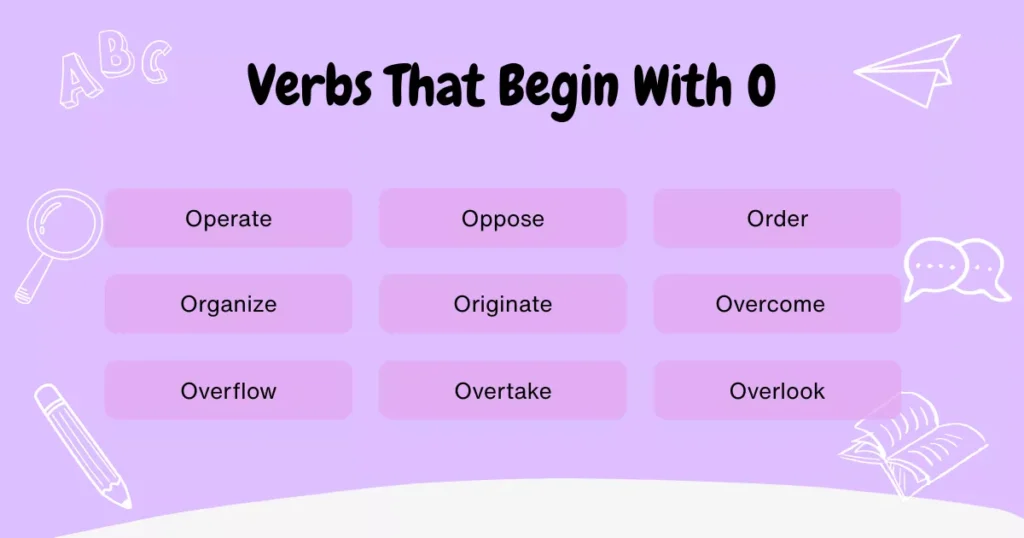
Verbs that start with O may not be the most common in English, but they are some of the most useful and expressive words you can learn. From everyday actions like open, offer, and observe to stronger words like overcome, organize, and outshine, these verbs help bring clarity, movement, and energy to your speaking and writing. Whether you are a student building vocabulary, a writer searching for better word choices, or a parent helping kids learn English, O-verbs can make language more powerful and interesting.
Understanding Verbs That Start With Letter O
Verbs that start with the letter O are action or state words used to describe what someone does, feels, or experiences. These verbs range from common everyday words like open, offer, and observe to stronger and more descriptive words like overcome, organize, and outperform. Learning O verbs helps improve vocabulary, speaking, and writing skills by giving you more ways to express actions clearly and effectively. They are useful in daily conversations, schoolwork, creative writing, and professional communication.
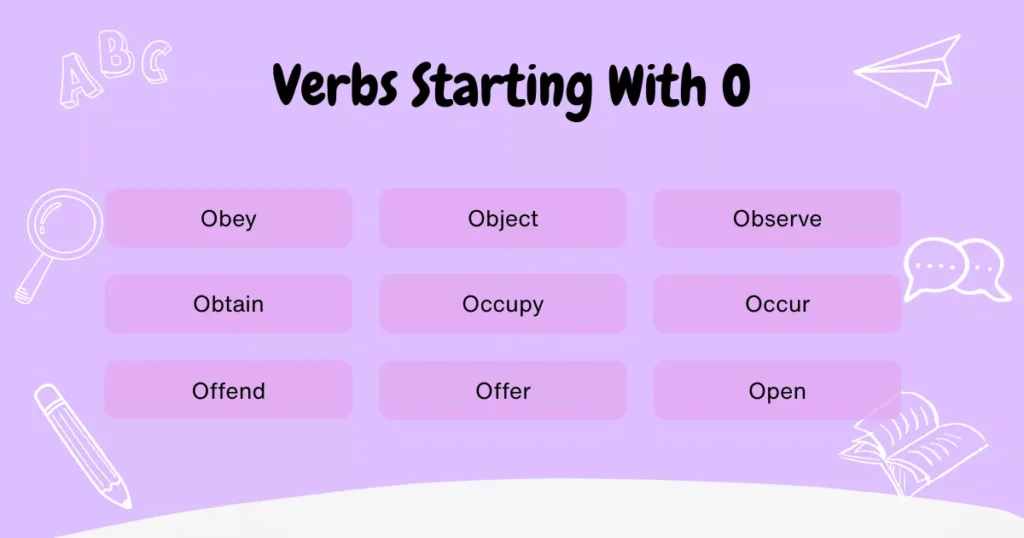
List of Common Verbs Starting With O
- Open – To make something not closed
Example: Please open the door. - Offer – To present or give something
Example: She offered me tea. - Observe – To watch carefully
Example: We observed the birds. - Obtain – To get something
Example: He obtained a passport. - Occupy – To take space or time
Example: The chair occupies the corner. - Occur – To happen
Example: The accident occurred yesterday. - Order – To request or arrange
Example: I ordered pizza tonight. - Organize – To arrange properly
Example: She organized the files. - Operate – To control or run
Example: He operates the machine. - Overcome – To defeat or succeed over
Example: She overcame fear. - Own – To possess something
Example: They own a car. - Owe – To be in debt
Example: I owe him money. - Outline – To describe briefly
Example: He outlined the plan. - Oppose – To disagree with
Example: They oppose the rule. - Omit – To leave out
Example: Please omit that line. - Originate – To begin or come from
Example: The idea originated here. - Overlook – To fail to notice
Example: I overlooked the mistake. - Overflow – To spill over edges
Example: The river overflowed. - Overhear – To hear accidentally
Example: I overheard the talk. - Overload – To put too much load
Example: Do not overload the truck. - Overtake – To pass by moving faster
Example: The car overtook us. - Outgrow – To become too big for
Example: He outgrew his shoes. - Outlast – To last longer than
Example: This battery outlasts others. - Outnumber – To be more than
Example: We outnumbered them. - Outperform – To do better than
Example: She outperformed everyone. - Outshine – To appear better than others
Example: He outshines rivals. - Outweigh – To be more important than
Example: Benefits outweigh risks. - Overpay – To pay too much
Example: I overpaid for it. - Overreact – To react too strongly
Example: Don’t overreact now. - Overwork – To work too hard
Example: He tends to overwork.
You May Also Like: Verbs That Start With L
Action Verbs That Start With O
- Open – To unlock or uncover
Example: Open the window. - Observe – To watch carefully
Example: Observe the stars tonight. - Organize – To arrange in order
Example: Organize your desk. - Operate – To run or control
Example: She operates the crane. - Offer – To give willingly
Example: He offered help. - Obtain – To get
Example: I obtained permission. - Order – To request
Example: We ordered lunch. - Outline – To summarize
Example: Outline your essay. - Overtake – To pass ahead
Example: The bike overtook us. - Overload – To load too much
Example: Don’t overload the bag. - Overflow – To spill over
Example: Water overflowed the cup. - Overhear – To hear by chance
Example: I overheard them talking. - Overlook – To miss seeing
Example: She overlooked the note. - Outgrow – To become too large for
Example: Kids outgrow clothes fast. - Outlast – To endure longer
Example: These tires outlast others. - Outnumber – To exceed in number
Example: Fans outnumbered players. - Outperform – To do better
Example: He outperformed the team. - Outshine – To shine brighter
Example: Her talent outshines others. - Overcome – To defeat
Example: They overcame obstacles. - Occupy – To take space
Example: Boxes occupy the room.
Positive and Motivational Verbs With O
- Overcome – To defeat challenges
Example: She overcame difficulties. - Outshine – To do better than others
Example: You can outshine limits. - Outperform – To achieve better results
Example: He outperformed expectations. - Obtain – To gain success
Example: She obtained her goal. - Organize – To arrange efficiently
Example: Organize your dreams. - Offer – To give help kindly
Example: Offer support to others. - Open – To begin or welcome
Example: Open your mind to ideas. - Originate – To create or begin
Example: Great ideas originate here. - Own – To accept responsibility
Example: Own your mistakes proudly. - Observe – To notice carefully
Example: Observe every opportunity. - Outgrow – To move beyond limits
Example: You can outgrow fear. - Outlast – To remain strong longer
Example: Hope can outlast pain. - Overtake – To catch up and pass
Example: Success will overtake effort. - Optimize – To improve fully
Example: Optimize your routine daily. - Overhaul – To improve completely
Example: Overhaul your habits. - Oblige – To willingly help
Example: She obliged happily. - Overpower – To defeat strongly
Example: Courage overpowers doubt. - Outweigh – To be more valuable
Example: Positivity outweighs fear. - Overfill – To fill completely
Example: Overfill life with joy. - Open – up To share feelings
Example: Open up to friends.
Regular and Irregular Verbs Starting With O
- Open – To make not closed
Example: He opened the box. - Offer – To present
Example: She offered advice. - Observe – To watch carefully
Example: We observed birds. - Obtain – To get
Example: He obtained a visa. - Occupy – To take space
Example: Chairs occupied the hall. - Order – To request
Example: I ordered food. - Organize – To arrange
Example: She organized books. - Operate – To control
Example: He operated the lift. - Oppose – To disagree
Example: They opposed the idea. - Omit – To leave out
Example: I omitted one line. - Originate – To begin
Example: The rumor originated there. - Overflow – To spill over
Example: Water overflowed. - Overload – To burden too much
Example: He overloaded the cart. - Overpay – To pay too much
Example: I overpaid yesterday. - Overreact – To react too much
Example: She overreacted badly. - Overwork – To work too hard
Example: He overworked himself. - Outline – To summarize
Example: She outlined the plan. - Outnumber – To exceed in number
Example: We outnumbered them. - Outperform – To do better
Example: She outperformed all. - Outshine – To surpass
Example: He outshined rivals. - Overcome – To defeat
Example: She overcame fear. - Overhear – To hear accidentally
Example: I overheard them. - Overlook – To fail to notice
Example: He overlooked errors. - Overtake – To pass ahead
Example: We overtook the bus. - Outgrow – To become too big for
Example: He outgrew shoes. - Outdo – To do better than
Example: She outdid herself. - Outsell – To sell more than
Example: Product A outsold B. - Outrun – To run faster than
Example: He outran everyone. - Overthrow – To remove by force
Example: They overthrew the ruler. - Offset – To balance or compensate
Example: Gains offset losses.
You May Also Like: Verbs That Start With M
Phrasal Verbs That Start With O
| Verb | Meaning | Example |
|---|---|---|
| Opt out | Choose not to join | He opted out of the trip. |
| Own up | Admit the truth | She owned up to the mistake. |
| Open up | Begin sharing feelings | He opened up to his friend. |
| Order in | Request food delivery | We ordered in pizza tonight. |
| Order about | Give commands bossily | She orders everyone about. |
| Order around | Control by commands | He was ordered around all day. |
| Owe to | Be because of | Success is owed to teamwork. |
| Offload onto | Transfer burden to | He offloaded tasks onto me. |
| Open onto | Lead to another place | The room opens onto a garden. |
| Open out | Become wider | The road opens out ahead. |
| Open out to | Expand toward | The valley opens out to sea. |
| Open over | Open above something | The balcony opens over the hall. |
| Open for | Become available | Registration opens for students Monday. |
| Open with | Begin using | She opened with a joke. |
| Open into | Lead into another room | The door opens into the kitchen. |
| Open on | Start on a date | The show opens on Friday. |
| Operate on | Perform surgery | Doctors operated on him yesterday. |
| Occur to | Come into the mind | An idea occurred to me. |
| Owe back | Return borrowed money | I owe back ten dollars. |
| Own on | Continue proudly (informal) | He owned on despite criticism. |
| Over to | Hand control to | Over to you now. |
| Opt for | Choose something | I opted for tea. |
| Opt into | Choose to join | She opted into the program. |
| Open against | Begin against opposition | They opened against strong rivals. |
| Open around | Unfold around | Flowers opened around noon. |
Professional, Academic, and Technical O Verbs
- Observe – Examine carefully
Example: Scientists observed the reaction. - Obtain – Acquire officially
Example: She obtained certification. - Organize – Arrange systematically
Example: He organized the database. - Operate – Run machinery or systems
Example: Engineers operate the plant. - Optimize – Improve efficiency
Example: We optimized the process. - Outline – Summarize key points
Example: The report outlines goals. - Originate – Begin from a source
Example: The signal originated here. - Offset – Balance an effect
Example: Savings offset costs. - Oversee – Supervise work
Example: She oversees operations. - Overhaul – Repair completely
Example: They overhauled the engine. - Orchestrate – Coordinate skillfully
Example: He orchestrated the campaign. - Objectify – Present with facts
Example: Researchers objectify results. - Obfuscate – Make unclear
Example: Poor wording obfuscates meaning. - Operationalize – Turn into practice
Example: We operationalized the theory. - Ordain – Officially appoint
Example: The board ordained leadership changes. - Outsource – Hire external services
Example: The company outsourced support. - Outrank – Hold higher rank
Example: She outranks her manager. - Outperform – Do better than
Example: Sales outperformed forecasts. - Overestimate – Judge too highly
Example: They overestimated demand. - Overstate – Exaggerate formally
Example: Do not overstate findings. - Overload – Put excessive burden on
Example: Extra tasks overloaded staff. - Overwrite – Replace stored data
Example: The update overwrote files. - Omit – Leave out
Example: Please omit private details. - Order – Arrange logically
Example: Data was ordered by date. - Occupy – Use time or space
Example: Meetings occupied the afternoon.
Emotional, Creative, and Descriptive O Verbs
- Open – Become receptive
Example: She opened her heart. - Overjoy – Fill with happiness
Example: The news overjoyed him. - Overwhelm – Affect strongly
Example: The support overwhelmed her. - Outshine – Seem better or brighter
Example: Her smile outshines stars. - Overcome – Defeat emotional struggle
Example: He overcame sadness. - Observe – Notice deeply
Example: She observed every detail. - Originate – Create something new
Example: Artists originate bold ideas. - Ornament – Decorate beautifully
Example: They ornamented the hall. - Ogle – Look with admiration
Example: Tourists ogled the skyline. - Outpour – Express freely
Example: Tears outpoured suddenly. - Oscillate – Move back and forth emotionally
Example: His mood oscillated daily. - Obsess – Fill the mind constantly
Example: The thought obsessed her. - Overthink – Think too much
Example: I overthink small issues. - Overreact – Respond too strongly
Example: He overreacted to criticism. - Open up – Share feelings honestly
Example: She opened up at last. - Overvalue – Value too highly
Example: He overvalued praise. - Outgrow – Move beyond emotionally
Example: She outgrew old fears. - Outlast – Endure longer
Example: Love can outlast pain. - Overpower – Defeat emotionally
Example: Fear overpowered confidence. - Overlook – Fail to notice
Example: He overlooked her kindness. - Overtake – Catch up suddenly
Example: Joy overtook sadness. - Own – Accept personally
Example: Own your feelings honestly. - Offer – Give warmly
Example: She offered comfort. - Overfill – Fill completely
Example: Music overfilled the room. - Openhand – Give generously
Example: They openhand support freely.
You May Also Like: Verbs That Start With N
Rare, Unique, and Advanced Verbs That Start With O
- Obfuscate – Make confusing
Example: The jargon obfuscated meaning. - Obliterate – Destroy completely
Example: Fire obliterated the hut. - Osculate – Touch or come into contact
Example: The curves osculate there. - Oust – Remove from position
Example: They ousted the leader. - Ossify – Become rigid or fixed
Example: Rules ossified over time. - Obviate – Remove the need for
Example: Planning obviates delays. - Obdurate – Harden in attitude
Example: Failure obdurated his views. - Orchestrate – Arrange skillfully
Example: She orchestrated negotiations. - Overawe – Impress greatly
Example: The palace overawed visitors. - Overarch – Extend above
Example: Trees overarched the path. - Overrun – Spread beyond limits
Example: Weeds overran the field. - Overstate – Exaggerate
Example: He overstated profits. - Overextend – Stretch too far
Example: The company overextended itself. - Overwrite – Replace existing writing/data
Example: I accidentally overwrote notes. - Outmaneuver – Defeat with strategy
Example: She outmaneuvered opponents. - Outfox – Defeat cleverly
Example: He outfoxed the rivals. - Outbid – Offer a higher price
Example: They outbid competitors. - Outwit – Defeat using intelligence
Example: She outwitted everyone. - Outlast – Continue longer than others
Example: This fabric outlasts cotton. - Outmod – Make outdated
Example: Technology outmoded old tools. - Orogenize – Form mountains geologically
Example: Forces orogenized the region. - Ophidianize – Make snake-like
Example: The design ophidianized curves. - Orientalize – Give Eastern style influence
Example: The artist orientalized patterns. - Ozonize – Treat with ozone
Example: They ozonized the water. - Obtemper – Comply or obey
Example: He obtempered the order.
Common Mistakes When Using O Verbs
- Using the wrong tense of irregular O verbs
Many learners say overcomed instead of overcame or outgrowed instead of outgrew.
Correct: She overcame fear and outgrew old habits. - Confusing similar meanings
Words like observe, overlook, and watch are different.
Observe means notice carefully, while overlook can mean fail to notice.
Correct: I observed the mistake, not overlooked it. - Using formal O verbs in casual speech
Some verbs like obtain or originate sound formal in daily conversation.
Better choice: Use get instead of obtain in casual settings. - Forgetting prepositions in phrasal verbs
Phrasal verbs need the right word after them.
Correct: opt for, opt out of, open up to. - Overusing advanced O verbs unnecessarily
Using words like obfuscate or orchestrate in simple sentences can sound unnatural.
Use easier verbs when clarity matters most.
Fun Facts About Verbs That Begin With O
- “O” Verbs Often Show Action and Change
Many verbs starting with O describe movement, progress, or transformation, such as open, overcome, organize, and operate. They often suggest action or improvement. - One of the Most Common Daily Verbs Is “Open”
The verb open is used constantly in everyday life like open a door, open a book, open an app, or open your mind. It’s one of the most practical “O” verbs. - Some “O” Verbs Come From Latin Origins
Words like observe, obtain, oppose, and offer come from Latin roots, showing how English borrowed many useful “O” verbs from older languages. - “O” Verbs Can Express Emotions and Thinking
Not all “O” verbs are physical actions. Words like overthink, obsess, and owe relate to feelings, thoughts, or responsibilities. - Many “O” Verbs Use Prefix Power
A lot of “O” verbs become stronger through prefixes like over- in overcome, overreact, overtake, and overflow, adding extra meaning such as excess or victory.
FAQs
Conclusion
Verbs that start with O are valuable, expressive, and surprisingly practical in English. From simple everyday words like open and offer to inspiring verbs like overcome, outperform, and outshine, they help improve speaking, writing, and communication skills. Whether you are a student, teacher, writer, or English learner, mastering O verbs can make your vocabulary stronger and more confident. By learning their meanings, examples, and correct usage, you can use these words naturally in daily life, schoolwork, and professional settings.