

Verbs are the driving force of any sentence because they show action, express feelings, and connect ideas in a meaningful way. Among them, verbs that start with the letter “M” bring a wide range of expression, from everyday actions like make, move, and meet to more descriptive or powerful words like motivate, magnify, and manage. These verbs are not only useful in daily conversation but also valuable in academic writing, storytelling, and professional communication. Whether you’re looking to improve your vocabulary, enhance your writing, or communicate more effectively, these M-verbs will help you add clarity, energy, and variety to your language.
Understanding Verbs That Start With Letter M
Verbs that start with the letter “M” are action or state words that help describe what someone does, feels, or experiences. These verbs cover a wide range of meanings, from simple everyday actions like make and move to more specific or expressive ones like motivate, measure, and manage. Understanding these verbs helps you communicate more clearly, add variety to your sentences, and express ideas with greater precision in both speaking and writing.
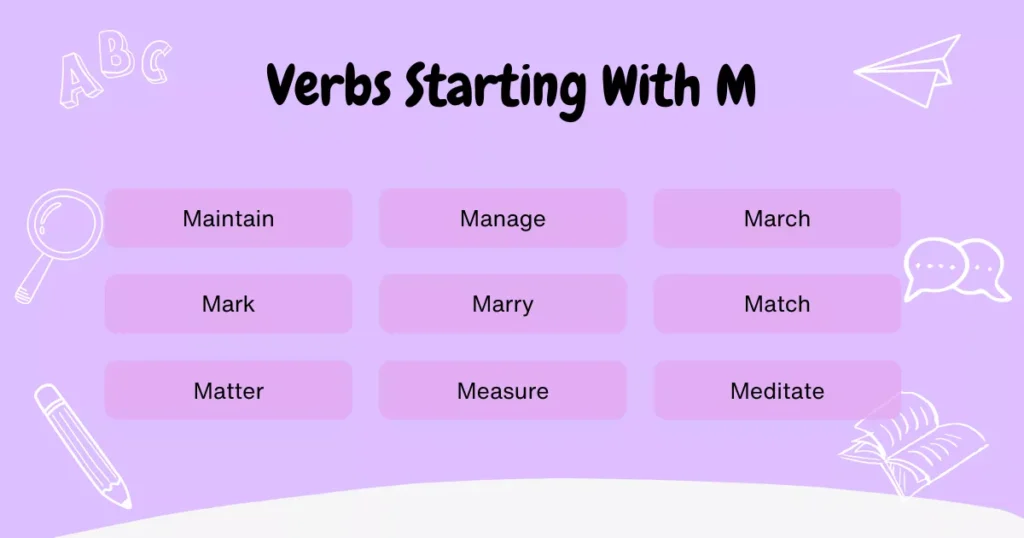
List of Common Verbs Starting With M
- Make – to create something
Example: She makes a cake every Sunday. - Move – to change position
Example: Please move your chair. - Meet – to come together
Example: We will meet tomorrow. - Manage – to handle or control
Example: He manages the office well. - Mean – to express or intend
Example: What does this word mean? - Mark – to label or note
Example: Mark the correct answer. - Measure – to find size or amount
Example: Measure the length carefully. - Mention – to refer briefly
Example: She mentioned your name. - Mix – to combine things
Example: Mix the ingredients well. - Miss – to fail to reach or feel absence
Example: I miss my friends. - Mend – to repair
Example: She mended the shirt. - Multiply – to increase in number
Example: Numbers multiply quickly. - Melt – to become liquid
Example: Ice melts in heat. - Mow – to cut grass
Example: He mows the lawn. - Mail – to send by post
Example: I mailed the letter. - March – to walk in rhythm
Example: Soldiers march together. - Mutter – to speak softly
Example: He muttered something. - Model – to display or represent
Example: She models clothes. - Motivate – to encourage
Example: Teachers motivate students. - Monitor – to observe closely
Example: They monitor progress. - Memorize – to learn by heart
Example: Memorize the poem. - Match – to pair or be equal
Example: These shoes match your dress. - Modify – to change slightly
Example: We modified the plan. - Maintain – to keep in good condition
Example: Maintain your health. - Multiply – to increase (repeat intentionally avoided, but included commonly)
Example: The bacteria multiply fast. - Migrate – to move location
Example: Birds migrate in winter. - Merge – to combine
Example: The companies merged. - Mount – to climb or place
Example: He mounted the horse. - Mock – to make fun of
Example: Don’t mock others. - Meditate – to focus the mind
Example: She meditates daily.
You May Also Like: Verbs That Start With J
Action Verbs That Start With M
- March – to walk in a steady rhythm
Example: Soldiers march together. - Mix – to combine
Example: Mix the colors. - Move – to change position
Example: Move forward. - Mow – to cut grass
Example: He mows the lawn. - Make – to create
Example: She makes crafts. - Mount – to climb
Example: He mounted the bike. - Measure – to calculate size
Example: Measure the room. - Mark – to label
Example: Mark your work. - Mend – to repair
Example: Fix and mend clothes. - Melt – to liquefy
Example: Butter melts quickly. - Multiply – to increase
Example: Multiply numbers. - Mix up – to confuse
Example: Don’t mix up the files. - Move on – to continue
Example: Let’s move on. - Map – to plan or outline
Example: Map your journey. - Mimic – to imitate
Example: He mimics accents. - Massage – to rub muscles
Example: She massages gently. - Mail – to send
Example: Mail the letter. - Monitor – to observe
Example: Monitor progress. - Manufacture – to produce
Example: They manufacture goods. - Mobilize – to prepare
Example: Mobilize resources.
Positive and Motivational Verbs With M
- Motivate – to inspire
Example: Good leaders motivate others. - Master – to become skilled
Example: She mastered English. - Magnify – to make greater
Example: Magnify your strengths. - Mend – to fix or improve
Example: Mend relationships. - Maintain – to keep steady
Example: Maintain a positive mindset. - Manifest – to bring into reality
Example: Manifest your goals. - Maximize – to increase fully
Example: Maximize your potential. - Motivate – to encourage
Example: Motivate yourself daily. - Mobilize – to take action
Example: Mobilize your efforts. - Move forward – to progress
Example: Keep moving forward. - Make – to create
Example: Make your dreams real. - Multiply – to grow
Example: Multiply your success. - Model – to set an example
Example: Model good behavior. - Meditate – to gain clarity
Example: Meditate for peace. - Merge – to unite
Example: Merge ideas creatively. - Manage – to control effectively
Example: Manage your time. - Motivate – to push ahead
Example: Motivate your team. - Magnify – to expand
Example: Magnify positivity. - Mastermind – to plan creatively
Example: Mastermind your success. - Move – to take action
Example: Move toward your goals.
Regular and Irregular Verbs Starting With M
- Mark – marked
Example: She marked the paper. - Mend – mended
Example: He mended the fence. - Mix – mixed
Example: She mixed the colors. - Move – moved
Example: They moved house. - Manage – managed
Example: He managed the team. - Measure – measured
Example: She measured the cloth. - Mail – mailed
Example: I mailed the parcel. - Monitor – monitored
Example: They monitored activity. - Modify – modified
Example: We modified the plan. - Motivate – motivated
Example: She motivated her team. - Migrate – migrated
Example: Birds migrated south. - Merge – merged
Example: The files merged. - Model – modeled
Example: She modeled the outfit. - Massage – massaged
Example: He massaged his arm. - Mock – mocked
Example: They mocked him. - Make – made
Example: She made a cake. - Meet – met
Example: I met him yesterday. - Mean – meant
Example: He meant well. - Mistake – mistook
Example: She mistook the answer. - Misunderstand – misunderstood
Example: I misunderstood you. - Mislead – misled
Example: He misled the group. - Mistake – mistaken (past participle form example)
Example: I have mistaken the number. - Miswrite – miswrote
Example: He miswrote the word. - Misread – misread
Example: I misread the question. - Mishear – misheard
Example: She misheard the instructions. - Misdo – misdid
Example: He misdid the task. - Misgive – misgave
Example: The news misgave her. - Misdeal – misdealt
Example: He misdealt the cards. - Mischoose – mischose
Example: She mischose her words. - Misbecome – misbecame
Example: That behavior misbecame him.
You May Also Like: Verbs That Start With K
Phrasal Verbs That Start With M
| Verb | Meaning | Example |
|---|---|---|
| Make up | to invent or reconcile | She made up a story. |
| Make out | to understand or see | I can’t make out the sign. |
| Make for | to move toward | They made for the exit. |
| Make off | to leave quickly | The thief made off with money. |
| Make into | to transform | She made the room into an office. |
| Make over | to change appearance | They made over the house. |
| Make up for | to compensate | He made up for his mistake. |
| Make do (with) | to manage with less | We made do with what we had. |
| Make after | to chase | The dog made after the cat. |
| Make away with | to steal or destroy | He made away with the jewels. |
| Make off with | to steal | Someone made off with my bag. |
| Mess up | to spoil | I messed up the project. |
| Mess around | to waste time | Stop messing around. |
| Mess with | to bother | Don’t mess with him. |
| Mix up | to confuse | I mixed up the names. |
| Move on | to continue | Let’s move on to the next topic. |
| Move in | to start living somewhere | They moved in yesterday. |
| Move out | to leave a place | She moved out last week. |
| Move up | to advance | He moved up in rank. |
| Move back | to return | We moved back home. |
| Move aside | to step aside | Please move aside. |
| Move along | to keep going | Move along, please. |
| Move away | to go far | They moved away. |
| Move around | to change position | He moves around a lot. |
| Move forward | to progress | We must move forward. |
Professional, Academic, and Technical M Verbs
- Manage – to control or lead
Example: She manages a team. - Measure – to quantify
Example: Measure the data accurately. - Monitor – to observe closely
Example: Monitor system performance. - Modify – to change
Example: Modify the experiment. - Model – to represent
Example: Model the process. - Map – to chart
Example: Map the results. - Merge – to combine
Example: Merge the datasets. - Maintain – to keep stable
Example: Maintain equipment. - Maximize – to increase efficiency
Example: Maximize output. - Minimize – to reduce
Example: Minimize errors. - Manipulate – to handle skillfully
Example: Manipulate variables. - Mediate – to resolve conflict
Example: Mediate disputes. - Motivate – to encourage
Example: Motivate employees. - Mobilize – to organize resources
Example: Mobilize the workforce. - Manufacture – to produce
Example: Manufacture goods. - Market – to promote
Example: Market the product. - Monetize – to generate revenue
Example: Monetize content. - Moderate – to regulate
Example: Moderate the discussion. - Migrate – to transfer systems
Example: Migrate data. - Maintain – to sustain
Example: Maintain standards. - Measure up – to meet standards
Example: He measures up to expectations. - Mechanize – to automate
Example: Mechanize the process. - Materialize – to become real
Example: Plans materialized. - Modeling – to simulate
Example: Modeling improves design. - Monitor – to track
Example: Monitor progress continuously.
Emotional, Creative, and Descriptive M Verbs
- Marvel – to feel wonder
Example: She marveled at the view. - Mourn – to feel grief
Example: They mourned the loss. - Muse – to think deeply
Example: He mused quietly. - Motivate – to inspire
Example: Stories motivate people. - Mesmerize – to captivate
Example: The performance mesmerized us. - Melt – to soften emotionally
Example: Her smile melted him. - Magnify – to intensify
Example: Fear magnified his thoughts. - Mock – to ridicule
Example: They mocked his idea. - Mutter – to speak softly
Example: She muttered angrily. - Moan – to complain or express pain
Example: He moaned in pain. - Mingle – to mix socially
Example: Guests mingled happily. - Motivate – to uplift
Example: Her speech motivated us. - Mesmerize – to charm
Example: The artist mesmerized the crowd. - Mimic – to imitate
Example: He mimicked her voice. - Mold – to shape personality
Example: Experiences mold us. - Move – to emotionally affect
Example: The movie moved me. - Meditate – to reflect
Example: She meditates daily. - Mellow – to soften
Example: He mellowed with age. - Magnify – to enhance
Example: Music magnifies emotion. - Manifest – to show clearly
Example: Feelings manifested openly. - Mesmerize – to enchant
Example: Lights mesmerized children. - Mourn – to grieve
Example: She mourned silently. - Muse – to reflect creatively
Example: Artists muse often. - Mingle – to blend emotions
Example: Joy mingled with fear. - Motivate – to encourage growth
Example: Friends motivate each other.
You May Also Like: Verbs That Start With L
Rare, Unique, and Advanced Verbs That Start With M
- Magnanimize – to make generous
Example: Success magnanimized him. - Malign – to speak badly about
Example: They maligned his reputation. - Mandate – to officially require
Example: The law mandates safety. - Masticate – to chew
Example: Animals masticate food. - Meander – to wander aimlessly
Example: The river meanders. - Meliorate – to improve
Example: Efforts meliorated conditions. - Memorialize – to preserve memory
Example: They memorialized the hero. - Mercerize – to treat fabric
Example: The cotton was mercerized. - Mesmerize – to hypnotize
Example: The show mesmerized viewers. - Metamorphose – to transform
Example: The caterpillar metamorphosed. - Migrate – to relocate
Example: Workers migrated abroad. - Misconstrue – to misunderstand
Example: Don’t misconstrue my words. - Mitigate – to reduce severity
Example: Policies mitigate risks. - Modulate – to adjust tone
Example: Modulate your voice. - Mollify – to calm
Example: He mollified the crowd. - Monopolize – to dominate
Example: One company monopolized the market. - Mortify – to embarrass
Example: She was mortified. - Motivate – to stimulate action
Example: Rewards motivate workers. - Multitask – to handle multiple tasks
Example: She multitasks efficiently. - Muster – to gather
Example: He mustered courage. - Mutate – to change form
Example: The virus mutated. - Mystify – to confuse
Example: The puzzle mystified me. - Mythologize – to create myths
Example: Stories mythologize heroes. - Magnetize – to attract strongly
Example: Charisma magnetizes people. - Monetize – to earn revenue
Example: Creators monetize content.
Common Mistakes When Using M Verbs
- Confusing similar verbs (e.g., make vs. do)
Many learners say “do a cake” instead of “make a cake.”
Correct: Use make for creating and do for tasks or activities. - Incorrect past forms of irregular verbs
Mistakes like “maked” or “meeted” are common.
Correct: Correct forms are made and met. - Overusing basic verbs like make and move
Repeating simple verbs reduces variety.
Correct: Try alternatives like create, produce, shift, or relocate. - Wrong preposition with phrasal verbs
Saying “make up to a story” instead of “make up a story.”
Correct: Learn correct phrasal verb structures. - Using formal verbs in casual situations (or vice versa)
Words like mitigate or mollify may sound unnatural in daily speech.
Correct: Match the verb to the context and audience.
Fun Facts About Verbs That Begin With M
- “Make” is one of the most versatile verbs in English
It forms dozens of phrases like make up, make out, make over, and more. - Many M verbs relate to movement and change
Words like move, migrate, morph, and modify all show transformation. - M verbs are common in motivational language
Verbs like motivate, maximize, and manifest are widely used in self-help and success content. - Some M verbs come from Latin roots
For example, mitigate (to reduce) and migrate (to move) have classical origins. - M verbs appear frequently in science and technology
Terms like measure, model, monitor, and mechanize are essential in technical fields.
FAQs
Conclusion
Verbs that start with the letter “M” offer a powerful and diverse way to express actions, emotions, and ideas in English. From simple everyday words like make and move to advanced terms like mitigate and metamorphose, these verbs enrich both spoken and written communication. By learning and practicing different categories you can expand your vocabulary, improve clarity, and sound more natural in any context. Keep exploring and using these M verbs regularly to build confidence and mastery in English.