Hope is the quiet strength that helps us move forward, even when life feels uncertain. It inspires us to believe that better days are ahead, no matter how difficult the present may seem. One of the most expressive ways to talk about hope in English is through idioms. These colorful expressions make conversations, writing, and storytelling more vivid while capturing the emotions of optimism, patience, resilience, and faith. Whether you’re an English learner, student, writer, or simply someone who loves expressive language, these hope idioms will help you communicate encouragement and positivity more naturally and confidently.
Understanding Hope Through Idioms
Hope is more than just wishing for good things to happen but it’s about the belief that positive change is possible, even during difficult times. English idioms about hope use vivid images and creative expressions to describe optimism, perseverance, and confidence in the future. Learning these idioms helps you understand native speakers more easily while making your own speaking and writing more natural, expressive, and engaging.
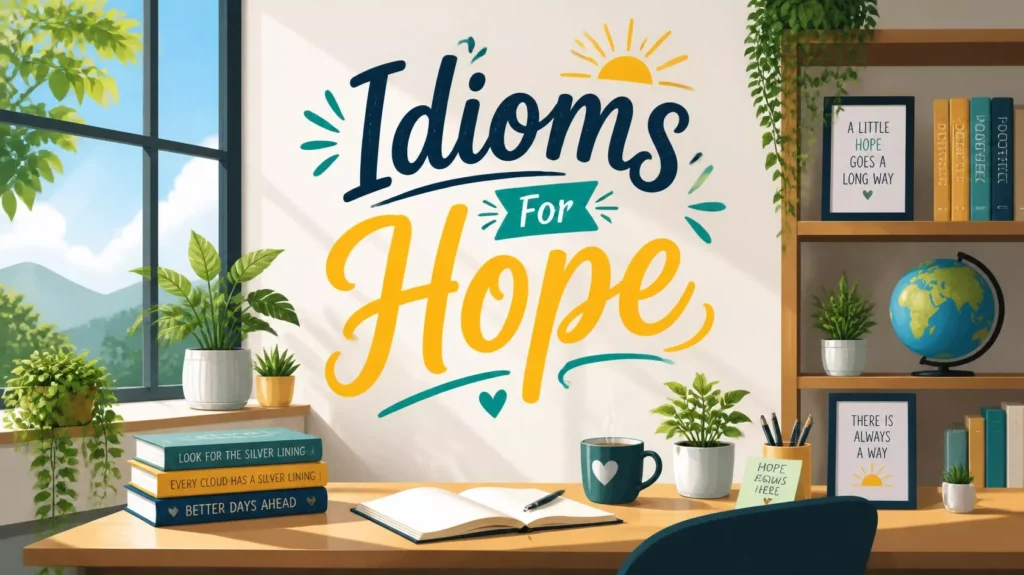
Everyday & Common Idioms For Hope
- Light at the end of the tunnel – A sign that a difficult situation is coming to an end.
Example: After months of job searching, Sarah finally saw light at the end of the tunnel when she received an interview invitation. - Keep your chin up – Stay positive during difficult times.
Example: Keep your chin up; your hard work will pay off soon. - Hang in there – Don’t give up despite challenges.
Example: Hang in there, the exam results will be worth the effort. - Cross your fingers – Hope that something good happens.
Example: We’re crossing our fingers for good weather this weekend. - Look on the bright side – Focus on the positive aspects.
Example: Even though the trip was canceled, let’s look on the bright side and plan another adventure. - Every cloud has a silver lining – Every bad situation has something positive.
Example: Losing that job led him to a much better career, every cloud has a silver lining. - Tomorrow is another day – There is always another chance.
Example: Don’t worry about today’s mistakes; tomorrow is another day. - Keep hope alive – Continue believing that things will improve.
Example: The community kept hope alive during the rebuilding process. - Never say die – Never lose hope or determination.
Example: Her never-say-die attitude inspired the whole team. - Hold out hope – Continue expecting a positive outcome.
Example: Doctors still hold out hope for his full recovery. - On the right track – Making progress toward success.
Example: Your study plan puts you on the right track. - A new lease on life – A fresh opportunity or renewed hope.
Example: The successful surgery gave him a new lease on life. - See better days – Expect improvement in the future.
Example: This neighborhood has seen better days, but it’s improving. - Stay the course – Continue despite difficulties.
Example: Stay the course, and your efforts will eventually pay off. - Weather the storm – Survive a difficult period.
Example: The family weathered the storm with courage. - The tide will turn – Circumstances will improve.
Example: Be patient; the tide will turn soon. - A glimmer of hope – A small sign of encouragement.
Example: The test results gave the doctors a glimmer of hope. - Turn over a new leaf – Make a fresh start.
Example: He turned over a new leaf after graduating. - Keep the faith – Continue believing in success.
Example: Keep the faith, and your dream will come true. - The best is yet to come – Better things lie ahead.
Example: After retirement, she believed the best was yet to come. - Reach for the stars – Aim for great success.
Example: Don’t be afraid to reach for the stars. - Dream big – Have ambitious hopes.
Example: Dream big and work hard every day. - Take heart – Feel encouraged.
Example: Take heart; your efforts are making a difference. - Hope against hope – Continue hoping despite slim chances.
Example: They hoped against hope that the missing dog would return. - Onward and upward – Continue improving.
Example: After the promotion, it was onward and upward. - Silver lining – The positive side of a bad situation.
Example: Missing the flight turned out to be a silver lining because she met an old friend. - See the light – Realize a better path or solution.
Example: He finally saw the light and decided to continue his education. - Bounce back – Recover from setbacks.
Example: She bounced back stronger after the failure. - A ray of sunshine – Someone or something that brings hope.
Example: Her smile was a ray of sunshine during difficult times. - Faith can move mountains – Strong belief can overcome obstacles.
Example: With teamwork and faith, they proved faith can move mountains. - Keep the dream alive – Continue pursuing your goals.
Example: He worked two jobs to keep the dream alive. - The sky’s the limit – There are no limits to success.
Example: With your talent, the sky’s the limit. - Rise from the ashes – Recover after failure.
Example: The company rose from the ashes after bankruptcy. - Follow your dreams – Pursue your aspirations.
Example: She moved abroad to follow her dreams. - Good things come to those who wait – Patience brings rewards.
Example: Good things come to those who wait, so don’t rush. - Bright future ahead – A promising future.
Example: The young athlete has a bright future ahead. - Turn the corner – Begin to improve.
Example: His health has finally turned the corner. - Keep moving forward – Continue progressing.
Example: No matter what happens, keep moving forward. - Open new doors – Create fresh opportunities.
Example: Learning English opened new doors for her career. - Nothing is impossible – Everything can be achieved with effort.
Example: The coach reminded the players that nothing is impossible.
You May Also Like: Idioms for Cold
Rare Hope Idioms Worth Learning
- Build castles in the air – Dream about a hopeful future.
Example: She built castles in the air while planning her business. - Carry the torch – Keep hope or an idea alive.
Example: The young volunteers carried the torch for change. - Wait for the stars to align – Hope for the perfect opportunity.
Example: He waited for the stars to align before launching his company. - A seed of hope – A small beginning of optimism.
Example: The kind letter planted a seed of hope in her heart. - Keep the home fires burning – Maintain hope while waiting.
Example: Families kept the home fires burning during the deployment. - Find a crack in the wall – Discover a small opportunity.
Example: They found a crack in the wall and solved the problem. - Hold the line – Stay strong despite challenges.
Example: We must hold the line until things improve. - A beacon of hope – Someone or something that inspires optimism.
Example: The new hospital became a beacon of hope for the town. - Breathe new life into – Restore hope or energy.
Example: The new manager breathed new life into the project. - The dawn is breaking – Better times are beginning.
Example: After years of hardship, the dawn was breaking. - Keep the candle burning – Continue believing.
Example: She kept the candle burning despite setbacks. - Stand on the threshold – Be close to a hopeful change.
Example: The graduates stood on the threshold of exciting careers. - Ride out the storm – Endure difficulties with hope.
Example: They rode out the storm together. - Open a window of opportunity – Create hope for success.
Example: The scholarship opened a window of opportunity. - Plant the seeds of success – Begin something that will bring future rewards.
Example: Daily practice planted the seeds of success.
Idioms For Hope in Pop Culture
- May the Force be with you – Wish someone success.
Example: Before the competition, his friends said, “May the Force be with you.” - To infinity and beyond – Aim beyond limits with hope.
Example: Their startup’s motto was “To infinity and beyond.” - There’s always tomorrow – Another opportunity will come.
Example: She smiled and said, “There’s always tomorrow.” - Keep the dream alive – Continue believing in your goal.
Example: The band kept the dream alive despite setbacks. - The comeback is stronger than the setback – Recovery is possible.
Example: After his injury, he proved the comeback was stronger than the setback. - Rise up – Stand again after failure.
Example: The community decided to rise up after the disaster. - Never give up – Keep hoping and trying.
Example: The movie’s message was to never give up. - Against all odds – Succeed despite great difficulty.
Example: Against all odds, they won the championship. - Believe in yourself – Trust your abilities.
Example: Her favorite song reminds listeners to believe in themselves. - Reach for the sky – Aim high.
Example: The motivational speaker encouraged everyone to reach for the sky. - Dreams come true – Hopes can become reality.
Example: Winning the award made her feel dreams come true. - Break new ground – Achieve something new.
Example: The scientist broke new ground with the discovery. - Keep your eyes on the prize – Stay focused on your goal.
Example: He kept his eyes on the prize throughout the season. - Go the distance – Continue until success.
Example: She was determined to go the distance. - Reach new heights – Achieve greater success.
Example: The artist reached new heights in her career. - Never lose hope – Stay optimistic.
Example: The documentary encouraged viewers to never lose hope. - Follow the light – Choose the hopeful path.
Example: The hero decided to follow the light. - A hero’s journey – A hopeful path through challenges.
Example: His life became a true hero’s journey. - Happy ending – A positive conclusion.
Example: Everyone loved the movie’s happy ending. - Make it happen – Turn hope into action.
Example: Stop waiting and make it happen.

Words Related to Hope You Should Know
| Word | Meaning |
|---|---|
| Optimism | A positive belief that good things will happen. |
| Faith | Strong trust or confidence in someone or something. |
| Confidence | Belief in your own abilities or success. |
| Expectation | The belief that something is likely to happen. |
| Aspiration | A strong desire to achieve something. |
| Encouragement | Support that gives someone hope or confidence. |
| Perseverance | Continuing despite difficulties. |
| Resilience | The ability to recover from setbacks. |
| Promise | A sign or indication of future success. |
| Possibility | A chance that something may happen. |
You May Also Like: Idioms for Crazy
Using Hope Idioms Naturally
- Match the Idiom to the Situation
Use hope idioms in conversations about overcoming challenges, achieving goals, or looking forward to the future. For example, say “There’s light at the end of the tunnel” when a difficult period is almost over. - Choose Common Idioms First
Start with widely used expressions like “Keep your chin up,” “Hang in there,” and “Cross your fingers.” They sound natural in everyday English. - Don’t Overuse Idioms
Using one or two hope idioms in a conversation is enough. Too many idioms at once can make your speech sound forced. - Learn Idioms in Context
Read books, watch movies, listen to podcasts, and notice how native speakers use hope idioms in real-life situations. - Practice in Your Own Sentences
Create sentences about your goals, studies, work, or daily life. The more you use idioms personally, the easier they become to remember.
Practical Ways to Remember Hope Idioms
- Group Similar Idioms Together
Learn idioms with similar meanings, such as “Hold on to hope,” “Keep the faith,” and “Never say die.” - Connect Idioms with Real Experiences
Think of moments in your life when you stayed hopeful and match those memories with suitable idioms. - Use Flashcards
Write the idiom on one side and its meaning with an example on the other. Review them regularly. - Practice a Few Every Week
Instead of memorizing many idioms at once, learn 3–5 each week and use them in conversations or writing. - Watch English Content
Movies, TV shows, YouTube videos, and podcasts often use hope-related idioms naturally, making them easier to remember.
You May Also Like: Idioms for Shock
Test Yourself Hope Idioms
- Which idiom means “a sign that a difficult situation is coming to an end”?
A. Cross your fingers
B. Light at the end of the tunnel
C. Keep your chin up
D. Dream big
Answer: B. Light at the end of the tunnel - What does “Keep your chin up” mean?
A. Look upward
B. Stay positive during difficult times
C. Speak loudly
D. Win every challenge
Answer: B. Stay positive during difficult times - Which idiom means “hope that something good will happen”?
A. Hold your horses
B. Cross your fingers
C. Hit the road
D. Break the bank
Answer: B. Cross your fingers - Which idiom encourages someone not to give up?
A. Hang in there
B. Spill the beans
C. Under the weather
D. Call it a day
Answer: A. Hang in there - “Every cloud has a silver lining” means:
A. Clouds always disappear
B. Every difficult situation has something positive
C. Rain is good luck
D. Weather changes quickly
Answer: B. Every difficult situation has something positive - Which idiom means “continue believing despite difficulties”?
A. Keep the faith
B. Bite the bullet
C. Hit the sack
D. Cost an arm and a leg
Answer: A. Keep the faith - If someone says, “Things are looking up,” they mean:
A. They are watching the sky
B. The situation is improving
C. They are getting taller
D. They are moving upstairs
Answer: B. The situation is improving - Which idiom means “begin to recover or improve after hardship”?
A. Turn the corner
B. Miss the boat
C. Pull someone’s leg
D. Burn the midnight oil
Answer: A. Turn the corner - Which idiom means “continue hoping even when success seems unlikely”?
A. Hope against hope
B. Jump the gun
C. Let the cat out of the bag
D. Hit the nail on the head
Answer: A. Hope against hope - Which idiom means “aim for great success or ambitious goals”?
A. Reach for the stars
B. Break a leg
C. Sit on the fence
D. Bend over backward
Answer: A. Reach for the stars
FAQs
Conclusion
Hope is one of the strongest emotions people experience, and English idioms provide a creative way to express it. From everyday expressions like “light at the end of the tunnel” to inspiring phrases such as “keep the faith” and “hold on to hope,” these idioms make conversations, writing, and storytelling more meaningful and engaging. By learning their meanings and practicing them in real-life situations, you’ll improve both your English vocabulary and your ability to communicate optimism, encouragement, and resilience naturally. Keep reviewing these hope idioms, use them in your daily conversations, and you’ll soon speak with greater confidence and fluency.