The letter “S” stands out as one of the most versatile and frequently used letters in English, making it a powerful starting point for building a rich and expressive vocabulary. Verbs that begin with “S” play a key role in communication, helping us describe actions, emotions, movement, and everyday activities with clarity and impact. From simple words like start and stop to more expressive choices like soar, strengthen, and succeed, these verbs appear across casual conversations, storytelling, academic writing, and professional content. Expanding your knowledge of S verbs not only enhances your writing style but also gives you more flexibility and confidence when expressing ideas.
Understanding Verbs That Start With Letter S
Verbs that start with the letter “S” are action words used to describe what a person, object, or idea does. These verbs cover a wide range of meanings, including physical actions (slide, strike), mental processes (suppose, study), communication (say, suggest), and emotions (smile, suffer). Because “S” is a commonly used letter, many of these verbs appear frequently in both spoken and written English. Learning and understanding them helps improve sentence variety, clarity, and overall communication skills, making your language more natural and expressive.
List of Common Verbs Starting With S
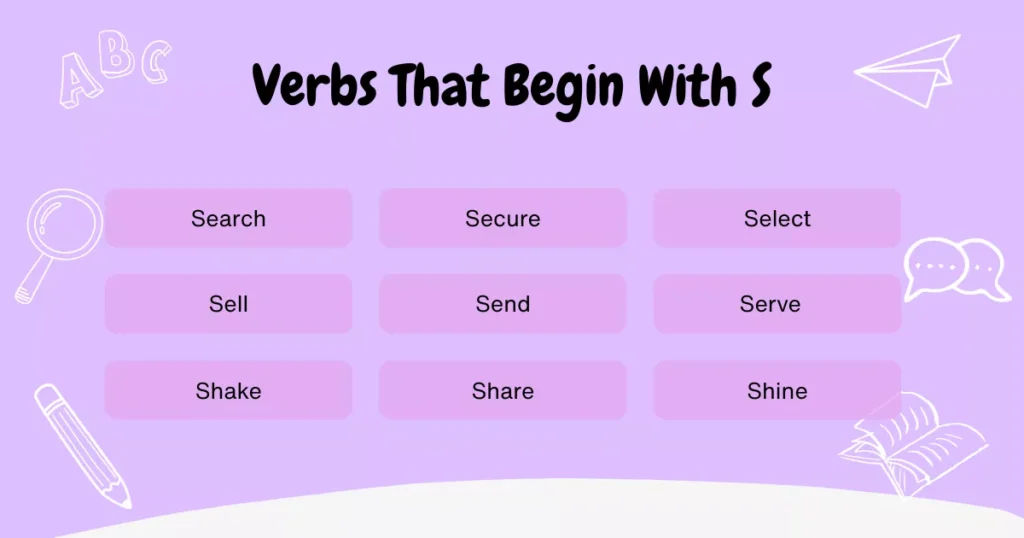
- Say – to speak words
Example: She said hello to everyone. - See – to use your eyes
Example: I can see the mountains clearly. - Start – to begin something
Example: They will start the meeting soon. - Stop – to end or pause
Example: Please stop talking during the lecture. - Send – to make something go to someone
Example: He sent me a message. - Show – to display or present
Example: She showed her new dress. - Speak – to talk
Example: He speaks English fluently. - Study – to learn
Example: She studies every night. - Sit – to rest on a seat
Example: Please sit here. - Stand – to be upright
Example: He stood near the door. - Sleep – to rest
Example: The baby is sleeping. - Smile – to show happiness
Example: She smiled at the child. - Shout – to speak loudly
Example: He shouted for help. - Sell – to give something for money
Example: They sell fresh fruits. - Save – to keep safe
Example: Save your work before closing. - Share – to divide or give part
Example: She shared her food. - Search – to look for
Example: He searched for his keys. - Solve – to find an answer
Example: She solved the puzzle. - Support – to help or back up
Example: They support each other. - Suggest – to give an idea
Example: I suggest taking a break. - Stay – to remain
Example: Stay here until I return. - Switch – to change
Example: Switch off the lights. - Serve – to provide service
Example: They serve delicious food. - Spend – to use money/time
Example: She spends time reading. - Sing – to make musical sounds
Example: He sings beautifully. - Swim – to move in water
Example: They swim in the pool. - Shake – to move back and forth
Example: He shook the bottle. - Select – to choose
Example: She selected a dress. - Secure – to make safe
Example: Secure the door properly. - Set – to place or arrange
Example: He set the table.
You May Also Like: Verbs That Start With P
Action Verbs That Start With S
- Sprint – to run fast
Example: He sprinted to the finish line. - Strike – to hit
Example: The boxer struck his opponent. - Slide – to move smoothly
Example: The child slid down the slide. - Swing – to move back and forth
Example: She swung on the rope. - Stretch – to extend
Example: He stretched his arms. - Stack – to pile up
Example: Stack the books neatly. - Scrub – to clean hard
Example: She scrubbed the floor. - Sweep – to clean with a broom
Example: He swept the room. - Slam – to shut forcefully
Example: She slammed the door. - Spin – to turn quickly
Example: The wheel spins fast. - Skip – to jump lightly
Example: The child skipped happily. - Scare – to frighten
Example: The noise scared me. - Scratch – to mark with nails
Example: The cat scratched the sofa. - Snatch – to grab quickly
Example: He snatched the bag. - Squeeze – to press tightly
Example: She squeezed the lemon. - Stir – to mix
Example: Stir the soup well. - Step – to move by walking
Example: He stepped forward. - Snap – to break suddenly
Example: The stick snapped in half. - Shovel – to move with a shovel
Example: They shoveled the snow. - Scan – to look over quickly
Example: She scanned the document.
Positive and Motivational Verbs With S
- Succeed – to achieve goals
Example: Work hard to succeed. - Shine – to glow or stand out
Example: Let your talent shine. - Support – to help
Example: Always support your friends. - Strengthen – to make stronger
Example: Exercise strengthens the body. - Smile – to show happiness
Example: Smile and stay positive. - Serve – to help others
Example: He serves the community. - Spark – to inspire
Example: Her speech sparked hope. - Simplify – to make easier
Example: Simplify your tasks. - Secure – to make safe
Example: Secure your future. - Stabilize – to make steady
Example: Practice stabilizes your skills. - Support – to encourage
Example: Parents support their children. - Sustain – to maintain
Example: Sustain your efforts. - Solve – to fix problems
Example: Solve challenges calmly. - Strengthen – to build power
Example: Reading strengthens your mind. - Start – to begin
Example: Start your journey today. - Sharpen – to improve
Example: Sharpen your skills daily. - Stretch – to grow beyond limits
Example: Stretch your abilities. - Savor – to enjoy fully
Example: Savor every moment. - Stand – to stay firm
Example: Stand strong in tough times. - Support – to uplift others
Example: Support those in need.
Regular and Irregular Verbs Starting With S
- Sing (Irregular) – to make music
Example: She sang a song. - Swim (Irregular) – to move in water
Example: He swam across the river. - Speak (Irregular) – to talk
Example: He spoke clearly. - See (Irregular) – to view
Example: I saw a bird. - Sit (Irregular) – to rest
Example: She sat on the chair. - Stand (Irregular) – to be upright
Example: He stood up quickly. - Steal (Irregular) – to take unlawfully
Example: He stole the wallet. - Shake (Irregular) – to move
Example: She shook the bottle. - Shine (Irregular) – to glow
Example: The sun shone brightly. - Shoot (Irregular) – to fire
Example: He shot the target. - Spend (Irregular) – to use
Example: She spent money. - Send (Irregular) – to dispatch
Example: He sent a letter. - Sell (Irregular) – to trade
Example: They sold their car. - Say (Irregular) – to speak
Example: She said goodbye. - Sleep (Irregular) – to rest
Example: He slept early. - Sweep (Irregular) – to clean
Example: She swept the floor. - Set (Irregular) – to place
Example: He set the alarm. - Save (Regular) – to keep safe
Example: She saved money. - Start (Regular) – to begin
Example: They started the project. - Stop (Regular) – to end
Example: He stopped the car. - Study (Regular) – to learn
Example: She studied hard. - Search (Regular) – to look for
Example: He searched the room. - Support (Regular) – to help
Example: They supported the team. - Suggest (Regular) – to recommend
Example: I suggested an idea. - Share (Regular) – to divide
Example: She shared her lunch. - Secure (Regular) – to protect
Example: Secure the building. - Switch (Regular) – to change
Example: He switched channels. - Serve (Regular) – to provide
Example: They served food. - Solve (Regular) – to find answer
Example: She solved the problem. - Smile (Regular) – to show joy
Example: He smiled happily.
Phrasal Verbs That Start With S
| Verb | Meaning | Example |
|---|---|---|
| Set up | to arrange or organize | They set up the event quickly. |
| Show up | to arrive | He showed up late to class. |
| Shut down | to close completely | The factory shut down last year. |
| Sort out | to solve or organize | We need to sort out this issue. |
| Speak up | to talk louder | Please speak up during the meeting. |
| Stick to | to continue doing | Stick to your plan. |
| Stand up | to rise | She stood up to answer. |
| Sit down | to take a seat | Please sit down here. |
| Set off | to begin a journey | They set off early. |
| Slow down | to reduce speed | Slow down while driving. |
| Speed up | to go faster | He sped up the process. |
| Sign up | to register | I signed up for the course. |
| Step in | to intervene | The teacher stepped in. |
| Step out | to leave briefly | She stepped out for a moment. |
| Stick out | to be noticeable | His talent sticks out. |
| Shake off | to get rid of | He shook off the fear. |
| Settle down | to become calm | The kids settled down. |
| Sleep in | to wake up late | I slept in today. |
| Sell out | to have all items sold | The tickets sold out. |
| Send back | to return | She sent back the product. |
| Show off | to display proudly | He showed off his skills. |
| Stand by | to support | I will stand by you. |
| Sign in | to log or enter | Please sign in first. |
| Sort through | to examine carefully | She sorted through the files. |
| Scale up | to increase size or scope | The company scaled up production. |
You May Also Like: Verbs That Start With Q
Professional, Academic, and Technical S Verbs
- Synthesize – to combine ideas
Example: Researchers synthesize data. - Specify – to state clearly
Example: Please specify your requirements. - Standardize – to make uniform
Example: They standardized procedures. - Simulate – to imitate a process
Example: The system simulates real conditions. - Structure – to organize
Example: She structured the report well. - Substantiate – to support with evidence
Example: He substantiated his claim. - Scrutinize – to examine closely
Example: The report was scrutinized carefully. - Stabilize – to make steady
Example: Policies stabilize the economy. - Streamline – to improve efficiency
Example: They streamlined operations. - Segment – to divide into parts
Example: The market was segmented. - Secure – to protect
Example: Secure the system from threats. - Synchronize – to coordinate timing
Example: The devices synchronized automatically. - Survey – to collect data
Example: They surveyed customers. - Submit – to present formally
Example: Submit your assignment. - Supervise – to manage
Example: She supervises the team. - Solve – to find a solution
Example: Engineers solve complex problems. - Scale – to adjust size
Example: The system scales easily. - Schedule – to plan time
Example: They scheduled a meeting. - Support – to assist
Example: The team supports innovation. - Summarize – to give a brief
Example: Summarize the article. - Systematize – to organize methodically
Example: They systematized the process. - Simplify – to make easier
Example: Simplify the instructions. - Secure – to ensure safety
Example: Secure your data. - Standardize – to unify
Example: The company standardized formats. - Scan – to examine quickly
Example: Scan the document for errors.
Emotional, Creative, and Descriptive S Verbs
- Smile – to show happiness
Example: She smiled warmly. - Sigh – to express relief or sadness
Example: He sighed deeply. - Shiver – to shake from cold/fear
Example: She shivered in the cold. - Sob – to cry loudly
Example: The child sobbed. - Spark – to inspire
Example: The story sparked imagination. - Soothe – to calm
Example: Music soothed her mind. - Surprise – to amaze
Example: They surprised her. - Stun – to shock
Example: The news stunned him. - Savor – to enjoy deeply
Example: She savored the moment. - Seduce – to attract strongly
Example: The idea seduced investors. - Stir – to move emotions
Example: The speech stirred hearts. - Shine – to glow
Example: Her eyes shone brightly. - Scream – to shout loudly
Example: He screamed in fear. - Snicker – to laugh quietly
Example: They snickered softly. - Smile – to express joy
Example: He smiled kindly. - Sympathize – to feel compassion
Example: I sympathize with you. - Support – to comfort
Example: She supported her friend. - Stimulate – to encourage
Example: The book stimulated creativity. - Stagger – to move unsteadily
Example: He staggered in shock. - Surrender – to give up emotionally
Example: She surrendered to her feelings. - Swell – to grow in emotion
Example: Pride swelled in his heart. - Smirk – to smile in a sly way
Example: He smirked confidently. - Startle – to surprise suddenly
Example: The noise startled me. - Soften – to make gentle
Example: Her voice softened. - Stare – to look fixedly
Example: He stared in wonder.
Rare, Unique, and Advanced Verbs That Start With S
- Satiate – to satisfy fully
Example: The meal satiated his hunger. - Scintillate – to sparkle or shine
Example: Her ideas scintillate. - Sublimate – to transform
Example: He sublimated his anger. - Sanctify – to make holy
Example: The place was sanctified. - Scruple – to hesitate morally
Example: He scrupled at the idea. - Serrate – to form jagged edges
Example: The blade serrates easily. - Striate – to mark with lines
Example: The rock was striated. - Soliloquize – to talk to oneself
Example: The actor soliloquized on stage. - Supersede – to replace
Example: New laws supersede old ones. - Sequester – to isolate
Example: The jury was sequestered. - Stultify – to make ineffective
Example: Fear stultifies growth. - Sporulate – to produce spores
Example: The fungus sporulates quickly. - Subjugate – to control
Example: They subjugated the region. - Suffuse – to spread over
Example: Light suffused the room. - Susurrate – to whisper softly
Example: Leaves susurrated in the wind. - Sclerose – to harden
Example: Tissue can sclerose over time. - Somnambulate – to sleepwalk
Example: He somnambulated at night. - Sophisticate – to make refined
Example: Travel sophisticates the mind. - Syncretize – to combine beliefs
Example: Cultures syncretize traditions. - Speculate – to guess
Example: Experts speculate about trends. - Stipulate – to demand conditions
Example: The contract stipulates rules. - Substantiate – to prove
Example: She substantiated her claim. - Synthesize – to combine elements
Example: Scientists synthesize compounds. - Suffocate – to choke
Example: Smoke suffocated the room. - Sanction – to approve or penalize
Example: The committee sanctioned the plan.
You May Also Like: Verbs That Start With R
Common Mistakes When Using S Verbs
- Confusing Similar S Verbs (Say vs. Speak)
Many learners mix up verbs like say and speak.
Incorrect: He said to me loudly.
Correct: He spoke to me loudly. - Incorrect Verb Forms (Irregular Verbs)
Some S verbs are irregular and don’t follow “-ed” rules.
Incorrect: She sended the email.
Correct: She sent the email. - Using Wrong Prepositions with Phrasal Verbs
Phrasal verbs can change meaning with different prepositions.
Incorrect: She is looking the problem.
Correct: She is sorting out the problem. - Overusing Basic Verbs Instead of Specific Ones
Using say or see repeatedly makes writing dull.
Incorrect: He said many things.
Correct: He suggested several ideas. - Ignoring Context and Tone
Some verbs sound too formal or too casual depending on context.
Incorrect: The manager shouted the instructions (formal setting)
Correct: The manager stated the instructions
Fun Facts About Verbs That Begin With S
- “S” is One of the Most Productive Letters
A huge number of English verbs start with “S,” making it one of the richest letters for vocabulary building. - Many Positive Words Start With S
Words like succeed, shine, support, and smile carry strong positive and motivational meanings. - S Verbs Often Show Movement
Verbs like slide, sprint, swing, and soar are commonly used to describe motion and action. - “S” Helps Form Phrasal Verbs Easily
English includes many phrasal verbs with S, like set up, sort out, and step in, which are widely used in daily conversation. - Common in Storytelling and Writing
Writers often use S verbs to create rhythm and flow because of their soft and smooth sound.
FAQs
Conclusion
Verbs that start with the letter “S” are an essential part of English vocabulary, offering a wide range of expressions for actions, emotions, communication, and ideas. From simple everyday words like start and stop to more advanced verbs like synthesize and substantiate, these verbs help make your language clearer, stronger, and more engaging. Whether you are a student, writer, or professional, learning and using S verbs can significantly improve your speaking and writing skills. By exploring different categories you can build a more flexible and powerful vocabulary. Keep practicing these verbs in real-life sentences to boost confidence and communicate more effectively.