Verbs are the driving force of any sentence because they turn ideas into action and give meaning to communication. While nouns name things, verbs bring them to life by showing what is happening, what someone feels, or how situations change. Among the many verbs in English, those that start with the letter “P” are especially powerful and versatile. From simple everyday words like play and push to more expressive and impactful verbs like persevere and promote, these words help you communicate clearly and effectively. Whether you’re a student, writer, or language learner, building your vocabulary with “P” verbs can strengthen both your speaking and writing skills.
Understanding Verbs That Start With Letter P
Verbs that start with the letter “P” are action or state words that describe what someone does, feels, or experiences. These verbs can express a wide variety of meanings, including physical actions (push, pull), mental processes (perceive, ponder), emotions (prefer, pity), and progress or change (progress, improve). What makes “P” verbs especially useful is their flexibility. Some are commonly used in daily conversations, while others are more suitable for formal, academic, or creative writing. For example, play is simple and widely used, while proclaim or persevere add depth and strength to more advanced communication.
List of Common Verbs Starting With P
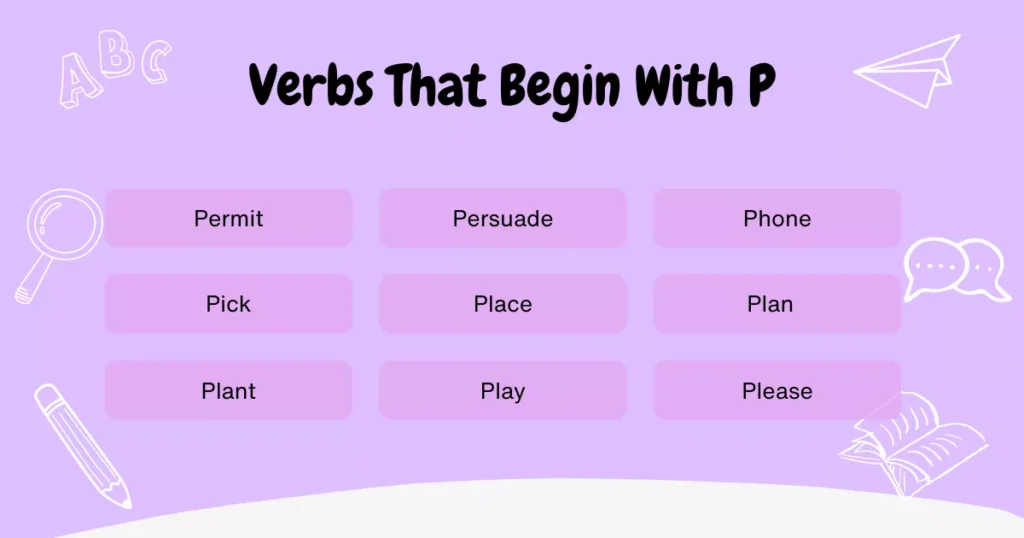
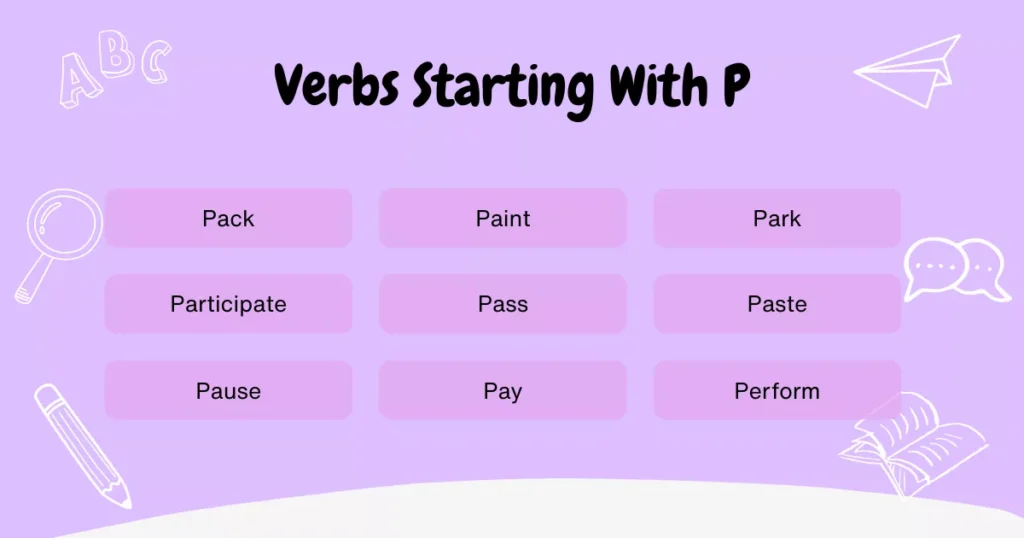
- Play – to engage in an activity for fun
Example: She plays the piano every evening. - Push – to apply force to move something
Example: He pushed the door open. - Pull – to draw something toward you
Example: She pulled the rope tightly. - Put – to place something somewhere
Example: Please put the book on the table. - Pay – to give money in exchange
Example: He paid for the meal. - Pick – to choose or select
Example: Pick your favorite color. - Pass – to go by or transfer
Example: She passed the ball quickly. - Plan – to decide in advance
Example: We plan our trip carefully. - Prepare – to get ready
Example: He prepared for the exam. - Provide – to supply something
Example: They provide free food. - Protect – to keep safe
Example: Parents protect their children. - Practice – to repeat to improve
Example: She practices daily. - Promise – to give your word
Example: He promised to help. - Prefer – to like more
Example: I prefer tea over coffee. - Press – to push firmly
Example: Press the button gently. - Produce – to make or create
Example: This factory produces cars. - Prove – to show truth
Example: He proved his point. - Print – to produce text on paper
Example: Print the document. - Pack – to put items together
Example: She packed her bag. - Pause – to stop briefly
Example: He paused before speaking. - Perform – to carry out
Example: They performed well. - Post – to publish online
Example: She posted a photo. - Point – to indicate
Example: He pointed at the map. - Permit – to allow
Example: They permit entry. - Prevent – to stop something
Example: This prevents damage. - Publish – to release publicly
Example: She published a book. - Paint – to apply color
Example: He painted the wall. - Phone – to call
Example: I will phone you later. - Place – to set something
Example: Place the keys here. - Participate – to take part
Example: She participates in events.
You May Also Like: Verbs That Start With M
Action Verbs That Start With P
- Punch – to hit with a fist
Example: He punched the bag. - Push – to move with force
Example: Push the cart forward. - Pull – to draw toward you
Example: Pull the door open. - Paddle – to move through water
Example: They paddled the canoe. - Plant – to put in soil
Example: She planted flowers. - Pour – to flow liquid
Example: Pour the juice carefully. - Peel – to remove skin
Example: Peel the banana. - Pack – to organize items
Example: He packed his suitcase. - Polish – to make shiny
Example: She polished the shoes. - Press – to apply pressure
Example: Press the switch. - Pin – to attach with a pin
Example: Pin the note on board. - Paint – to color a surface
Example: They painted the house. - Pat – to tap gently
Example: She patted the dog. - Poke – to push lightly
Example: He poked the balloon. - Pump – to force liquid/air
Example: Pump water into the tank. - Pluck – to pull quickly
Example: She plucked a flower. - Push aside – to move away
Example: He pushed aside the chair. - Pursue – to follow or chase
Example: They pursued their dreams. - Propel – to drive forward
Example: Waves propel the boat. - Pound – to hit repeatedly
Example: He pounded the nail.
Positive and Motivational Verbs With P
- Persevere – to continue despite difficulty
Example: She persevered through challenges. - Progress – to move forward
Example: He progressed quickly. - Prosper – to succeed
Example: The business prospered. - Promote – to support growth
Example: They promote education. - Pursue – to follow goals
Example: She pursued her dreams. - Perform – to do well
Example: He performed excellently. - Participate – to join in
Example: They participated actively. - Provide – to give support
Example: She provides guidance. - Protect – to keep safe
Example: We protect nature. - Praise – to express approval
Example: Teachers praise students. - Polish – to improve skills
Example: He polished his writing. - Practice – to improve ability
Example: Practice leads to success. - Prepare – to get ready
Example: Prepare for opportunities. - Plan – to organize ahead
Example: Plan your goals. - Persist – to keep going
Example: She persisted despite failure. - Prove – to show ability
Example: He proved himself. - Promote growth – to help development
Example: Education promotes growth. - Purify – to make better
Example: Kindness purifies hearts. - Power – to give strength
Example: Knowledge powers success. - Pass – to succeed
Example: He passed the exam.
Regular and Irregular Verbs Starting With P
- Play (Regular) – to have fun
Example: She played outside. - Push (Regular) – to move forward
Example: He pushed the box. - Pull (Regular) – to draw closer
Example: She pulled the rope. - Pick (Regular) – to choose
Example: He picked a book. - Pack (Regular) – to arrange items
Example: She packed her bag. - Paint (Regular) – to apply color
Example: They painted the wall. - Plan (Regular) – to arrange
Example: We planned a trip. - Prepare (Regular) – to get ready
Example: She prepared dinner. - Provide (Regular) – to supply
Example: They provided help. - Protect (Regular) – to keep safe
Example: He protected his friend. - Practice (Regular) – to repeat
Example: She practiced daily. - Promise (Regular) – to assure
Example: He promised support. - Print (Regular) – to produce text
Example: She printed the paper. - Post (Regular) – to publish
Example: He posted online. - Participate (Regular) – to join
Example: They participated actively. - Pass (Regular) – to succeed
Example: She passed the test. - Permit (Regular) – to allow
Example: They permitted entry. - Prevent (Regular) – to stop
Example: This prevented damage. - Prove (Irregular) – to show truth
Example: He proved his point. - Put (Irregular) – to place
Example: She put the keys here. - Pay (Irregular) – to give money
Example: He paid the bill. - Plead (Irregular) – to beg or argue
Example: He pled guilty. - Predict (Regular) – to forecast
Example: She predicted rain. - Perform (Regular) – to carry out
Example: They performed well. - Publish (Regular) – to release
Example: He published a book. - Pause (Regular) – to stop briefly
Example: She paused for a moment. - Point (Regular) – to indicate
Example: He pointed at the sign. - Polish (Regular) – to refine
Example: She polished her skills. - Pursue (Regular) – to follow
Example: He pursued his dreams. - Persist (Regular) – to continue
Example: She persisted in efforts.
Phrasal Verbs That Start With P
| Verb | Meaning | Example |
|---|---|---|
| Pass away | to die | His grandfather passed away peacefully. |
| Pass out | to faint or distribute | She passed out from exhaustion. |
| Pass by | to go past | We passed by the old house. |
| Pass on | to give or transfer | He passed on the message. |
| Pass up | to miss an opportunity | Don’t pass up this chance. |
| Pick up | to collect or improve | She picked up her friend. |
| Pick out | to choose | He picked out a shirt. |
| Pick on | to bully | They pick on him at school. |
| Pick apart | to criticize | She picked apart the argument. |
| Pull over | to stop a vehicle | He pulled over safely. |
| Pull out | to withdraw | They pulled out of the deal. |
| Pull through | to recover | She pulled through the illness. |
| Pull up | to stop | The car pulled up outside. |
| Put off | to delay | Don’t put off your work. |
| Put on | to wear | She put on her jacket. |
| Put out | to extinguish | He put out the fire. |
| Put up with | to tolerate | I can’t put up with noise. |
| Put down | to criticize or place | Don’t put others down. |
| Put away | to store | She put away her toys. |
| Put back | to return | Put the book back. |
| Pay back | to return money | He paid back the loan. |
| Pay off | to succeed or finish paying | Hard work paid off. |
| Phase out | to gradually stop | They phased out old systems. |
| Play along | to cooperate | She played along with the joke. |
| Point out | to highlight | He pointed out the mistake. |
You May Also Like: Verbs That Start With N
Professional, Academic, and Technical P Verbs
- Present – to show formally
Example: She presented her research. - Propose – to suggest
Example: He proposed a new plan. - Publish – to release publicly
Example: They published findings. - Process – to handle data
Example: The system processes information. - Program – to write code
Example: He programs software. - Project – to estimate or display
Example: They projected growth. - Perform – to carry out tasks
Example: The machine performs well. - Plan – to organize
Example: We plan strategies. - Predict – to forecast
Example: Scientists predict changes. - Produce – to create
Example: Factories produce goods. - Promote – to support
Example: They promote innovation. - Provide – to supply
Example: The company provides services. - Protect – to safeguard
Example: Policies protect data. - Participate – to take part
Example: Students participate actively. - Prove – to demonstrate
Example: He proved the theory. - Perceive – to understand
Example: She perceives patterns. - Preserve – to maintain
Example: We preserve records. - Perform analysis – to examine
Example: They perform analysis. - Prioritize – to rank importance
Example: Prioritize your tasks. - Plan out – to detail steps
Example: He planned out the project. - Prototype – to create a model
Example: They prototyped the design. - Partition – to divide
Example: The system partitions memory. - Parameterize – to define variables
Example: Engineers parameterize models. - Predefine – to set in advance
Example: Values are predefined. - Postulate – to assume
Example: Scientists postulate ideas.
Emotional, Creative, and Descriptive P Verbs
- Prefer – to like more
Example: I prefer calm places. - Ponder – to think deeply
Example: She pondered the question. - Praise – to express approval
Example: They praised her work. - Pity – to feel sympathy
Example: He pitied the poor. - Perceive – to notice
Example: She perceived a change. - Proclaim – to announce strongly
Example: He proclaimed victory. - Portray – to describe or act
Example: She portrayed the character well. - Paint – to create visually
Example: He painted a beautiful scene. - Play – to perform creatively
Example: She played the violin. - Project – to express outwardly
Example: He projects confidence. - Presume – to assume
Example: I presume you agree. - Plead – to beg emotionally
Example: She pleaded for help. - Pray – to speak spiritually
Example: They prayed for peace. - Pulse – to beat rhythmically
Example: Music pulsed through the room. - Pause – to stop briefly
Example: She paused dramatically. - Panic – to feel sudden fear
Example: He panicked quickly. - Perish – to die tragically
Example: Many perished in the storm. - Please – to satisfy
Example: She aims to please. - Playact – to act out
Example: They playacted scenes. - Provoke – to stir emotions
Example: The speech provoked anger. - Placate – to calm
Example: He placated the crowd. - Persuade – to convince
Example: She persuaded him. - Pine – to long deeply
Example: He pined for home. - Preoccupy – to absorb attention
Example: Thoughts preoccupied her. - Praise highly – to admire greatly
Example: Critics praised highly.
Rare, Unique, and Advanced Verbs That Start With P
- Pontificate – to speak in a pompous way
Example: He pontificated about politics. - Perambulate – to walk around
Example: They perambulated the park. - Prevaricate – to avoid truth
Example: He prevaricated in court. - Prognosticate – to predict
Example: Experts prognosticate trends. - Propitiate – to win favor
Example: They propitiated the gods. - Peregrinate – to travel widely
Example: He peregrinated across countries. - Pulverize – to crush completely
Example: The machine pulverized rocks. - Palpitate – to beat rapidly
Example: Her heart palpitated. - Perforate – to pierce
Example: They perforated the paper. - Precipitate – to cause suddenly
Example: The event precipitated change. - Proliferate – to increase rapidly
Example: Ideas proliferated quickly. - Paraphrase – to restate
Example: She paraphrased the text. - Predominate – to be most common
Example: Blue colors predominate. - Propagate – to spread
Example: Plants propagate easily. - Punctuate – to mark or interrupt
Example: He punctuated his speech. - Plummet – to fall quickly
Example: Prices plummeted suddenly. - Permeate – to spread throughout
Example: A smell permeated the room. - Placate – to calm anger
Example: They placated the audience. - Peruse – to read carefully
Example: She perused the document. - Prattle – to talk foolishly
Example: He prattled endlessly. - Proscribe – to forbid
Example: The law proscribes actions. - Promulgate – to announce officially
Example: They promulgated rules. - Palliate – to relieve without curing
Example: Medicine palliates pain. - Puncture – to pierce
Example: The nail punctured the tire. - Prostrate – to lie flat
Example: He prostrated himself.
You May Also Like: Verbs That Start With O
Common Mistakes When Using P Verbs
- Confusing Similar Meanings (e.g., perceive vs presume)
Many learners mix verbs that look or sound similar. Perceive means to notice, while presume means to assume.
Mistake: I perceive he is right.
Correct: I presume he is right. - Using the Wrong Preposition with Phrasal Verbs
Phrasal verbs like put off, pick up, or pay back require correct prepositions.
Mistake: She put the meeting down. (wrong meaning)
Correct: She put off the meeting. - Incorrect Verb Forms (Regular vs Irregular)
Some “P” verbs like put and pay are irregular and don’t follow standard “-ed” patterns.
Mistake: He putted the book away.
Correct: He put the book away. - Overusing Basic Verbs Instead of Stronger Ones
Using simple verbs like play or put too often can make writing dull.
Mistake: He put effort into the project.
Correct: He pursued the project with dedication. - Misusing Formal vs Informal Verbs
Some verbs like proclaim or persevere sound formal and may not fit casual conversation.
Mistake: I proclaim I’m hungry.
Correct: I’m really hungry.
Fun Facts About Verbs That Begin With P
- “P” Verbs Often Show Progress and Growth
Words like progress, prosper, and promote are commonly linked to success and development. - Many Powerful Motivational Words Start with “P”
Verbs like persevere, pursue, and perform are widely used in motivational speaking. - “P” Verbs Are Common in Daily Conversations
Simple verbs like put, play, and pick are among the most frequently used in English. - A Lot of Academic Verbs Start with “P”
Words like present, propose, and publish are essential in academic and professional writing. - “P” Verbs Span All Types of Actions
From physical (push) to mental (ponder) to emotional (pity), “P” verbs cover every aspect of expression.
FAQs
Conclusion
Verbs are the backbone of effective communication, and verbs that start with the letter “P” offer a powerful mix of simplicity, creativity, and expression. From everyday actions like play and put to more advanced and inspiring verbs like persevere, promote, and pursue, these words help bring clarity and energy to both speech and writing. By learning and practicing different types of “P” verbs you can significantly improve your vocabulary and communication skills. The key is to not only memorize these verbs but also use them correctly in context. With time and practice, you’ll be able to express ideas more confidently, creatively, and effectively.