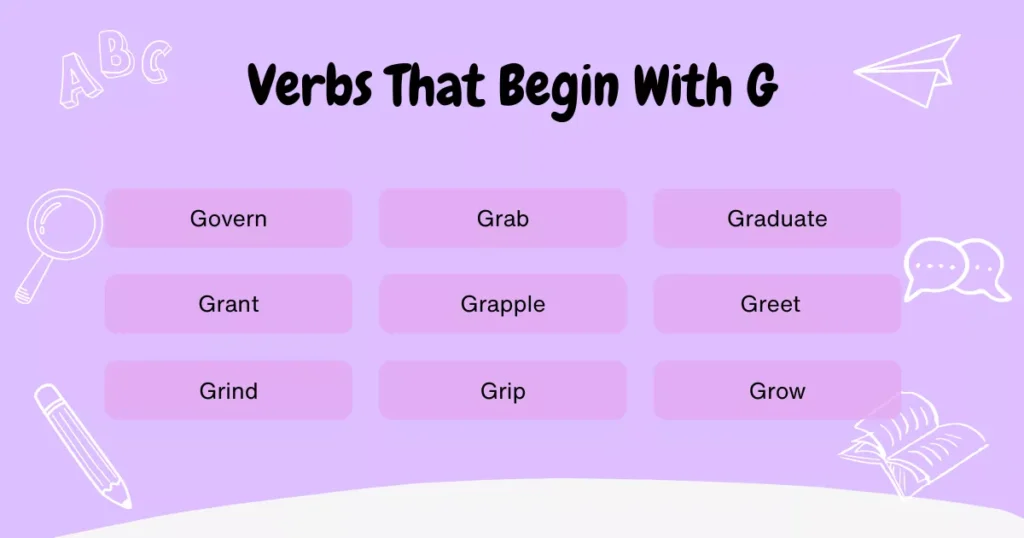
Verbs are the driving force of any sentence because they show action, movement, change, or a state of being. Verbs that start with the letter “G” are especially useful in everyday English, ranging from simple, common actions like go, get, and give to more advanced and descriptive words like generate, govern, and generalize. These verbs help make communication clearer, more expressive, and more engaging in both spoken and written language. In this guide, you’ll explore a well-organized collection of G-verbs with meanings and easy examples, designed to support learners of all levels while making vocabulary building simple, practical, and enjoyable.
Understanding Verbs That Start With Letter G
Verbs that begin with the letter “G” are action or state-of-being words that help describe what someone does, feels, or becomes. These verbs cover a wide range of uses in English from everyday actions like go, get, and give to more specific or advanced actions like generate, guide, and govern. Understanding these verbs helps improve sentence clarity, adds variety to your vocabulary, and makes communication more effective. Whether used in simple conversations or formal writing, G-verbs play an important role in expressing actions, emotions, and changes clearly.
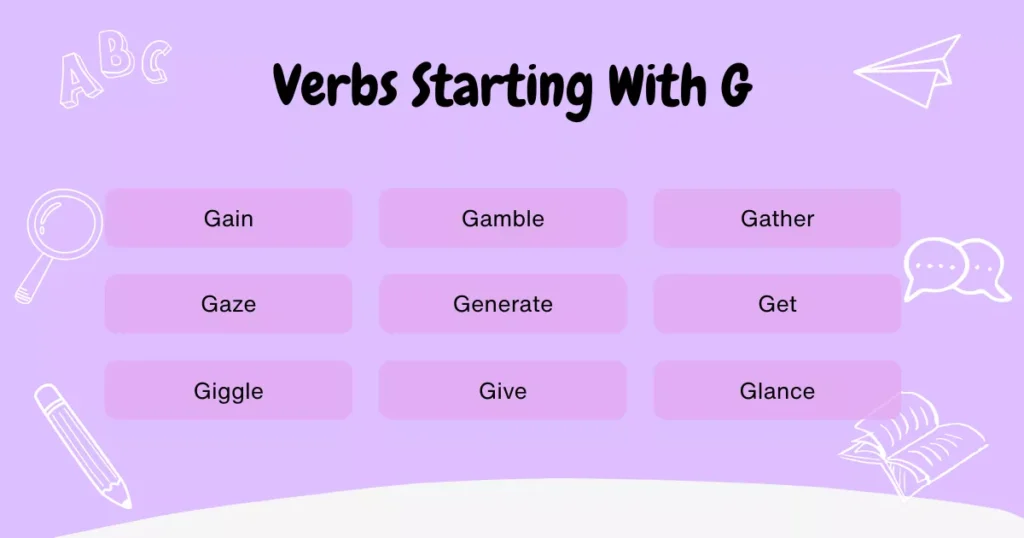
List of Common Verbs Starting With G
- Go – to move from one place to another
Example: I go to school every day. - Get – to receive or obtain
Example: She gets good grades. - Give – to offer something to someone
Example: He gives me a gift. - Grow – to increase in size or develop
Example: Plants grow quickly in sunlight. - Grab – to take quickly
Example: She grabbed her bag and left. - Gain – to achieve or obtain
Example: He gained experience from the job. - Guess – to form an opinion without full knowledge
Example: I guess the answer is correct. - Guide – to lead or show the way
Example: The teacher guides the students. - Gather – to collect or bring together
Example: They gathered flowers in the garden. - Glow – to shine softly
Example: The stars glow at night. - Grin – to smile widely
Example: He grinned with happiness. - Grasp – to understand or hold firmly
Example: She grasped the concept quickly. - Greet – to welcome someone
Example: They greeted their guests warmly. - Grill – to cook over fire
Example: We grilled chicken for dinner. - Grind – to crush into small pieces
Example: He grinds coffee beans. - Guard – to protect
Example: The dog guards the house. - Glance – to look quickly
Example: She glanced at the clock. - Glide – to move smoothly
Example: The swan glides across the water. - Grumble – to complain quietly
Example: He grumbled about the noise. - Gasp – to breathe suddenly in surprise
Example: She gasped at the news. - Grant – to give or allow
Example: The teacher granted permission. - Gaze – to look steadily
Example: He gazed at the stars. - Gamble – to risk something
Example: He gambled his savings. - Groom – to clean or prepare
Example: She groomed her pet. - Gush – to flow quickly
Example: Water gushed from the pipe. - Glorify – to praise highly
Example: They glorify their heroes. - Generate – to produce
Example: The machine generates electricity. - Generalize – to make a broad statement
Example: Don’t generalize about people. - Govern – to rule or control
Example: They govern the country fairly. - Giggle – to laugh lightly
Example: The children giggled happily.
Action Verbs That Start With G
- Grab – take quickly
Example: Grab the keys before leaving. - Go – move somewhere
Example: Let’s go home. - Give – hand something over
Example: Give me the book. - Gather – collect things
Example: They gathered sticks. - Grind – crush into powder
Example: Grind the spices well. - Grill – cook over heat
Example: He grills meat outside. - Glide – move smoothly
Example: The boat glides on water. - Gaze – look steadily
Example: She gazes at the sky. - Greet – welcome
Example: They greet visitors politely. - Guard – protect
Example: Soldiers guard the border. - Guide – lead
Example: She guides tourists. - Gulp – swallow quickly
Example: He gulped the juice. - Grasp – hold firmly
Example: She grasped the rope. - Glance – look briefly
Example: He glanced at his phone. - Groom – clean or prepare
Example: She grooms the horse. - Gush – flow rapidly
Example: Water gushes out. - Gamble – take a risk
Example: He gambled his money. - Grapple – struggle physically
Example: They grappled during the match. - Gouge – cut deeply
Example: The tool gouged the wood. - Gallop – run fast (horse)
Example: The horse gallops freely.
You May Also Like: Verbs That Start With D
Positive and Motivational Verbs With G
- Grow – develop or improve
Example: You will grow with practice. - Gain – achieve something
Example: She gained confidence. - Give – offer help or kindness
Example: Always give your best. - Guide – lead positively
Example: Mentors guide students. - Glow – shine with happiness
Example: She glows with joy. - Grin – smile happily
Example: He grinned with pride. - Grasp – understand clearly
Example: You will grasp the idea soon. - Grant – allow or give
Example: They granted him success. - Glorify – praise or honor
Example: We glorify hard work. - Generate – create something useful
Example: Ideas generate success. - Galvanize – inspire action
Example: The speech galvanized the team. - Greet – welcome warmly
Example: Greet everyone with a smile. - Gift – give something meaningful
Example: She gifted her time to help others. - Ground – make stable
Example: Meditation grounds the mind. - Glisten – shine beautifully
Example: Her eyes glisten with hope. - Gratify – give pleasure or satisfaction
Example: Helping others gratifies the heart. - Go – move forward
Example: Go after your dreams. - Gather – bring people together
Example: We gather for support. - Guide – show the right path
Example: Values guide your life. - Glow up – improve oneself
Example: She glowed up with confidence.
Regular and Irregular Verbs Starting With G
- Go (Irregular) – move
Example: They go to work daily. - Get (Irregular) – obtain
Example: I get results quickly. - Give (Irregular) – offer
Example: She gives advice. - Grow (Irregular) – develop
Example: Kids grow fast. - Grind (Irregular) – crush
Example: He grinds spices. - Grab (Regular) – take quickly
Example: Grab your bag. - Gain (Regular) – achieve
Example: He gained success. - Guess (Regular) – estimate
Example: Guess the answer. - Guide (Regular) – lead
Example: She guides them. - Gather (Regular) – collect
Example: They gather fruits. - Glow (Irregular) – shine
Example: Stars glow brightly. - Grin (Regular) – smile
Example: He grins often. - Grasp (Regular) – understand
Example: She grasps ideas fast. - Greet (Regular) – welcome
Example: They greet guests. - Grill (Regular) – cook
Example: We grill fish. - Guard (Regular) – protect
Example: He guards the gate. - Glance (Regular) – look quickly
Example: She glanced back. - Glide (Regular) – move smoothly
Example: Birds glide in air. - Grumble (Regular) – complain
Example: He grumbles daily. - Gasp (Regular) – breathe suddenly
Example: She gasped loudly. - Grant (Regular) – allow
Example: Permission was granted. - Gaze (Regular) – look steadily
Example: He gazes outside. - Gamble (Regular) – risk
Example: He gambles often. - Groom (Regular) – clean
Example: She grooms pets. - Gush (Regular) – flow
Example: Water gushed out. - Glorify (Regular) – praise
Example: They glorify heroes. - Generate (Regular) – produce
Example: Machines generate power. - Generalize (Regular) – make broad statements
Example: Don’t generalize. - Govern (Regular) – rule
Example: They govern wisely. - Giggle (Regular) – laugh lightly
Example: Kids giggle loudly.
Phrasal Verbs That Start With G
| Verb | Meaning | Example |
|---|---|---|
| Get up | to rise from bed | I get up early every day. |
| Get on | to board or have a good relationship | She gets on the bus at 8. |
| Get off | to leave a vehicle | He got off the train. |
| Get over | to recover from something | She got over her illness. |
| Get through | to finish or succeed | They got through the exam. |
| Get along | to have a good relationship | We get along well. |
| Get back | to return | He got back home late. |
| Get away | to escape | They got away safely. |
| Get ahead | to succeed | Work hard to get ahead. |
| Get by | to manage | She gets by with little money. |
| Get out | to leave | Get out of the room! |
| Get in | to enter | They got in the car. |
| Get down | to feel sad or to lower | Don’t get down about mistakes. |
| Get together | to meet | Let’s get together soon. |
| Get around | to travel or avoid | He gets around the city easily. |
| Get at | to reach or suggest | What are you getting at? |
| Get across | to communicate clearly | She got her point across. |
| Get over with | to finish something unpleasant | Let’s get it over with. |
| Get behind | to support or fall late | They got behind the plan. |
| Get ahead of | to move in front | He got ahead of the group. |
| Go on | to continue | The show must go on. |
| Go off | to explode or start ringing | The alarm went off. |
| Go through | to experience | She went through tough times. |
| Go over | to review | Let’s go over the notes. |
| Go back | to return | We went back home. |
You May Also Like: Verbs That Start With E
Professional, Academic, and Technical G Verbs
- Generate – produce
Example: The system generates reports. - Generalize – form broad conclusions
Example: Avoid generalizing results. - Govern – control or manage
Example: Laws govern behavior. - Grade – evaluate work
Example: Teachers grade assignments. - Graph – represent data visually
Example: We graph the results. - Group – organize into categories
Example: Data is grouped by type. - Gauge – measure or estimate
Example: We gauge performance. - Grant – officially allow
Example: The board granted approval. - Guide – direct or advise
Example: Mentors guide research. - Ground – base on evidence
Example: The theory is grounded in facts. - Globalize – expand worldwide
Example: Companies globalize operations. - Gear – prepare for a purpose
Example: The plan is geared toward success. - Grid – structure systematically
Example: The city is gridded neatly. - Graft – combine elements
Example: Scientists graft tissues. - Germinate – begin to grow or develop
Example: Ideas germinate over time. - Gather – collect data
Example: Researchers gather evidence. - Guarantee – ensure
Example: Policies guarantee safety. - Glide – move smoothly (technical context)
Example: The drone glides steadily. - Graduate – complete a course
Example: She graduated last year. - Gravitate – move toward something
Example: Students gravitate toward science. - Glean – collect information
Example: We glean insights from data. - Groom – prepare for a role
Example: He is groomed for leadership. - Groundwork – prepare the basics (verb use: lay groundwork)
Example: They groundwork the project early. - Galvanize – stimulate action
Example: The speech galvanized the team. - Governance (use: govern) – manage systems
Example: Committees govern policies.
Emotional, Creative, and Descriptive G Verbs
- Glow – shine softly
Example: Her face glows with happiness. - Grin – smile widely
Example: He grins with joy. - Giggle – laugh lightly
Example: They giggled at the joke. - Gasp – react with surprise
Example: She gasped in shock. - Gaze – look with emotion
Example: He gazes lovingly. - Grieve – feel deep sadness
Example: They grieve the loss. - Gush – express emotion strongly
Example: She gushes about her trip. - Glorify – praise highly
Example: Stories glorify heroes. - Glisten – shine with light
Example: Tears glisten in her eyes. - Grapple – struggle emotionally
Example: He grapples with fear. - Groan – express pain or frustration
Example: He groaned in pain. - Glow up – improve emotionally or physically
Example: She glowed up with confidence. - Gratify – bring pleasure
Example: Helping others gratifies me. - Greet – welcome warmly
Example: She greets everyone kindly. - Grumble – complain softly
Example: He grumbles when tired. - Glimmer – shine faintly
Example: Hope glimmers in darkness. - Gawk – stare rudely
Example: Don’t gawk at others. - Gush over – praise excitedly
Example: She gushes over her favorite singer. - Glide – move gracefully
Example: She glides across the stage. - Gamble – take emotional risks
Example: He gambles on love. - Gleam – shine brightly
Example: Her eyes gleam with joy. - Grasp – understand deeply
Example: She grasps emotions well. - Glimpse – see briefly
Example: I glimpsed her smile. - Germinate – develop ideas
Example: Creative ideas germinate slowly. - Gild – enhance appearance
Example: Stories gild reality.
Rare, Unique, and Advanced Verbs That Start With G
- Gainsay – deny or contradict
Example: No one can gainsay the truth. - Garnish – decorate
Example: She garnished the dish. - Gentrify – renovate an area
Example: The city gentrified the district. - Garner – collect or gather
Example: He garnered support. - Goad – provoke into action
Example: He was goaded into speaking. - Guttle – eat greedily
Example: They guttled the meal. - Gambol – jump playfully
Example: Lambs gambol in fields. - Gloze – flatter or deceive
Example: He glozed over mistakes. - Gyrate – move in circles
Example: She gyrates while dancing. - Gibber – speak unintelligibly
Example: He gibbered in fear. - Glimpse – see briefly
Example: I glimpsed the bird. - Graft – join parts together
Example: They grafted branches. - Gravitate – move toward
Example: People gravitate to success. - Grizzle – complain
Example: He grizzles constantly. - Gorgonize – paralyze with fear
Example: The sight gorgonized him. - Gurgle – make bubbling sound
Example: Water gurgles in the stream. - Gavel – bring to order
Example: The judge gaveled the court. - Glimmer – shine faintly
Example: Light glimmers softly. - Glean – gather information
Example: She gleaned facts. - Gainsay – deny strongly
Example: He cannot gainsay it. - Gash – cut deeply
Example: The knife gashed the wood. - Gird – prepare oneself
Example: He girded for battle. - Gloze over – explain away
Example: She glozed over errors. - Gainsay – oppose
Example: No one gainsays the fact. - Gesticulate – use gestures while speaking
Example: He gesticulates while talking.
You May Also Like: Verbs That Start With F
Common Mistakes When Using G Verbs
- Confusing similar verbs (get vs. gain)
Mistake: “I gained a gift from him.”
Correction: Use get for general receiving and gain for achievement.
Correct: “I got a gift from him.” - Using incorrect verb forms (irregular verbs)
Mistake: “She gived me advice.”
Correction: Some G verbs are irregular.
Correct: “She gave me advice.” - Misusing phrasal verbs (get off, get out, get over)
Mistake: “Get off the room.”
Correction: Each phrasal verb has a specific meaning.
Correct: “Get out of the room.” - Overusing basic verbs like ‘go’ and ‘get’
Mistake: “He went to success.”
Correction: Use more precise verbs.
Correct: “He achieved success.” - Wrong prepositions with G verbs
Mistake: “She is good in English.”
Correction: Prepositions matter.
Correct: “She is good at English.”
Fun Facts About Verbs That Begin With G
- “Get” is one of the most flexible verbs in English
It can mean receive, become, arrive, understand, and more! - Many G verbs describe movement
Words like go, glide, gallop, and gather all show motion. - Some G verbs express emotions clearly
Verbs like grieve, glow, and gasp capture feelings vividly. - “Go” is one of the most commonly used verbs worldwide
It appears in everyday speech across all English levels. - G verbs are powerful in storytelling
Words like gaze, glimmer, and gush make writing more descriptive and engaging.
FAQs
Conclusion
Verbs that start with the letter “G” play a powerful and versatile role in English. From everyday essentials like go, get, and give to more expressive and advanced verbs like generate, galvanize, and garnish, these words help bring clarity, energy, and precision to communication. Whether you’re a beginner building vocabulary or an advanced learner refining your language skills, mastering G-verbs allows you to express actions, emotions, and ideas more effectively. By understanding their meanings, correct usage, and common mistakes, you can confidently use these verbs in both spoken and written English.