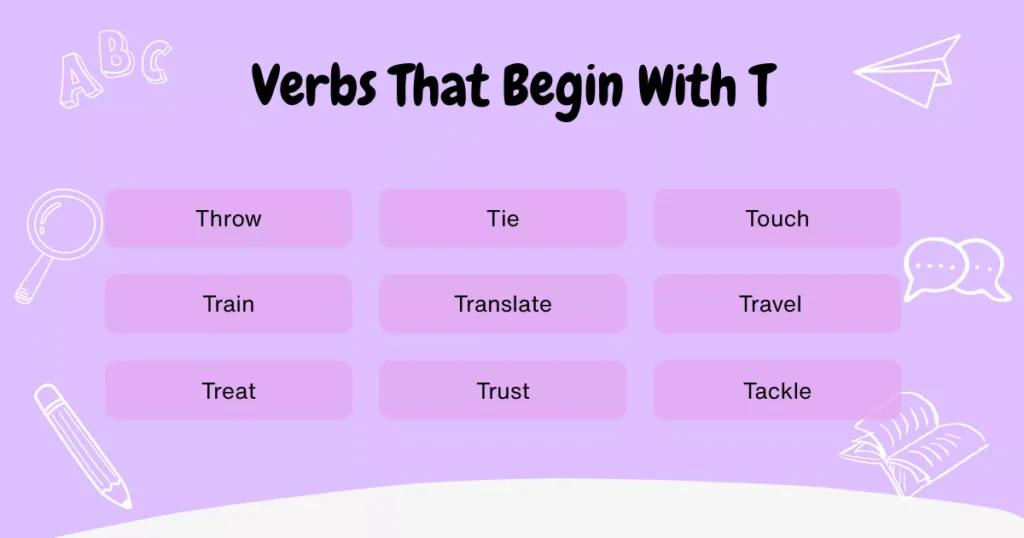
Verbs are the driving force of language, without them, sentences would feel incomplete and lifeless. If you’re looking to strengthen your vocabulary in a simple and structured way, exploring verbs by letter is a great place to start. In this article, we focus on verbs that begin with the letter “T”, a powerful group of words that capture everything from everyday actions like talk and try to more advanced and expressive verbs used in academic and descriptive writing. Whether you’re a student, writer, or beginner learner, these T-verbs will help you communicate more effectively, improve your writing skills, and make your language more dynamic and engaging.
Understanding Verbs That Start With Letter T
Verbs that start with the letter “T” are an important part of everyday English. They describe a wide range of actions, thoughts, and states, such as talk (to speak), travel (to move from one place to another), and think (to use your mind). These verbs are used in both simple conversations and more formal writing, making them highly versatile. By learning T-verbs, you can express ideas more clearly, add variety to your sentences, and improve both your speaking and writing skills.
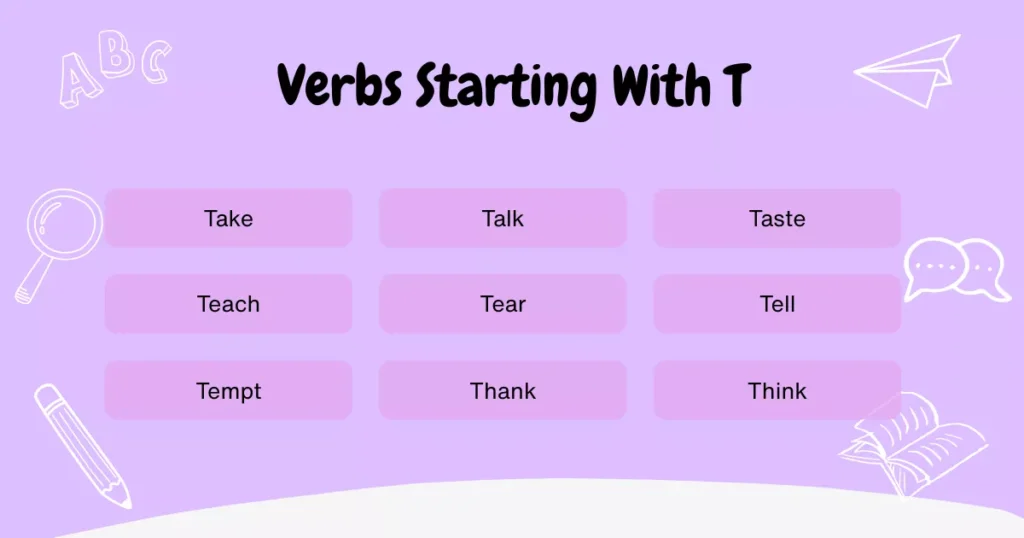
List of Common Verbs Starting With T
- Talk – to speak
Example: She likes to talk to her friends daily. - Take – to receive or carry
Example: Please take this book with you. - Tell – to say something
Example: He will tell the truth. - Think – to use the mind
Example: I think this is a good idea. - Try – to make an effort
Example: She will try again tomorrow. - Turn – to change direction
Example: Turn left at the corner. - Travel – to go from one place to another
Example: They love to travel abroad. - Teach – to give knowledge
Example: She teaches English. - Touch – to feel with hands
Example: Do not touch the fire. - Throw – to send something through the air
Example: He can throw the ball far. - Trust – to believe in someone
Example: I trust my best friend. - Train – to practice skills
Example: They train every morning. - Treat – to behave in a certain way
Example: Treat others kindly. - Test – to check something
Example: The teacher will test us. - Tie – to fasten
Example: Tie your shoes properly. - Taste – to experience flavor
Example: Taste this delicious cake. - Type – to write using a keyboard
Example: She types very fast. - Translate – to change language
Example: He translates English into Urdu. - Trace – to follow or copy
Example: Trace the shape carefully. - Track – to follow progress
Example: Track your goals daily. - Transfer – to move something
Example: Transfer the files quickly. - Tidy – to clean
Example: Tidy your room now. - Tap – to hit lightly
Example: Tap the screen gently. - Tear – to rip
Example: Do not tear the paper. - Tolerate – to accept
Example: She cannot tolerate noise. - Twist – to turn something
Example: Twist the cap to open. - Target – to aim at
Example: Aim to target your goals. - Thank – to show gratitude
Example: Thank your parents. - Trigger – to cause something
Example: Stress can trigger headaches. - Tempt – to attract
Example: The cake tempts me.
You May Also Like: Verbs That Start With Q
Action Verbs That Start With T
- Tackle – to deal with a problem
Example: He tackled the issue bravely. - Tag – to label
Example: Tag your friend in the post. - Tailor – to adjust
Example: She tailored the dress. - Tame – to make less wild
Example: He tamed the animal. - Tap – to hit gently
Example: She tapped on the door. - Target – to aim
Example: They targeted the goal. - Tease – to make fun playfully
Example: Friends tease each other. - Teleport – to move instantly (imaginary)
Example: He teleported in the game. - Tend – to take care of
Example: She tends the garden. - Terminate – to end
Example: They terminated the contract. - Test – to examine
Example: Test the system now. - Text – to send a message
Example: Text me later. - Throw – to toss
Example: Throw the ball. - Tick – to mark
Example: Tick the correct answer. - Tie – to fasten
Example: Tie the rope tightly. - Tilt – to lean
Example: Tilt your head. - Time – to measure time
Example: Time your run. - Tip – to give extra money
Example: Tip the waiter. - Toss – to throw lightly
Example: Toss the coin. - Tow – to pull
Example: The truck towed the car.
Positive and Motivational Verbs With T
- Thrive – to grow well
Example: She thrives in challenges. - Transform – to change for the better
Example: Hard work can transform lives. - Trust – to believe
Example: Trust yourself always. - Thank – to show gratitude
Example: Thank those who help you. - Teach – to guide
Example: Teachers teach valuable lessons. - Try – to make effort
Example: Always try your best. - Train – to improve skills
Example: Train daily to succeed. - Treasure – to value deeply
Example: Treasure your time. - Tolerate – to accept patiently
Example: Learn to tolerate differences. - Team – to work together
Example: Team up for success. - Triumph – to win
Example: She triumphed over difficulties. - Trigger – to start something positive
Example: Kindness can trigger happiness. - Tune – to adjust
Example: Tune your mindset positively. - Target – to set goals
Example: Target your dreams. - Tackle – to face problems
Example: Tackle challenges boldly. - Think – to reflect
Example: Think positively. - Thankfulness (verb form: thank) – to feel grateful
Example: Thank others daily. - Touch – to emotionally affect
Example: His words touched hearts. - Turn – to change direction
Example: Turn failures into success. - Take charge – to lead
Example: Take charge of your life.
Regular and Irregular Verbs Starting With T
- Take (Irregular) – to receive
Example: She took the book. - Teach (Irregular) – to educate
Example: He taught math. - Tell (Irregular) – to say
Example: She told a story. - Think (Irregular) – to use mind
Example: I thought about it. - Throw (Irregular) – to toss
Example: He threw the ball. - Tear (Irregular) – to rip
Example: She tore the paper. - Throw (Irregular) – to send through air
Example: He has thrown it. - Take (Irregular) – to grab
Example: They have taken it. - Talk (Regular) – to speak
Example: She talked yesterday. - Try (Regular) – to attempt
Example: He tried hard. - Turn (Regular) – to change direction
Example: She turned left. - Travel (Regular) – to move
Example: They traveled far. - Train (Regular) – to practice
Example: He trained daily. - Treat (Regular) – to behave
Example: She treated him well. - Test (Regular) – to check
Example: They tested the system. - Touch (Regular) – to feel
Example: He touched the wall. - Tie (Regular) – to fasten
Example: She tied the rope. - Type (Regular) – to write
Example: He typed fast. - Translate (Regular) – to convert language
Example: She translated the text. - Track (Regular) – to follow
Example: They tracked progress. - Transfer (Regular) – to move
Example: He transferred money. - Tidy (Regular) – to clean
Example: She tidied the room. - Tap (Regular) – to hit lightly
Example: He tapped the table. - Tolerate (Regular) – to accept
Example: She tolerated the noise. - Twist (Regular) – to turn
Example: He twisted the lid. - Target (Regular) – to aim
Example: They targeted success. - Thank (Regular) – to show gratitude
Example: She thanked him. - Tempt (Regular) – to attract
Example: The cake tempted me. - Tick (Regular) – to mark
Example: He ticked the answer. - Toss (Regular) – to throw lightly
Example: She tossed the coin.
Phrasal Verbs That Start With T
| Verb | Meaning | Example |
|---|---|---|
| Take after | to resemble | She takes after her mother. |
| Take apart | to separate | He took the machine apart. |
| Take away | to remove | Take away the plates. |
| Take back | to return | I took the book back. |
| Take down | to write or remove | Take down these notes. |
| Take in | to understand | It was hard to take in the news. |
| Take off | to remove or leave quickly | The plane took off. |
| Take on | to accept responsibility | She took on a new role. |
| Take out | to remove or invite | He took her out for dinner. |
| Take over | to gain control | The company took over its rival. |
| Take up | to start a hobby | She took up painting. |
| Take through | to guide step-by-step | He took me through the process. |
| Take to | to start liking | She took to the new teacher. |
| Take along | to bring with | Take your friend along. |
| Take aside | to speak privately | He took me aside to talk. |
| Take out on | to express anger on someone | Don’t take it out on me. |
| Talk back | to reply rudely | Don’t talk back to elders. |
| Talk over | to discuss | Let’s talk over the plan. |
| Talk through | to explain step-by-step | She talked me through the task. |
| Talk into | to persuade | He talked me into joining. |
| Talk out of | to discourage | She talked him out of quitting. |
| Turn on | to start a device | Turn on the lights. |
| Turn off | to stop a device | Turn off the TV. |
| Turn up | to appear or increase | He turned up late. |
| Turn down | to reject or reduce | She turned down the offer. |
Professional, Academic, and Technical T Verbs
- Transmit – to send information
Example: Data is transmitted online. - Transform – to change form
Example: Technology transforms industries. - Translate – to convert language
Example: She translates documents. - Test – to evaluate
Example: Scientists test hypotheses. - Track – to monitor
Example: Track your progress carefully. - Train – to teach skills
Example: The company trains employees. - Transfer – to move
Example: Transfer funds securely. - Target – to aim at
Example: The campaign targets youth. - Trigger – to cause
Example: Stress can trigger reactions. - Tabulate – to arrange data
Example: Tabulate the results. - Theorize – to form a theory
Example: Experts theorize outcomes. - Time – to measure duration
Example: Time the experiment. - Tally – to count
Example: Tally the votes. - Terminate – to end
Example: They terminated the contract. - Tweak – to adjust slightly
Example: Tweak the design. - Tune – to adjust precisely
Example: Tune the system. - Trace – to track origin
Example: Trace the error. - Troubleshoot – to solve problems
Example: He troubleshoots issues. - Type – to input text
Example: Type the report. - Technologize – to apply technology
Example: They technologize processes. - Tend – to manage
Example: She tends operations. - Testify – to give evidence
Example: He testified in court. - Tie (data) – to connect
Example: Tie the results together. - Tool – to equip with tools
Example: Tool the system properly. - Tokenize – to convert into tokens
Example: Tokenize the assets.
You May Also Like: Verbs That Start With R
Emotional, Creative, and Descriptive T Verbs
- Treasure – to value deeply
Example: She treasures memories. - Trust – to believe
Example: Trust your instincts. - Thank – to express gratitude
Example: Thank your mentor. - Touch – to move emotionally
Example: The story touched me. - Tingle – to feel slight sensation
Example: Her hands tingled. - Tremble – to shake with emotion
Example: He trembled with fear. - Thrill – to excite
Example: The ride thrilled us. - Tease – to joke playfully
Example: Friends tease each other. - Twinkle – to shine softly
Example: Stars twinkle at night. - Tangle – to twist together
Example: Her hair tangled. - Transform – to change creatively
Example: Art transforms ideas. - Tear up – to cry
Example: She teared up with joy. - Tickle – to cause laughter
Example: He tickled the child. - Tantalize – to excite desire
Example: The smell tantalized me. - Tire – to become tired
Example: I tire easily. - Tempt – to attract
Example: Chocolate tempts me. - Tune – to adjust feelings
Example: Tune your emotions. - Tell – to express
Example: Tell your story. - Think – to reflect
Example: Think deeply. - Tolerate – to accept
Example: Learn to tolerate others. - Tighten – to make tense
Example: Stress tightened her chest. - Trail – to follow gently
Example: Leaves trailed behind. - Trace – to outline softly
Example: Trace the рисунок. - Tint – to color lightly
Example: Tint the image. - Twist – to change shape
Example: The plot twists suddenly.
Rare, Unique, and Advanced Verbs That Start With T
- Truncate – to shorten
Example: The text was truncated. - Transcend – to rise above
Example: Great art transcends time. - Transfix – to hold attention
Example: She was transfixed by the view. - Transmute – to change form
Example: Ideas transmute over time. - Tessellate – to form patterns
Example: Shapes tessellate perfectly. - Thermoregulate – to control temperature
Example: Animals thermoregulate. - Tintinnabulate – to ring
Example: The bells tintinnabulated. - Titrate – to measure concentration
Example: They titrated the solution. - Torpedo – to destroy
Example: The plan was torpedoed. - Tarry – to delay
Example: Do not tarry here. - Tauten – to tighten
Example: The rope tautened. - Templatize – to standardize
Example: They templatized documents. - Tergiversate – to avoid commitment
Example: He tergiversated on the issue. - Terrify – to frighten greatly
Example: The noise terrified him. - Testate – to leave a will
Example: He died testate. - Thwart – to prevent
Example: Police thwarted the plan. - Thrash – to beat or defeat
Example: They thrashed the opponent. - Thrive – to grow strongly
Example: Plants thrive in sunlight. - Transcribe – to write down
Example: She transcribed the speech. - Transpose – to change order
Example: Transpose the data. - Trammel – to restrict
Example: Rules trammel creativity. - Traipse – to walk wearily
Example: They traipsed through mud. - Trepan – to drill surgically
Example: Doctors trepan skulls. - Trill – to produce a sound
Example: Birds trill beautifully. - Tumesce – to swell
Example: The tissue tumesced.
Common Mistakes When Using T Verbs
- Confusing Similar Verbs (Take vs. Bring)
Many learners mix up take and bring.
Incorrect: Bring this book to school tomorrow. (wrong if moving away)
Correct: Take this book to school tomorrow. - Incorrect Past Forms of Irregular T Verbs
Verbs like take, teach, think have irregular forms.
Incorrect: I taked the pen.
Correct: I took the pen. - Overusing Basic Verbs Like “Talk” and “Tell”
Using simple verbs repeatedly instead of more precise ones.
Incorrect: He talked about the issue again and again.
Correct: He explained the issue clearly. - Wrong Use of Phrasal Verbs
Phrasal verbs like take off or turn down can have multiple meanings.
Incorrect: He turned down the light. (awkward)
Correct: He turned off the light. - Using Verbs Without Proper Context
Some T verbs need the right structure or object.
Incorrect: She told about the story.
Correct: She told the story.
You May Also Like: Verbs That Start With S
Fun Facts About Verbs That Begin With T
- “Take” is One of the Most Flexible Verbs
It forms dozens of phrasal verbs like take off, take up, take over. - Many T Verbs Show Movement
Words like travel, turn, toss, and trail all describe motion. - T Verbs Are Common in Daily Speech
Simple verbs like talk, try, tell, and think are used constantly in conversations. - Some T Verbs Sound Like Their Meaning
Words like tap, tick, and tinkle imitate real sounds. - T Verbs Range from Simple to Highly Advanced
From basic words like touch to advanced ones like transcend and tessellate.
FAQs
Conclusion
Verbs that start with the letter “T” play a powerful role in English communication, helping us describe actions, emotions, thoughts, and changes with clarity and impact. From everyday verbs like talk, take, and try to advanced and technical terms like transform and transcend, T-verbs offer a rich variety of expression for learners at every level. By understanding their meanings, practicing their usage, and avoiding common mistakes, you can significantly improve your speaking and writing skills. Whether you’re a student, writer, or language enthusiast, mastering T-verbs is a simple yet effective way to build a stronger, more dynamic vocabulary.