Verbs that start with H play an important role in making English clear, expressive, and engaging. As action words, verbs help us describe what people do, feel, think, and experience; whether it’s something simple like help and hold or more expressive actions like heal, honor, and hurry. Learning these verbs not only strengthens your vocabulary but also improves both speaking and writing skills. Some H-verbs follow regular patterns, while others are irregular, giving learners a chance to understand how English works in real situations.
Understanding Verbs That Start With Letter H
Verbs that start with the letter H are action or state words that help describe what someone does, feels, or experiences. These verbs cover a wide range of uses from everyday actions like help, hold, and hurry to more descriptive or emotional verbs like hope, hate, and heal. Like other verbs in English, H-verbs can be regular (adding -ed in the past tense, such as help → helped) or irregular (changing form, such as hear → heard). Understanding these verbs makes it easier to build clear sentences, improve communication, and expand vocabulary.
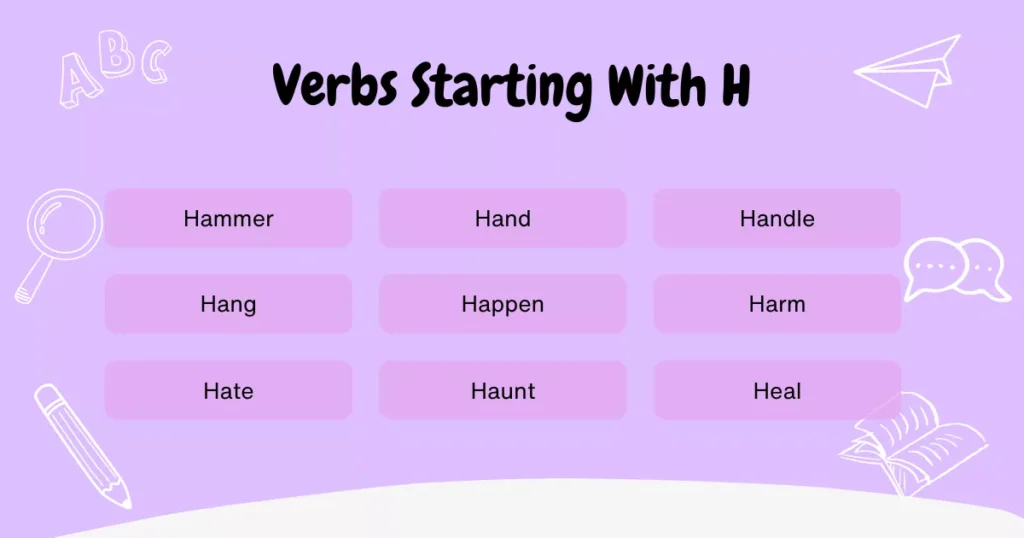
List of Common Verbs Starting With H
- Help – to assist someone
Example: She helps her mother in the kitchen. - Hold – to carry or keep in hand
Example: He held the baby gently. - Hear – to perceive sound
Example: I heard a strange noise outside. - Hope – to wish for something
Example: We hope for good results. - Hurry – to move quickly
Example: They hurried to catch the bus. - Happen – to take place
Example: What happened yesterday? - Hide – to keep out of sight
Example: The cat hid under the table. - Hit – to strike something
Example: He hit the ball hard. - Hug – to embrace
Example: She hugged her friend tightly. - Handle – to manage or deal with
Example: He handled the situation calmly. - Hate – to strongly dislike
Example: I hate waking up early. - Hunt – to search for animals or things
Example: They hunt for treasure. - Harm – to cause damage or injury
Example: Smoking can harm your health. - Hesitate – to pause before doing something
Example: Don’t hesitate to ask questions. - Hum – to make a low sound
Example: She hummed a soft tune. - Hop – to jump lightly
Example: The rabbit hopped away. - Hunt – to search or chase
Example: Lions hunt in groups. - Hatch – to come out of an egg
Example: The chicks hatched this morning. - Hinder – to create difficulty
Example: Rain hindered our plans. - Heal – to become healthy again
Example: The wound healed quickly. - Hail – to greet or call out
Example: They hailed a taxi. - Host – to organize or receive guests
Example: She hosted a party. - Highlight – to emphasize
Example: The teacher highlighted key points. - Hover – to stay in one place in the air
Example: The helicopter hovered above. - Head – to move in a direction
Example: We headed home early. - Harvest – to gather crops
Example: Farmers harvest wheat in summer. - Huddle – to gather closely
Example: The team huddled before the match. - Hike – to walk long distances
Example: They hiked in the mountains. - Holler – to shout loudly
Example: He hollered for help. - Hypnotize – to put into a trance
Example: The magician hypnotized the audience.
You May Also Like: Verbs That Start With E
Action Verbs That Start With H
- Hop – to jump lightly
Example: The rabbit hopped away. - Hunt – to chase animals
Example: They hunt deer. - Hike – to walk long distances
Example: We hiked uphill. - Hit – to strike
Example: He hit the drum. - Hug – to embrace
Example: She hugged her sister. - Hurry – to rush
Example: Hurry up! - Hurl – to throw forcefully
Example: He hurled the ball. - Haul – to pull or carry
Example: They hauled heavy boxes. - Hammer – to hit with a tool
Example: He hammered the nail. - Hand – to give something
Example: She handed me a pen. - Hike – to trek
Example: They hiked all day. - Hitch – to fasten or connect
Example: He hitched the trailer. - Hunt – to search for
Example: She hunted for keys. - Hose – to spray with water
Example: He hosed the garden. - Hug – to hold tightly
Example: They hugged each other. - Hurl – to throw
Example: She hurled the stick. - Hop – to jump
Example: The frog hopped quickly. - Hew – to cut or shape
Example: They hewed wood. - Hatch – to emerge from egg
Example: Chicks hatched. - Hobble – to walk with difficulty
Example: He hobbled slowly.
Positive and Motivational Verbs With H
- Help – to assist
Example: Always help others. - Hope – to wish positively
Example: Never lose hope. - Heal – to recover
Example: Time heals pain. - Honor – to respect
Example: Honor your parents. - Hug – to show affection
Example: Hug your loved ones. - Harmonize – to create balance
Example: They harmonize well together. - Highlight – to emphasize good things
Example: Highlight your strengths. - Hustle – to work hard
Example: Keep hustling for success. - Hold – to support
Example: Hold onto your dreams. - Hype – to encourage excitement
Example: He hyped his team. - Hallow – to make holy
Example: They hallowed the place. - Hearten – to give courage
Example: Her words heartened me. - Hone – to improve skills
Example: Hone your abilities. - Hail – to praise
Example: The crowd hailed the winner. - Help out – to assist
Example: She helped out her neighbor. - Harmonize – to work together
Example: Voices harmonize beautifully. - Hold up – to support
Example: Friends hold you up. - Heal up – to recover
Example: He healed up fast. - Help along – to make easier
Example: Practice helps along learning. - Hatch – to create ideas
Example: They hatched a great plan.
Regular and Irregular Verbs Starting With H
- Help – helped
Example: She helped me yesterday. - Hug – hugged
Example: He hugged his friend. - Hunt – hunted
Example: They hunted animals. - Harm – harmed
Example: The storm harmed crops. - Hurry – hurried
Example: We hurried home. - Handle – handled
Example: She handled the task well. - Hail – hailed
Example: They hailed a taxi. - Hike – hiked
Example: We hiked last weekend. - Hover – hovered
Example: The drone hovered above. - Holler – hollered
Example: He hollered loudly. - Huddle – huddled
Example: They huddled together. - Highlight – highlighted
Example: She highlighted the notes. - Hasten – hastened
Example: He hastened his steps. - Harmonize – harmonized
Example: They harmonized their voices. - Host – hosted
Example: She hosted a dinner. - Hear – heard
Example: I heard a noise. - Hold – held
Example: She held the bag. - Hide – hid
Example: He hid behind the door. - Hit – hit
Example: She hit the ball. - Hang – hung
Example: He hung the picture. - Have – had
Example: I had lunch. - Hew – hewed
Example: He hewed the wood. - Hurt – hurt
Example: He hurt his leg. - Hitch – hitched (can be irregular in some contexts)
Example: They hitched a ride. - Haw (rare) – hawed
Example: He hawed before answering. - Hold – held
Example: They held a meeting. - Hide – hidden (past participle)
Example: The treasure was hidden. - Hear – heard
Example: We heard music. - Hang – hung
Example: Clothes hung outside. - Hit – hit
Example: The ball hit the wall.
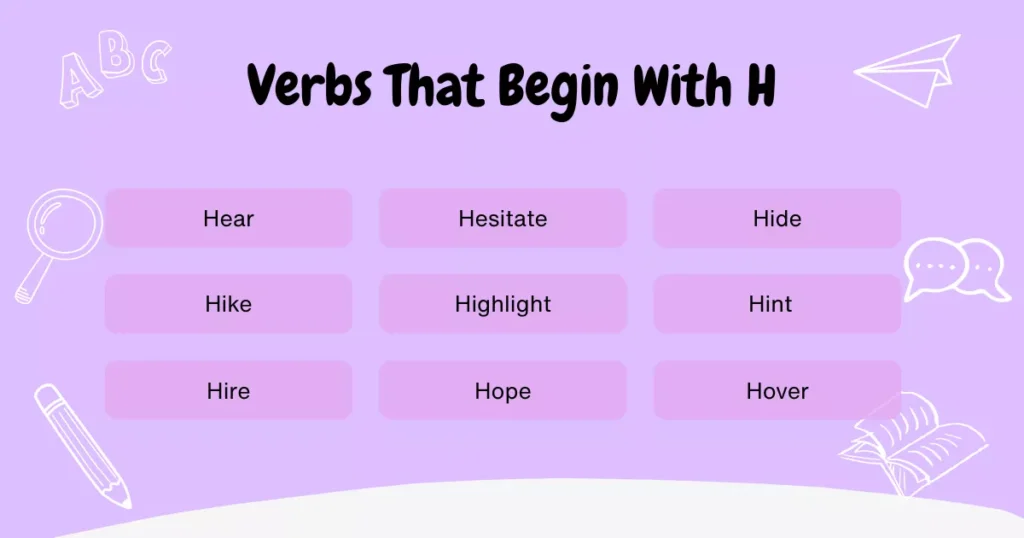
Phrasal Verbs That Start With H
| Verb | Meaning | Example |
|---|---|---|
| Hand in | to submit | She handed in her assignment on time. |
| Hand out | to distribute | The teacher handed out worksheets. |
| Hand over | to give control | He handed over the keys. |
| Hang out | to spend time casually | They hang out at the park. |
| Hang on | to wait | Hang on a minute, please. |
| Hang up | to end a call | She hung up suddenly. |
| Hold on | to wait or stay strong | Hold on, I’m coming. |
| Hold back | to restrain | He held back his anger. |
| Hold up | to delay | Traffic held us up. |
| Hold out | to continue resisting | They held out for better offers. |
| Heat up | to make warmer | Heat up the food. |
| Help out | to assist | She helped out at the event. |
| Hurry up | to move faster | Hurry up or we’ll be late. |
| Head out | to leave | We will head out soon. |
| Head back | to return | Let’s head back home. |
| Head for | to go toward | They headed for the beach. |
| Hook up | to connect | They hooked up the device. |
| Hold off | to delay | They held off the decision. |
| Hush up | to keep quiet about | They tried to hush up the issue. |
| Hand down | to pass to next generation | This tradition was handed down. |
| Hang back | to stay behind | He hung back from the crowd. |
| Have on | to be wearing | She has on a red dress. |
| Have over | to invite home | We had friends over. |
| Hit on | to suddenly think of / flirt | He hit on a great idea. |
| Hunt down | to search and find | They hunted down the thief. |
You May Also Like: Verbs That Start With F
Professional, Academic, and Technical H Verbs
- Hypothesize – to form a theory
Example: Scientists hypothesize new ideas. - Highlight – to emphasize
Example: The report highlights key data. - Handle – to manage
Example: She handles complex projects. - Host – to organize
Example: They hosted a conference. - Harmonize – to bring into agreement
Example: Policies must be harmonized. - Hedge – to reduce risk
Example: Investors hedge their bets. - Harness – to control and use
Example: We harness solar energy. - Heed – to pay attention
Example: Please heed the instructions. - Heighten – to increase
Example: The campaign heightened awareness. - Halt – to stop
Example: The process was halted. - Humanize – to make more relatable
Example: Stories humanize data. - Hone – to improve skill
Example: She honed her writing skills. - Hasten – to speed up
Example: They hastened development. - Hinge (on) – to depend
Example: Success hinges on effort. - Hostile (rare verb use) – to act aggressively
Example: The tone can hostile discussions. - Huddle (in business) – to discuss quickly
Example: The team huddled before launch. - Hash out – to discuss thoroughly
Example: They hashed out the details. - Headquarter (rare) – to base operations
Example: The company is headquartered here. - Handoff – to transfer responsibility
Example: The project was handed off. - Hybridize – to combine systems
Example: They hybridized the model. - Hyperlink – to link digitally
Example: Please hyperlink the sources. - Host (data) – to store online
Example: The site hosts files. - Harden – to strengthen systems
Example: Engineers harden security. - Hail (formal) – to recognize
Example: The discovery was hailed. - Hold (data) – to contain
Example: The file holds information.
Emotional, Creative, and Descriptive H Verbs
- Hope – to wish
Example: I hope for success. - Hate – to strongly dislike
Example: She hates dishonesty. - Hug – to embrace
Example: He hugged his friend. - Hurt – to feel pain
Example: His words hurt me. - Hesitate – to pause in doubt
Example: She hesitated before speaking. - Holler – to shout loudly
Example: He hollered in excitement. - Hum – to sing softly
Example: She hummed a melody. - Haunt – to stay in memory
Example: The song haunted him. - Hype – to promote excitedly
Example: They hyped the event. - Hallow – to honor as sacred
Example: We hallow this place. - Hearten – to encourage
Example: Your words hearten me. - Hypnotize – to fascinate deeply
Example: The performance hypnotized the crowd. - Hanker – to strongly desire
Example: She hankers for adventure. - Huddle – to gather closely
Example: They huddled for warmth. - Harmonize – to create pleasing sound
Example: Voices harmonize beautifully. - Huff – to show annoyance
Example: He huffed in anger. - Hoot – to laugh or shout
Example: They hooted with laughter. - Haze – to confuse or blur
Example: Memories hazed over time. - Hover – to linger nearby
Example: She hovered nervously. - Harden – to become less emotional
Example: Hardships hardened him. - Heal – to recover emotionally
Example: Time heals pain. - Hunger – to strongly desire
Example: He hungers for success. - Hush – to quiet
Example: She hushed the child. - Hail – to praise
Example: They hailed her bravery. - Hold dear – to cherish
Example: I hold dear these memories.
Rare, Unique, and Advanced Verbs That Start With H
- Habilitate – to equip with skills
Example: Training habilitates workers. - Habituate – to become accustomed
Example: He habituated to noise. - Haggle – to bargain
Example: They haggled over price. - Halve – to divide into two
Example: They halved the cake. - Hallow – to make sacred
Example: The place was hallowed. - Hamper – to hinder
Example: Rain hampered travel. - Hanker – to crave
Example: She hankers for freedom. - Harp (on) – to repeat often
Example: He harps on the same topic. - Hatch – to plan secretly
Example: They hatched a plan. - Haul – to pull heavily
Example: He hauled the load. - Haw – to hesitate
Example: He hemmed and hawed. - Heave – to lift with effort
Example: They heaved the box. - Heckle – to interrupt loudly
Example: The crowd heckled the speaker. - Hedge – to avoid commitment
Example: He hedged his answer. - Hie (old) – to go quickly
Example: They hied to the village. - Hinder – to obstruct
Example: Fog hindered visibility. - Hoard – to collect excessively
Example: He hoarded supplies. - Hobble – to walk with difficulty
Example: She hobbled along. - Hone – to sharpen
Example: Practice hones skill. - Hoodwink – to trick
Example: They hoodwinked the buyers. - Hurtle – to move rapidly
Example: The car hurtled forward. - Husband (resources) – to use carefully
Example: They husband resources wisely. - Hybridize – to combine types
Example: They hybridized plants. - Hydrate – to add water
Example: Athletes hydrate often. - Hyperventilate – to breathe rapidly
Example: He hyperventilated from stress.
You May Also Like: Verbs That Start With G
Common Mistakes When Using H Verbs
- Confusing Similar Forms (Hear vs. Listen)
Many learners say “I am hearing music” instead of “I hear music” or “I am listening to music.”
Hear is usually not used in continuous form, while listen is. - Incorrect Past Forms of Irregular Verbs
Mistakes like “He hitted the ball” instead of “He hit the ball” are common.
Some H-verbs (hit, hurt, put-like forms) don’t change in past tense. - Using the Wrong Preposition in Phrasal Verbs
Saying “hand on your homework” instead of “hand in your homework.”
Small prepositions completely change meaning. - Overusing Basic Verbs Like “Have” and “Help”
Learners rely too much on simple verbs and ignore richer options like assist, support, facilitate.
This makes writing less engaging and repetitive. - Confusing “Hold” and “Keep”
Example: “Hold this place clean” instead of “Keep this place clean.”
Hold is physical, while keep is about maintaining a state.
Fun Facts About Verbs That Begin With H
- “Have” is One of the Most Used Verbs in English
It works as both a main verb (I have a car) and an auxiliary verb (I have finished). - Many H Verbs Express Positive Actions
Words like help, heal, hope, and honor are commonly linked with kindness and growth. - Some H Verbs Never Change Form
Verbs like hit and hurt look the same in present, past, and past participle. - H Verbs Are Popular in Phrasal Verbs
English uses many H-based phrasal verbs like hold on, hang out, hand in, and help out. - Silent “H” Exists in Some English Words (But Not Verbs Often)
While words like honor and hour have a silent “H,” most H-verbs are clearly pronounced.
FAQs
Conclusion
Verbs that start with the letter H are powerful tools for expressing actions, emotions, and ideas in English. From simple everyday verbs like help and hold to more advanced ones like hypothesize and harmonize, these verbs enrich both spoken and written communication. By understanding their meanings, forms, and correct usage, learners can avoid common mistakes and communicate more clearly and confidently. Whether you’re a beginner or an advanced learner, expanding your knowledge of H-verbs is a smart step toward improving your overall vocabulary and language skills.