Learning verbs that start with the letter E can greatly improve both speaking and writing skills. Verbs are action words that bring sentences to life, helping us describe what people do, feel, or experience. The letter E introduces many useful verbs, from simple everyday words like eat and enjoy to more expressive choices such as encourage, explore, and empower. These verbs are especially helpful for learners, including preschoolers, students, and anyone building a stronger English vocabulary. By exploring these words, you can expand your vocabulary, communicate ideas more clearly, and add energy and confidence to your language.
Understanding Verbs That Start With Letter E
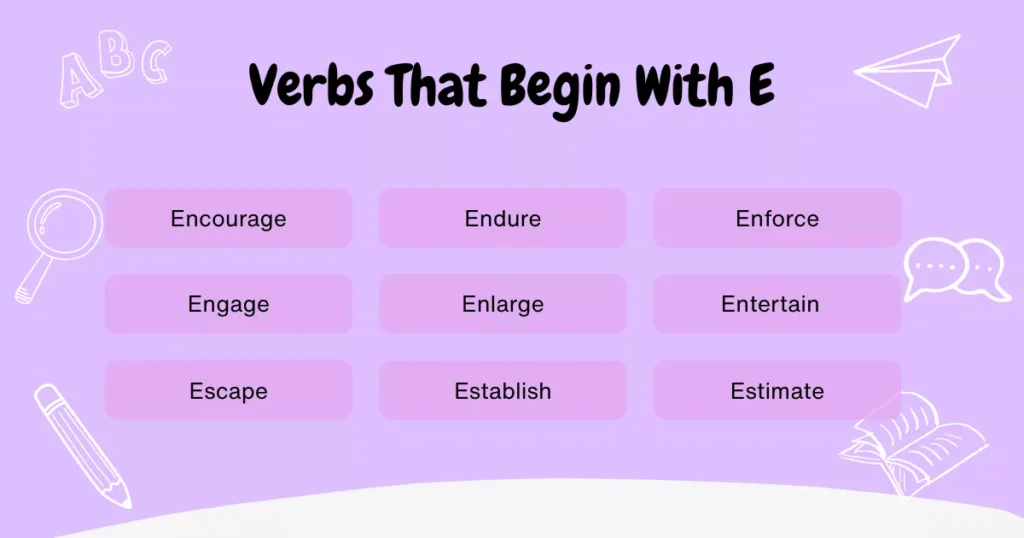
Verbs that start with the letter E are action or state words that help describe what someone does, feels, or experiences. These verbs range from simple everyday actions like eat, enter, and enjoy to more advanced words such as encourage, explain, and explore. Learning these verbs helps improve vocabulary, making speaking and writing clearer and more expressive. Many E verbs also carry positive or energetic meanings, helping people describe growth, movement, emotions, and ideas effectively. By understanding and practicing these verbs, learners can build stronger sentences and communicate their thoughts with greater confidence.
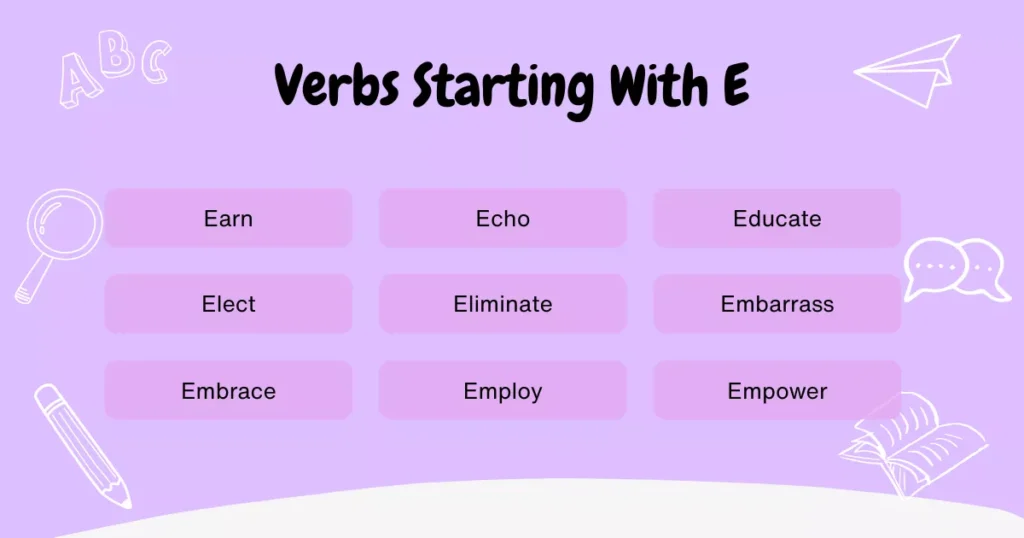
List of Common Verbs Starting With E
- Eat – to put food in the mouth and swallow it.
Example: She likes to eat fresh fruit every morning. - Enjoy – to take pleasure in something.
Example: I enjoy reading books before bed. - Enter – to go into a place.
Example: Please enter the room quietly. - Explain – to make something clear or easy to understand.
Example: The teacher will explain the lesson again. - Explore – to travel around and learn about something.
Example: The children love to explore the forest. - Encourage – to give support or confidence.
Example: Parents should encourage their children to try new things. - Express – to show thoughts or feelings.
Example: She likes to express her ideas through art. - Examine – to look at something carefully.
Example: The doctor will examine the patient. - Expand – to become larger or increase.
Example: The company plans to expand its business. - Educate – to teach or give knowledge.
Example: Schools educate students about science and history. - Edit – to correct or improve written work.
Example: He will edit the article before publishing. - Erase – to remove writing or marks.
Example: Please erase the mistake on the board. - Escape – to get free from a place or situation.
Example: The bird managed to escape from the cage. - Establish – to create or set up something.
Example: They plan to establish a new school. - Estimate – to guess the value or size of something.
Example: Can you estimate the total cost? - Exchange – to give something and receive another.
Example: They exchange gifts during the festival. - Encircle – to surround something.
Example: Tall trees encircle the lake. - Engage – to take part in something.
Example: Students should engage in class discussions. - Evaluate – to judge or assess something.
Example: The teacher will evaluate the project. - Execute – to carry out a plan or task.
Example: The team will execute the strategy carefully. - End – to finish something.
Example: The meeting will end at noon. - Enroll – to officially join a school or course.
Example: She decided to enroll in a language class. - Enhance – to improve something.
Example: Good lighting can enhance the room’s beauty. - Entertain – to amuse or provide enjoyment.
Example: The magician will entertain the audience. - Emerge – to come out or appear.
Example: The sun will emerge after the rain. - Embrace – to hug or accept something willingly.
Example: She embraced her friend warmly. - Employ – to give someone a job.
Example: The company employs many workers. - Encourage – to inspire confidence.
Example: Teachers encourage students to ask questions. - Evoke – to bring a feeling or memory.
Example: The song evokes childhood memories. - Exhibit – to show something publicly.
Example: The museum will exhibit ancient artifacts.
You May Also Like: Verbs That Start With B
Action Verbs That Start With E
- Eat – to consume food.
Example: We eat dinner at 7 p.m. - Enter – to go inside.
Example: They enter the building quickly. - Explore – to travel and discover.
Example: Scientists explore the ocean. - Examine – to inspect carefully.
Example: The mechanic examines the engine. - Engage – to participate actively.
Example: Students engage in group activities. - Escape – to break free.
Example: The prisoner tried to escape. - Erase – to remove writing.
Example: She erases the board after class. - Edit – to revise text.
Example: He edits videos for his channel. - Exchange – to swap items.
Example: They exchange ideas in meetings. - Expand – to grow bigger.
Example: The city continues to expand. - Exhale – to breathe out.
Example: Slowly exhale after breathing in. - Exert – to apply effort.
Example: Athletes exert great energy. - Execute – to perform a task.
Example: The manager executes the plan. - Engrave – to carve words or designs.
Example: The jeweler engraves the ring. - Extract – to pull something out.
Example: The dentist extracts the tooth. - Exhibit – to display something.
Example: Artists exhibit paintings in galleries. - Elevate – to lift up.
Example: The platform elevates the speaker. - Escort – to accompany someone.
Example: Guards escort the visitor. - Educate – to teach.
Example: Schools educate young minds. - Enclose – to surround or close off.
Example: A fence encloses the garden.
Positive and Motivational Verbs With E
- Encourage – to inspire confidence.
Example: Teachers encourage creativity. - Empower – to give strength or authority.
Example: Education empowers people. - Enrich – to improve quality or value.
Example: Reading enriches the mind. - Elevate – to raise or improve.
Example: Kind words elevate someone’s mood. - Enlighten – to give knowledge or insight.
Example: Books enlighten our thinking. - Embrace – to accept willingly.
Example: She embraced new opportunities. - Energize – to give energy.
Example: Music energizes the crowd. - Empathize – to understand others’ feelings.
Example: Good leaders empathize with people. - Enhance – to improve something.
Example: Practice enhances your skills. - Excite – to make someone enthusiastic.
Example: The news excited everyone. - Encircle – to support or surround positively.
Example: Friends encircle him with love. - Engage – to involve someone.
Example: Great teachers engage students. - Encourage – to motivate someone.
Example: Parents encourage hard work. - Endorse – to support something publicly.
Example: Experts endorse healthy habits. - Enable – to make something possible.
Example: Technology enables faster learning. - Evolve – to grow and develop.
Example: People evolve through experience. - Excel – to perform very well.
Example: She excels in mathematics. - Establish – to create something meaningful.
Example: They established a charity. - Encourage – to build confidence.
Example: Mentors encourage young talent. - Express – to share feelings clearly.
Example: Art helps people express emotions.
Regular and Irregular Verbs Starting With E
- Eat (Irregular) – to consume food.
Example: They eat dinner together. - Enter (Regular) – to go inside.
Example: Please enter the building. - Enjoy (Regular) – to feel pleasure.
Example: We enjoy music. - Explain (Regular) – to clarify something.
Example: The teacher explains the rule. - Explore (Regular) – to discover.
Example: Tourists explore new places. - Encourage (Regular) – to support someone.
Example: Friends encourage each other. - Escape (Regular) – to get free.
Example: The rabbit escaped quickly. - Erase (Regular) – to remove writing.
Example: She erased the board. - Edit (Regular) – to revise text.
Example: He edited the report. - Exchange (Regular) – to swap items.
Example: They exchange greetings. - Expand (Regular) – to grow bigger.
Example: The city expanded rapidly. - Employ (Regular) – to give work.
Example: The company employs many workers. - Encircle (Regular) – to surround.
Example: Trees encircle the park. - Engage (Regular) – to participate.
Example: Students engage in learning. - Evaluate (Regular) – to assess.
Example: The teacher evaluates essays. - Execute (Regular) – to carry out a plan.
Example: The team executed the project well. - Enhance (Regular) – to improve.
Example: Practice enhances ability. - Educate (Regular) – to teach.
Example: Schools educate children. - Establish (Regular) – to create.
Example: They established a company. - Entertain (Regular) – to amuse.
Example: The show entertains viewers. - Emerge (Regular) – to appear.
Example: The sun emerged from clouds. - Examine (Regular) – to inspect.
Example: The doctor examines patients. - Exhibit (Regular) – to display.
Example: The museum exhibits art. - Encourage (Regular) – to motivate.
Example: Coaches encourage players. - Elevate (Regular) – to lift up.
Example: The platform elevates the speaker. - End (Regular) – to finish.
Example: The class ended early. - Enroll (Regular) – to join officially.
Example: She enrolled in the course. - Enrich (Regular) – to improve quality.
Example: Travel enriches life. - Empower (Regular) – to give strength.
Example: Knowledge empowers people. - Evoke (Regular) – to bring a feeling.
Example: The smell evokes memories.
Phrasal Verbs That Start With E
| Verb | Meaning | Example |
|---|---|---|
| Eat out | to eat at a restaurant | We eat out every Saturday night. |
| Eat up | to finish all the food | Please eat up your vegetables. |
| Edge out | to defeat someone by a small margin | Our team edged out the competitors in the final round. |
| Egg on | to encourage someone to do something | His friends egged him on to try the challenge. |
| End up | to finally reach a result or situation | We ended up staying home due to the rain. |
| Enter into | to begin or become involved in something | The company entered into a partnership agreement. |
| Ease off | to reduce pressure or intensity | The rain will ease off later tonight. |
| Ease up | to become less strict or intense | The teacher eased up on homework this week. |
| Empty out | to remove everything from something | They emptied out the old storage room. |
| Embark on | to start an important activity or journey | She embarked on a new career. |
| End in | to result in something | The argument ended in laughter. |
| End with | to conclude with something | The meeting ended with a short speech. |
| Even out | to make something balanced or equal | The road evened out after the hill. |
| Eke out | to manage with limited resources | They eked out a living from farming. |
| Explain away | to give excuses to avoid blame | He tried to explain away the mistake. |
| Edge away | to slowly move away from something | The child edged away from the loud noise. |
| Ease into | to gradually begin something | She eased into her new role. |
| Ease back | to relax or reduce effort | The driver eased back on the speed. |
| End up with | to finally have something | We ended up with a great solution. |
| Enter upon | to start doing something formally | He entered upon his duties as manager. |
| Edge toward | to move slowly in a direction | The cat edged toward the door. |
| Egg away | to hide or store something secretly | They egged away their savings. |
| Eat away at | to gradually destroy or damage | Stress can eat away at your health. |
| Earmark for | to set aside for a purpose | The funds were earmarked for education. |
| Enter back into | to become involved again | She entered back into the competition. |
Professional, Academic, and Technical E Verbs
- Evaluate – to assess or judge something carefully.
Example: Researchers evaluate the results of experiments. - Examine – to study something closely.
Example: Scientists examine samples in the lab. - Establish – to set up or create something officially.
Example: The university established a new research center. - Execute – to carry out a plan or task.
Example: Engineers execute the design strategy. - Expand – to increase in size or scope.
Example: The company plans to expand internationally. - Enhance – to improve quality or value.
Example: Technology enhances productivity. - Eliminate – to remove something completely.
Example: The process eliminates unnecessary steps. - Estimate – to calculate an approximate value.
Example: Analysts estimate the project cost. - Exhibit – to display something publicly.
Example: The museum exhibits historical artifacts. - Enroll – to register officially.
Example: Students enroll in courses each semester. - Edit – to revise written material.
Example: Editors edit manuscripts carefully. - Educate – to teach or provide knowledge.
Example: Universities educate future professionals. - Engineer – to design or construct something.
Example: Experts engineer innovative solutions. - Experiment – to test ideas scientifically.
Example: Researchers experiment with new methods. - Encode – to convert information into a code.
Example: Computers encode data for security. - Extract – to obtain something from a source.
Example: Scientists extract DNA from samples. - Enforce – to ensure rules are followed.
Example: Authorities enforce safety regulations. - Extrapolate – to estimate unknown values from known data.
Example: Statisticians extrapolate trends. - Evaluate – to measure effectiveness.
Example: Teachers evaluate student performance. - Evolve – to develop gradually.
Example: Technology evolves rapidly. - Exceed – to go beyond a limit.
Example: Sales exceeded expectations. - Enumerate – to list items one by one.
Example: The report enumerates key findings. - Enclose – to surround or include something.
Example: The letter encloses additional documents. - Engage – to involve actively.
Example: Teachers engage students in discussion. - Endorse – to approve or support officially.
Example: Experts endorse the new policy.
You May Also Like: Verbs That Start With C
Emotional, Creative, and Descriptive E Verbs
- Express – to show feelings or ideas.
Example: She expressed her gratitude. - Embrace – to accept warmly.
Example: He embraced the new opportunity. - Encourage – to inspire confidence.
Example: Parents encourage their children. - Enrich – to improve quality or experience.
Example: Travel enriches life. - Envision – to imagine something clearly.
Example: She envisions a brighter future. - Enchant – to delight greatly.
Example: The music enchanted the audience. - Excite – to create enthusiasm.
Example: The announcement excited everyone. - Empathize – to understand others’ feelings.
Example: Good leaders empathize with people. - Energize – to give energy or vitality.
Example: Exercise energizes the body. - Elevate – to raise emotionally or spiritually.
Example: Kind words elevate someone’s spirit. - Enlighten – to give deeper understanding.
Example: Books enlighten readers. - Entertain – to amuse or engage.
Example: The comedian entertains the crowd. - Evoke – to bring a feeling or memory.
Example: The photo evokes nostalgia. - Encircle – to surround lovingly or protectively.
Example: Friends encircle him with support. - Exaggerate – to describe something as bigger than it is.
Example: He tends to exaggerate stories. - Emphasize – to give importance to something.
Example: The teacher emphasizes honesty. - Emerge – to appear gradually.
Example: A new idea emerged during discussion. - Engage – to attract interest.
Example: The story engages readers. - Exclaim – to speak suddenly with emotion.
Example: She exclaimed with joy. - Endear – to make someone loved.
Example: His kindness endears him to others. - Enthrall – to capture attention completely.
Example: The performance enthralled the audience. - Excite – to inspire passion.
Example: The idea excites young innovators. - Enfold – to wrap or embrace gently.
Example: The fog enfolded the valley. - Exalt – to praise highly.
Example: Fans exalt their heroes. - Evoke – to stir deep emotion.
Example: Poetry evokes powerful feelings.
Rare, Unique, and Advanced Verbs That Start With E
- Elicit – to draw out a response or reaction.
Example: The question elicited thoughtful answers. - Extrapolate – to estimate from known data.
Example: Scientists extrapolate trends from research. - Emulate – to imitate someone you admire.
Example: Young athletes emulate their idols. - Expedite – to speed up a process.
Example: Officials worked to expedite the approval. - Exonerate – to clear someone of blame.
Example: Evidence exonerated the suspect. - Extol – to praise highly.
Example: Critics extol the author’s talent. - Engender – to cause or bring about.
Example: Trust engenders cooperation. - Erode – to gradually wear away.
Example: Wind can erode rocks. - Enmesh – to trap or involve deeply.
Example: He became enmeshed in complex issues. - Expropriate – to take property for public use.
Example: The government expropriated land for a highway. - Emanate – to come out from a source.
Example: Warm light emanates from the lamp. - Embellish – to add decorative details.
Example: The writer embellished the story. - Ensnare – to trap or catch.
Example: The spider ensnares insects. - Evacuate – to move people from danger.
Example: Authorities evacuated the building. - Exacerbate – to make a problem worse.
Example: Stress can exacerbate health issues. - Enrapture – to fill with delight.
Example: The music enraptured listeners. - Expound – to explain in detail.
Example: The professor expounded the theory. - Exude – to give off a feeling or quality.
Example: She exudes confidence. - Exhort – to strongly encourage.
Example: Leaders exhort citizens to vote. - Envisage – to imagine or foresee.
Example: Experts envisage a brighter future. - Exculpate – to clear from blame.
Example: The report exculpated the employee. - Eulogize – to praise someone highly, often after death.
Example: Friends eulogized the great leader. - Enunciate – to pronounce words clearly.
Example: Speakers must enunciate carefully. - Evince – to reveal or show clearly.
Example: His actions evince dedication. - Exterminate – to destroy completely.
Example: Farmers tried to exterminate pests.
You May Also Like: Verbs That Start With D
Common Mistakes When Using E Verbs
- Confusing Similar Verbs
Some E verbs have similar meanings but are used differently, such as emigrate and immigrate or ensure, insure, and assure. Using the wrong one can change the meaning of your sentence.
Tip: Always check the context before choosing the verb. - Using the Wrong Verb Form
Learners sometimes forget irregular forms, especially with verbs like eat (eat–ate–eaten).
Incorrect: I have ate lunch.
Correct: I have eaten lunch. - Overusing Basic Verbs
Words like eat, enter, and enjoy are common, but using them too often can make writing repetitive.
Tip: Replace them with stronger verbs like explore, engage, or enhance when appropriate. - Incorrect Preposition with Phrasal Verbs
Many E verbs form phrasal verbs with specific prepositions, such as end up with, enter into, or eat away at. Using the wrong preposition can confuse readers.
Example: He ended up with a good result. - Misusing Formal and Informal Verbs
Some E verbs are more suitable for professional or academic writing (like evaluate or extrapolate), while others fit casual conversation better.
Tip: Choose verbs based on the tone of your writing.
Fun Facts About Verbs That Begin With E
- “Eat” Is One of the Oldest English Verbs
The verb eat comes from Old English etan and has been used for over a thousand years. - Many Positive Verbs Start with E
Words like encourage, empower, enrich, and elevate often carry uplifting meanings. - E Verbs Are Popular in Academic Writing
Verbs such as evaluate, examine, establish, and explain frequently appear in research papers and reports. - Some E Verbs Describe Growth and Change
Verbs like evolve, expand, and emerge are commonly used to talk about development and progress. - English Has Hundreds of E Verbs
From simple words like eat to advanced ones like extrapolate and exonerate, the letter E introduces a wide variety of expressive verbs.
FAQs
Conclusion
Verbs that start with the letter E play an important role in enriching English vocabulary and improving communication. From everyday action verbs like eat and enter to powerful academic words such as evaluate, establish, and extrapolate, these verbs help us describe actions, emotions, ideas, and processes with clarity. Learning different categories allows speakers and writers to express themselves more effectively. By understanding their meanings, practicing with example sentences, and avoiding common mistakes, you can confidently use E verbs in both casual conversation and professional writing. Expanding your knowledge of these verbs not only strengthens vocabulary but also makes language more engaging, expressive, and impactful.