
Verbs that start with the letter “I” play an important role in everyday English, helping us express actions, thoughts, emotions, and changes with clarity and style. From common words like improve and introduce to more expressive choices like inspire, illustrate, and innovate, these verbs can make both speaking and writing more engaging and precise. Whether you’re building basic communication skills or aiming for more advanced, academic language, learning “I” verbs is a simple way to expand your vocabulary and sound more confident.
Understanding Verbs That Start With Letter I
Verbs that start with the letter “I” are action or state words that help describe what someone does, feels, or experiences. These verbs can express a wide range of meanings, from physical actions like insert and inspect to mental processes like imagine and infer, and emotional or positive actions like inspire and impress. Learning these verbs helps improve sentence variety and makes communication more clear and engaging. By understanding their meanings and usage, you can use them confidently in speaking and writing, making your language more effective and expressive.
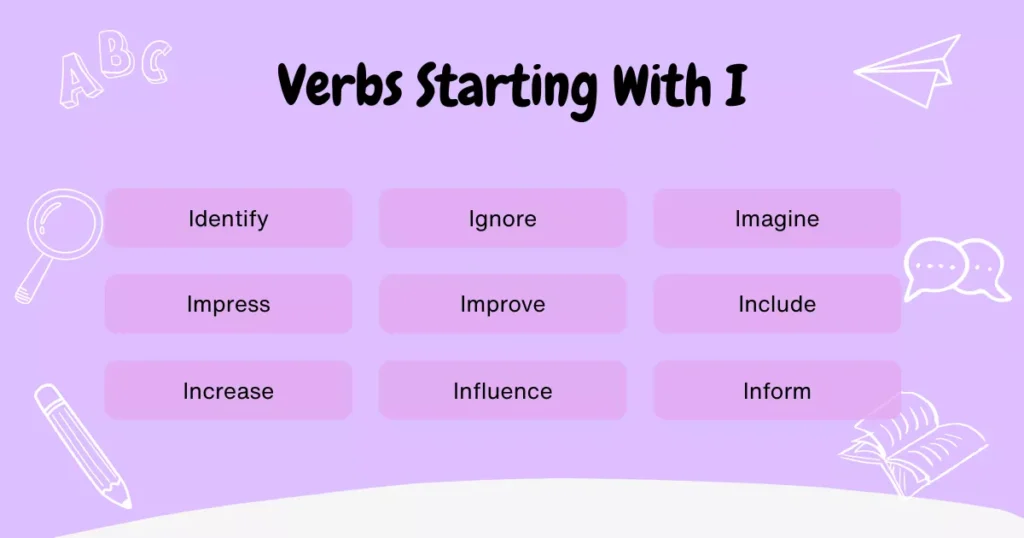
List of Common Verbs Starting With I
- Imagine – to form a picture in the mind
Example: I imagine a better future. - Improve – to make something better
Example: She wants to improve her English. - Introduce – to present someone/something
Example: He introduced me to his friend. - Include – to contain as part
Example: The price includes taxes. - Increase – to become greater
Example: Prices increased last year. - Inform – to give information
Example: Please inform me about the update. - Invite – to ask someone to come
Example: They invited us to dinner. - Inspect – to examine carefully
Example: The officer inspected the car. - Insert – to put something inside
Example: Insert the key into the lock. - Identify – to recognize
Example: She identified the problem quickly. - Ignore – to pay no attention
Example: He ignored my message. - Influence – to affect someone
Example: Parents influence their children. - Involve – to include or engage
Example: The job involves travel. - Invest – to put money or effort
Example: He invested in a business. - Inspire – to motivate
Example: Her story inspires me. - Impress – to make someone admire
Example: He impressed the teacher. - Indicate – to point out
Example: The sign indicates danger. - Interpret – to explain meaning
Example: She interpreted the message. - Interrupt – to stop someone speaking
Example: Don’t interrupt me. - Intend – to plan
Example: I intend to finish early. - Insist – to demand firmly
Example: She insisted on helping. - Injure – to hurt
Example: He injured his leg. - Inherit – to receive after death
Example: She inherited a house. - Invent – to create something new
Example: He invented a machine. - Illustrate – to explain with examples
Example: The teacher illustrated the idea. - Imitate – to copy
Example: Children imitate adults. - Install – to set up equipment
Example: They installed new software. - Investigation (Investigate) – to examine closely
Example: Police investigate the case. - Instruct – to teach or direct
Example: The coach instructed the players. - Interact – to communicate
Example: Students interact in class.
You May Also Like: Verbs That Start With F
Action Verbs That Start With I
- Insert – put inside
Example: Insert the card. - Inspect – check carefully
Example: He inspected the building. - Install – set up
Example: They installed a fan. - Ignite – set on fire
Example: The spark ignited the fuel. - Inject – put liquid into
Example: The doctor injected medicine. - Illustrate – explain visually
Example: She illustrated the story. - Imitate – copy
Example: He imitates his teacher. - Increase – raise
Example: They increased production. - Induce – cause
Example: The drug induced sleep. - Inflate – fill with air
Example: Inflate the balloon. - Influence – affect
Example: Friends influence behavior. - Inform – tell
Example: Inform the manager. - Initiate – start
Example: They initiated the project. - Interrupt – stop
Example: Don’t interrupt him. - Interfere – disturb
Example: Noise interferes with work. - Interpret – explain
Example: He interpreted the law. - Investigate – examine
Example: Police investigate crimes. - Invite – ask
Example: Invite your friends. - Involve – include
Example: The task involves teamwork. - Instruct – guide
Example: The teacher instructs students.
Positive and Motivational Verbs With I
- Inspire – motivate
Example: Great leaders inspire others. - Improve – get better
Example: Keep practicing to improve. - Innovate – create new ideas
Example: Companies innovate to grow. - Encourage (Inspire context) – support
Example: Teachers inspire students. - Illuminate – bring clarity
Example: Books illuminate the mind. - Invigorate – energize
Example: Exercise invigorates the body. - Influence – impact positively
Example: Good habits influence success. - Include – make part of
Example: Include everyone in activities. - Invest – commit effort
Example: Invest in your future. - Initiate – begin something good
Example: She initiated a charity. - Integrate – combine smoothly
Example: Integrate new ideas. - Intensify – strengthen
Example: Intensify your efforts. - Involve – engage
Example: Involve yourself in learning. - Instruct – teach
Example: Good mentors instruct clearly. - Impress – create positive impact
Example: Work hard to impress. - Interpret – understand deeply
Example: Interpret ideas carefully. - Identify – recognize potential
Example: Identify your strengths. - Imagine – think creatively
Example: Imagine big goals. - Indicate – show direction
Example: Signs indicate progress. - Inherit – receive positively
Example: She inherited strong values.
Regular and Irregular Verbs Starting With I
- Imagine – imagined
Example: I imagined the scene. - Improve – improved
Example: He improved his skills. - Invite – invited
Example: She invited me. - Inform – informed
Example: They informed us. - Inspect – inspected
Example: The officer inspected it. - Insert – inserted
Example: He inserted the card. - Influence – influenced
Example: Friends influenced him. - Involve – involved
Example: She involved everyone. - Invest – invested
Example: He invested money. - Impress – impressed
Example: She impressed them. - Indicate – indicated
Example: The sign indicated danger. - Interrupt – interrupted
Example: He interrupted me. - Intend – intended
Example: I intended to go. - Insist – insisted
Example: She insisted. - Invent – invented
Example: He invented a tool. - Input – input / inputted
Example: She input the data. - Inlay – inlaid
Example: The artist inlaid the wood. - Inset – inset
Example: The stone was inset. - Interweave – interwove / interwoven
Example: Threads interwove beautifully. - Interbreed – interbred
Example: The species interbred. - Interlink (sometimes regular) – interlinked
Example: The systems interlinked. - Indwell – indwelt
Example: The spirit indwelt him. - Inbreed – inbred
Example: The animals inbred. - Input (alt form) – inputted
Example: Data was inputted. - Inhold – inheld (rare)
Example: He inheld the breath. - Ingo – ingone (rare)
Example: The energy ingone. - Intercut – intercut
Example: Scenes intercut quickly. - Incast – incast
Example: The mold was incast. - Inset (repeat form) – inset
Example: Gems inset in gold. - Inwind – inwound
Example: The thread inwound tightly.
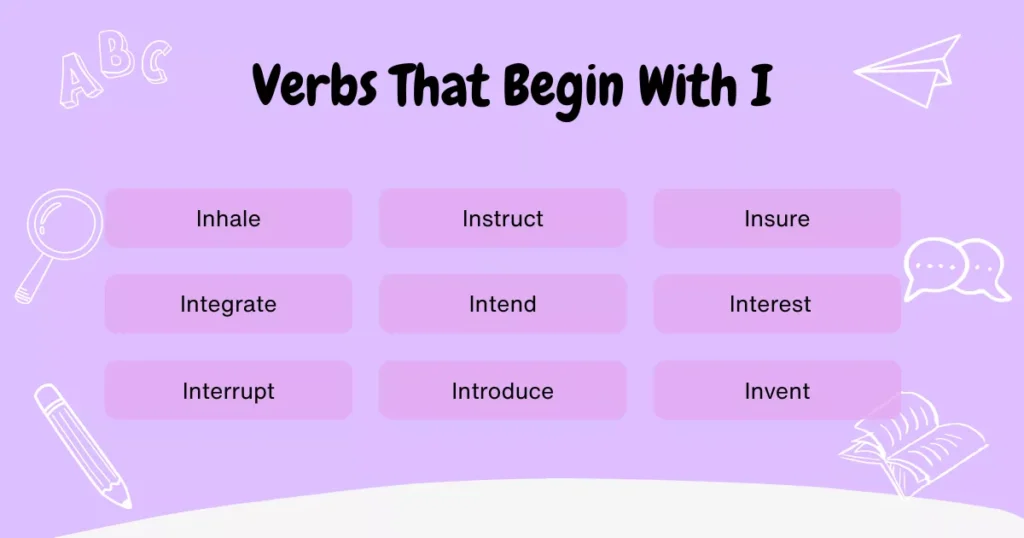
Phrasal Verbs That Start With I
| Verb | Meaning | Example |
|---|---|---|
| Ice up | to freeze or become very cold | The road iced up overnight. |
| Idle away | to waste time lazily | He idled away the afternoon. |
| Iron out | to resolve a problem | They ironed out their differences. |
| Invite in | to ask someone to enter | She invited me in for tea. |
| Invite over | to ask someone to your home | We invited them over for dinner. |
| Impose on | to take unfair advantage | I don’t want to impose on you. |
| Involve in | to include someone | She involved me in the project. |
| Interfere with | to disturb or interrupt | Noise interferes with my work. |
| Interfere in | to get involved unnecessarily | Don’t interfere in their matters. |
| Insist on | to demand something | He insisted on paying. |
| Invest in | to put money/time into | She invests in stocks. |
| Improve on | to make something better than before | This version improves on the last one. |
| Inform on | to report someone secretly | He informed on his colleague. |
| Identify with | to relate to | I identify with her story. |
| Include in | to make part of | Include me in the plan. |
| Indulge in | to enjoy something freely | He indulged in sweets. |
| Inquire about | to ask for information | She inquired about the course. |
| Inquire into | to investigate | They inquired into the issue. |
| Insist upon | to strongly demand | She insisted upon honesty. |
| Invite along | to ask someone to join | He invited me along. |
| Ink in | to fill something with ink | Please ink in the form. |
| Ink over | to cover with ink | He inked over the mistake. |
| Inhale in | to breathe in deeply | Inhale in slowly. |
| Inject into | to put into something | The nurse injected medicine into his arm. |
| Immerse in | to involve deeply | She immersed herself in study. |
You May Also Like: Verbs That Start With G
Professional, Academic, and Technical I Verbs
- Implement – to put into action
Example: The company implemented a new system. - Interpret – to explain meaning
Example: Scientists interpret the data. - Investigate – to examine carefully
Example: The team investigates the issue. - Integrate – to combine into a whole
Example: Schools integrate technology. - Innovate – to introduce new ideas
Example: Businesses innovate to stay competitive. - Indicate – to show or point out
Example: Results indicate growth. - Infer – to conclude from evidence
Example: We infer meaning from context. - Illustrate – to explain with examples
Example: The graph illustrates trends. - Initiate – to begin
Example: They initiated the project. - Incorporate – to include
Example: The design incorporates new features. - Inspect – to examine
Example: Engineers inspect the structure. - Install – to set up
Example: Technicians install software. - Influence – to affect
Example: Data influences decisions. - Index – to organize systematically
Example: The book is indexed properly. - Input – to enter data
Example: Please input the values. - Interface – to interact between systems
Example: Devices interface smoothly. - Intervene – to step in
Example: The manager intervened. - Isolate – to separate
Example: Scientists isolate variables. - Identify – to recognize
Example: Identify the problem. - Instruct – to direct or teach
Example: The guide instructs users. - Iterate – to repeat a process
Example: Developers iterate designs. - Imply – to suggest indirectly
Example: His words imply doubt. - Interconnect – to link together
Example: Systems interconnect globally. - Invalidate – to make invalid
Example: Errors invalidate results. - Inventory – to list items
Example: They inventory all equipment.
Emotional, Creative, and Descriptive I Verbs
- Inspire – to motivate
Example: Her story inspires me. - Imagine – to create in the mind
Example: Imagine a peaceful world. - Impress – to create admiration
Example: He impressed the audience. - Influence – to affect feelings
Example: Music influences mood. - Ignite – to spark emotion
Example: The speech ignited hope. - Illuminate – to enlighten
Example: Books illuminate minds. - Invigorate – to energize
Example: Fresh air invigorates me. - Indulge – to enjoy freely
Example: She indulged in art. - Intensify – to make stronger
Example: The storm intensified. - Involve – to engage emotionally
Example: The story involves readers. - Imitate – to copy creatively
Example: He imitates voices. - Innovate – to create new ideas
Example: Artists innovate constantly. - Interpret – to express meaning
Example: She interprets poetry. - Incorporate – to blend ideas
Example: He incorporates colors. - Idealize – to see as perfect
Example: She idealizes her hero. - Internalize – to absorb deeply
Example: He internalized the lesson. - Identify – to relate emotionally
Example: I identify with the character. - Immerse – to deeply involve
Example: She immersed herself in music. - Infuse – to fill with feeling
Example: The song infuses joy. - Inhabit – to live within
Example: Characters inhabit the story. - Illustrate – to show vividly
Example: The artist illustrates emotions. - Inspire upon – to influence deeply
Example: His words inspired upon many. - Instill – to gradually introduce
Example: Teachers instill values. - Intuit – to understand instinctively
Example: She intuits feelings. - Imbue – to fill with qualities
Example: The story is imbued with emotion.
Rare, Unique, and Advanced Verbs That Start With I
- Imbibe – to absorb
Example: He imbibed knowledge quickly. - Imbricate – to overlap
Example: Tiles imbricate neatly. - Immolate – to sacrifice
Example: He immolated his desires. - Imprecate – to curse
Example: She imprecated loudly. - Impugn – to challenge truth
Example: He impugned the claim. - Inveigh – to speak strongly against
Example: She inveighed against injustice. - Incise – to cut into
Example: The surgeon incised the skin. - Indurate – to harden
Example: The soil indurated. - Inhere – to exist within
Example: Rights inhere in people. - Inculcate – to teach firmly
Example: Parents inculcate values. - Intone – to speak in a tone
Example: He intoned the prayer. - Interject – to interrupt
Example: She interjected suddenly. - Inveigle – to persuade cleverly
Example: He inveigled them into helping. - Inscribe – to write or carve
Example: The name was inscribed. - Inundate – to flood
Example: Messages inundated her. - Inveterate – to make habitual (rare verb use)
Example: Habits become inveterate. - Infract – to break a rule
Example: He infracted the law. - Intercalate – to insert between
Example: Pages were intercalated. - Inspissate – to thicken
Example: The liquid inspissated. - Inthrall – to captivate
Example: The story enthralled us. - Intromit – to admit
Example: He was intromitted. - Inactivate – to make inactive
Example: The drug inactivates enzymes. - Incarnate – to embody
Example: She incarnates kindness. - Interlope – to intrude
Example: Outsiders interloped. - Incept – to begin (rare)
Example: The project incepted last year.
You May Also Like: Verbs That Start With H
Common Mistakes When Using I Verbs
- Confusing similar meanings (Imply vs. Infer)
Many learners mix these up. Imply means to suggest something, while infer means to understand or conclude.
Example: He implied the answer, but I inferred it. - Using the wrong preposition with phrasal verbs
Some “I” verbs need specific prepositions.
Mistake: Insist to go
Correct: Insist on going - Incorrect verb forms (regular vs. irregular)
Some verbs don’t follow standard patterns.
Mistake: He inputted the data yesterday (less common in formal English)
Correct: He input the data yesterday - Overusing common verbs like “improve” or “increase”
Repeating the same verbs can make writing dull. Try variety like enhance, boost, or expand. - Misusing formal verbs in casual contexts
Some verbs like initiate or implement sound too formal in everyday conversation.
Tip: Use start instead of initiate in casual speech.
Fun Facts About Verbs That Begin With I
- “Inspire” comes from Latin
It originally meant “to breathe into,” showing how language connects to deep ideas. - Many “I” verbs show change or growth
Words like increase, improve, and innovate are all about progress. - “I” verbs are common in academic English
Words like interpret, indicate, and infer are widely used in essays and research. - Some “I” verbs have multiple meanings
For example, introduce can mean presenting a person or bringing in a new idea. - “I” verbs often sound formal and powerful
Words like implement and integrate can make writing sound more professional.
FAQs
Conclusion
Verbs that start with the letter “I” are powerful tools that can greatly improve your English. From everyday words like improve and invite to more advanced ones like interpret and innovate, these verbs help you express actions, ideas, and emotions more clearly. By learning and practicing them, you can make your speaking more natural and your writing more engaging and professional. The key is not just to memorize these verbs but to understand how and when to use them correctly. With regular practice, you’ll be able to use “I” verbs confidently in conversations, academic work, and creative writing.