Verbs are the driving force of language, helping us express actions, thoughts, and connections in clear and meaningful ways. While some letters offer a wide range of verbs, the letter “Q” presents a smaller but uniquely powerful collection. These verbs may be less common, but they add precision, creativity, and depth to both speaking and writing. From simple, beginner-friendly words to more expressive and advanced ones, verbs that start with “Q” can describe movement, emotions, and changes in a vivid way. Exploring them not only strengthens vocabulary but also builds confidence in communication.
Understanding Verbs That Start With Letter Q
Understanding verbs that start with the letter “Q” helps learners explore a unique and less common part of the English language. These verbs may not appear as frequently as others, but they are still important for expressing actions, changes, and ideas clearly. Words like quicken, question, and quit show how Q verbs can describe movement, thinking, and decisions. Learning them improves vocabulary, supports better sentence formation, and makes communication more interesting. By practicing these verbs in everyday sentences, learners can gain confidence and develop a richer, more expressive way of speaking and writing.
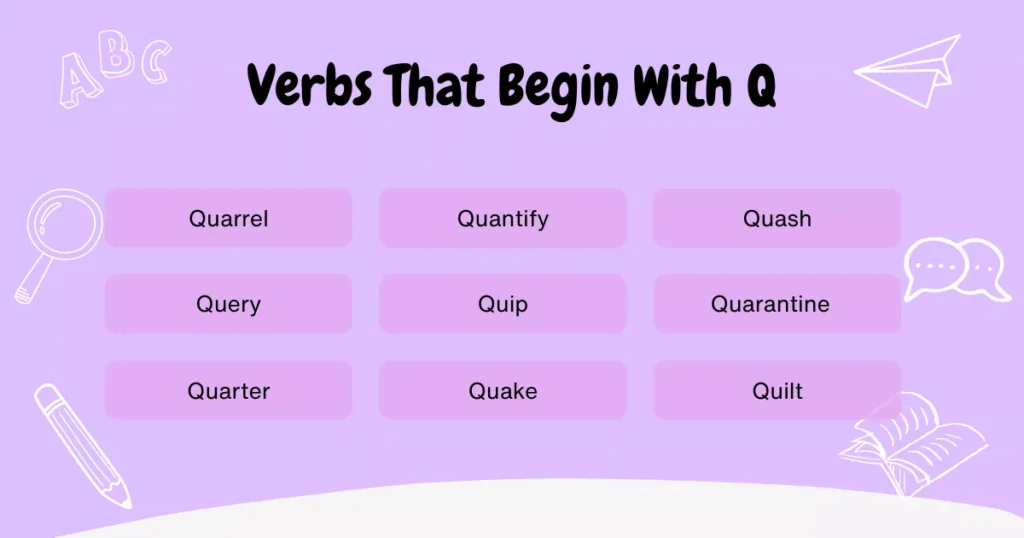
List of Common Verbs Starting With Q
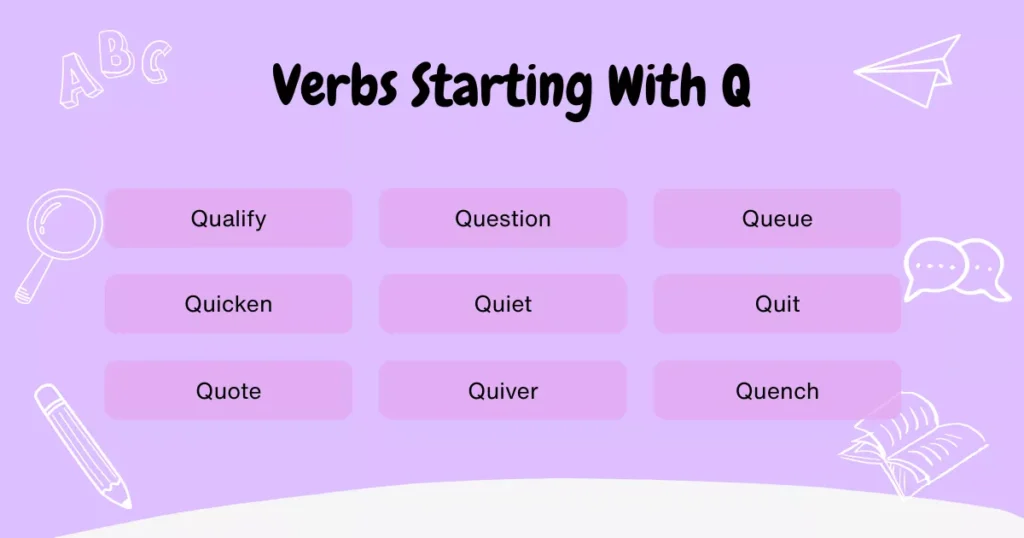
- Quack – to make a duck sound
Example: The duck quacked loudly. - Quail – to feel afraid or shrink back
Example: He quailed at the loud noise. - Quake – to shake or tremble
Example: The ground quaked during the storm. - Qualify – to meet requirements
Example: She qualified for the final round. - Quantify – to measure or express in numbers
Example: Scientists quantify the results carefully. - Quarrel – to argue
Example: They quarreled over money. - Quarry – to dig or extract stone
Example: Workers quarry marble from the hill. - Quarter – to divide into four parts
Example: She quartered the apple. - Quash – to suppress or stop
Example: The police quashed the protest. - Question – to ask or doubt
Example: He questioned the decision. - Queue – to stand in line
Example: People queued outside the shop. - Quicken – to make faster
Example: The pace quickened suddenly. - Quiet – to make calm or silent
Example: She quieted the crying baby. - Quit – to leave or stop
Example: He quit his job. - Quiz – to test knowledge
Example: The teacher quizzed the students. - Quote – to repeat someone’s words
Example: She quoted a famous author. - Quench – to satisfy thirst or stop fire
Example: Water quenched the flames. - Query – to ask a question
Example: He queried the result. - Quibble – to argue over small details
Example: They quibbled about minor issues. - Quiver – to shake slightly
Example: Her hands quivered in fear. - Quotient – (rare verb use) to calculate division
Example: The system quotients the values. - Quarantine – to isolate for safety
Example: They quarantined the patient. - Quickstep – to dance quickly
Example: They quickstepped across the floor. - Quirk – to twist or behave oddly
Example: His lips quirked into a smile. - Quieten – to become calm
Example: The crowd quietened after a while. - Quip – to make a witty remark
Example: He quipped humorously. - Quicken up – to speed up
Example: Please quicken up your work. - Quitclaim – to give up a legal claim
Example: He quitclaimed the property. - Quoit – to throw a ring (game)
Example: They quoited in the garden. - Quaver – to shake or tremble in voice
Example: Her voice quavered with emotion.
You May Also Like: Verbs That Start With N
Action Verbs That Start With Q
- Quack – to make a sound
Example: The duck quacked. - Quaff – to drink quickly
Example: He quaffed water. - Quake – to shake
Example: The building quaked. - Quarrel – to argue
Example: They quarreled loudly. - Quash – to stop
Example: The law quashed the protest. - Question – to ask
Example: She questioned him. - Queue – to line up
Example: We queued for tickets. - Quicken – to speed up
Example: He quickened his steps. - Quiet – to calm
Example: She quieted the class. - Quit – to stop
Example: He quit smoking. - Quip – to remark
Example: She quipped smartly. - Quiver – to tremble
Example: Leaves quivered in the wind. - Quench – to satisfy
Example: Water quenched his thirst. - Quell – to suppress
Example: They quelled the rebellion. - Query – to ask
Example: He queried the data. - Quote – to repeat
Example: She quoted a poem. - Quarantine – to isolate
Example: Officials quarantined the area. - Quibble – to argue
Example: They quibbled over price. - Quilt – to sew
Example: She quilted carefully. - Quick-freeze – to freeze fast
Example: They quick-froze the food.
Positive and Motivational Verbs With Q
- Qualify – to become capable
Example: She qualified for the finals. - Quicken – to increase speed or excitement
Example: His progress quickened. - Quench (desire to learn) – to satisfy curiosity
Example: Books quench her thirst for knowledge. - Quest – to search for something meaningful
Example: He quests for success. - Question (to learn) – to seek understanding
Example: Students question to grow. - Quote (inspire) – to share wise words
Example: She quoted inspiring lines. - Qualify (skills) – to improve abilities
Example: Training qualified him for the job. - Quicken (growth) – to develop faster
Example: Practice quickens learning. - Quell (fear) – to overcome fear
Example: He quelled his doubts. - Quench (motivation) – to fulfill ambition
Example: Hard work quenches ambition. - Quest (dreams) – to pursue goals
Example: She quests for excellence. - Question (ideas) – to think deeply
Example: Great minds question everything. - Quote (motivate) – to encourage others
Example: He quoted a powerful speech. - Qualify (achieve) – to earn success
Example: She qualified through effort. - Quicken (progress) – to move forward faster
Example: Discipline quickens success. - Quell (negativity) – to remove doubts
Example: Stay positive and quell fear. - Quench (curiosity) – to learn more
Example: Reading quenches curiosity. - Quest (knowledge) – to seek wisdom
Example: He quests for knowledge daily. - Question (challenge) – to challenge thinking
Example: Innovators question limits. - Qualify (improve) – to become better
Example: Practice qualifies you for success.
Regular and Irregular Verbs Starting With Q
- Quack – quacked – quacked
Example: The duck quacked loudly. - Quail – quailed – quailed
Example: He quailed in fear. - Quake – quaked – quaked
Example: The earth quaked. - Qualify – qualified – qualified
Example: She qualified easily. - Quantify – quantified – quantified
Example: They quantified the data. - Quarrel – quarreled – quarreled
Example: They quarreled often. - Quarter – quartered – quartered
Example: He quartered the fruit. - Quash – quashed – quashed
Example: The rumor was quashed. - Question – questioned – questioned
Example: She questioned him. - Queue – queued – queued
Example: They queued outside. - Quicken – quickened – quickened
Example: The pace quickened. - Quiet – quieted – quieted
Example: She quieted the baby. - Quiz – quizzed – quizzed
Example: The teacher quizzed us. - Quote – quoted – quoted
Example: He quoted a poem. - Quench – quenched – quenched
Example: Water quenched the fire. - Query – queried – queried
Example: She queried the result. - Quibble – quibbled – quibbled
Example: They quibbled over details. - Quiver – quivered – quivered
Example: His hands quivered. - Quarantine – quarantined – quarantined
Example: They quarantined the patient. - Quip – quipped – quipped
Example: He quipped humorously. - Quaver – quavered – quavered
Example: Her voice quavered. - Quit – quit – quit
Example: He quit the game. - Quieten – quietened – quietened
Example: The room quietened. - Quickstep – quickstepped – quickstepped
Example: They quickstepped gracefully. - Quest – quested – quested
Example: They quested for truth. - Quirk – quirked – quirked
Example: He quirked a smile. - Quoit – quoited – quoited
Example: They quoited in the yard. - Quitclaim – quitclaimed – quitclaimed
Example: He quitclaimed the land. - Quicken up – quickened up – quickened up
Example: She quickened up her pace. - Query again – queried – queried
Example: He queried again politely.
Phrasal Verbs That Start With Q
| Verb | Meaning | Example |
|---|---|---|
| Queue up | to form a line | People queued up outside the cinema. |
| Quieten down | to become calm or silent | The class quietened down after the bell. |
| Quicken up | to speed up | You need to quicken up your pace. |
| Quit on | to stop supporting someone | Don’t quit on your dreams. |
| Quit on someone | to abandon | He never quits on his team. |
| Quit out (of) | to leave suddenly | She quit out of the project. |
| Quarrel with | to argue with someone | He quarreled with his friend. |
| Quarrel over | to argue about something | They quarreled over money. |
| Question about | to ask about something | She questioned him about the issue. |
| Question on | to ask questions on a topic | The teacher questioned us on grammar. |
| Query about | to ask for information | He queried about the fees. |
| Query on | to raise a question | She queried on the results. |
| Quibble about | to argue over small things | They quibbled about minor details. |
| Quench with | to satisfy using something | He quenched his thirst with water. |
| Quench by | to put out | The fire was quenched by rain. |
| Quiet down | to become less noisy | Please quiet down. |
| Quieten up | to make less noisy | The teacher quietened up the class. |
| Quickstep through | to move quickly through | She quickstepped through the task. |
| Quit off | to stop doing something | He quit off smoking. |
| Quit from | to resign from | She quit from her job. |
| Quarrel back | to respond with anger | He quarreled back loudly. |
| Queue for | to wait in line for something | They queued for tickets. |
| Queue into | to move into a line | People queued into the hall. |
| Question over | to doubt something | They questioned over the decision. |
| Quieten into | to become calm gradually | The noise quietened into silence. |
You May Also Like: Verbs That Start With O
Professional, Academic, and Technical Q Verbs
- Qualify – to meet standards
Example: She qualified for the scholarship. - Quantify – to measure in numbers
Example: Researchers quantify the data. - Query – to ask questions
Example: The manager queried the report. - Question – to examine critically
Example: Scientists question assumptions. - Quote – to cite information
Example: He quoted a reliable source. - Quarantine – to isolate
Example: Doctors quarantined the patient. - Quash – to suppress legally
Example: The court quashed the order. - Queue – to organize in order
Example: Requests are queued automatically. - Quicken – to accelerate a process
Example: The update quickens performance. - Quiet – to reduce noise or disturbance
Example: The system quiets background noise. - Quarter – to divide into parts
Example: The data was quartered for analysis. - Quarry – to extract resources
Example: They quarry minerals for industry. - Quotient – to calculate division
Example: The program quotients the values. - Query-run – to execute a database query
Example: The system query-runs the command. - Quick-freeze – to freeze rapidly
Example: Food is quick-frozen for storage. - Quicken up – to speed workflow
Example: Automation quickens up processes. - Quality-check – to inspect quality
Example: Engineers quality-check products. - Quantize – to convert into discrete units
Example: Signals are quantized digitally. - Queue-process – to handle tasks in order
Example: The server queue-processes requests. - Query-optimize – to improve queries
Example: Developers query-optimize databases. - Quota-set – to assign limits
Example: Managers quota-set targets. - Quick-calculate – to compute fast
Example: The software quick-calculates results. - Question-test – to evaluate knowledge
Example: Teachers question-test students. - Quasi-analyze – to partially analyze
Example: Researchers quasi-analyze trends. - Quality-assure – to ensure standards
Example: Teams quality-assure production.
Emotional, Creative, and Descriptive Q Verbs
- Quiver – to shake with emotion
Example: Her voice quivered with joy. - Quail – to shrink in fear
Example: He quailed at the thought. - Quench – to satisfy deeply
Example: Reading quenches my curiosity. - Quicken – to stir emotions
Example: The music quickened her heart. - Quiet – to calm feelings
Example: Nature quiets the mind. - Quieten – to become peaceful
Example: The night quietened the city. - Quip – to speak playfully
Example: He quipped with humor. - Quaver – to tremble emotionally
Example: Her voice quavered with excitement. - Quest – to seek passionately
Example: She quests for meaning. - Question – to reflect deeply
Example: He questioned his choices. - Quarry (figurative) – to search deeply
Example: Writers quarry ideas from life. - Quirk – to show unusual behavior
Example: He quirks a smile. - Quickstep – to move lightly and joyfully
Example: They quickstepped happily. - Quicken up – to become lively
Example: The party quickened up. - Quench longing – to satisfy desire
Example: Travel quenches her longing. - Quiet down – to calm emotions
Example: She quieted down after crying. - Quibble – to fuss emotionally
Example: They quibbled over nothing. - Quake – to tremble with feeling
Example: He quaked with fear. - Quiver up – to tremble suddenly
Example: She quivered up in excitement. - Quieten heart – to calm inner feelings
Example: Prayer quietens the heart. - Quest forward – to keep searching
Example: He quests forward bravely. - Quench pain – to ease suffering
Example: Kind words quenched her pain. - Quicken pulse – to increase excitement
Example: The story quickened his pulse. - Quiet thoughts – to reduce stress
Example: Meditation quiets thoughts. - Quirk up – to brighten expression
Example: She quirks up when happy.
Rare, Unique, and Advanced Verbs That Start With Q
- Quaff – to drink deeply
Example: He quaffed the juice. - Quail – to lose courage
Example: She quailed under pressure. - Quarrel – to argue
Example: They quarreled bitterly. - Quash – to suppress completely
Example: The rumor was quashed. - Quell – to calm or put down
Example: Police quelled the unrest. - Quicken – to revive or speed up
Example: The news quickened interest. - Quiesce – to become quiet
Example: The system quiesced after shutdown. - Quiesce down – to settle
Example: The noise quiesced down. - Quiver – to tremble slightly
Example: Leaves quivered in the wind. - Quixotify – to make idealistic
Example: The story quixotifies reality. - Quixotize – to act romantically idealistic
Example: He quixotized the situation. - Quotient – to divide mathematically
Example: The tool quotients values. - Quod (slang) – to imprison
Example: He was quod for theft. - Quirk – to twist expression
Example: His lips quirked upward. - Quieten – to make silent
Example: The wind quietened. - Quaver – to tremble in sound
Example: Her voice quavered. - Quibble – to argue trivially
Example: They quibbled endlessly. - Quench – to extinguish
Example: Water quenched the fire. - Quest – to search
Example: They quest for truth. - Quarantine – to isolate
Example: Ships were quarantined. - Quickstep – to dance lightly
Example: They quickstepped elegantly. - Quarry – to extract or seek
Example: He quarried knowledge. - Quicken life – to bring vitality
Example: Art quickens life. - Quell fear – to calm fear
Example: She quelled her anxiety. - Quirk away – to twist away
Example: He quirked away from the crowd.
You May Also Like: Verbs That Start With P
Common Mistakes When Using Q Verbs
- Confusing similar meanings (Quell vs. Quench)
Many learners mix up quell (to calm or suppress emotions or unrest) and quench (to satisfy thirst or stop fire).
Incorrect: He quenched the protest.
Correct: He quelled the protest. - Using incorrect verb forms
Some Q verbs, like quit, are irregular and don’t change in past tense.
Incorrect: She quitted her job.
Correct: She quit her job. - Overusing rare verbs in simple contexts
Using advanced verbs like quixotize in everyday conversation can sound unnatural.
Better: Use simple verbs unless the context fits. - Wrong preposition usage in phrasal verbs
Learners often misuse prepositions with Q verbs.
Incorrect: He quarreled to his friend.
Correct: He quarreled with his friend. - Misunderstanding tone and context
Some Q verbs carry strong or formal tones (quash, quarantine), and using them casually can feel odd.
Tip: Match the verb with the situation.
Fun Facts About Verbs That Begin With Q
- Q verbs are rare but powerful
Compared to other letters, “Q” has far fewer verbs, making them unique and memorable. - Most Q verbs are followed by “u”
Almost every Q verb in English begins with “qu,” which gives them a distinct sound and pattern. - Many Q verbs have Latin origins
Words like qualify, quantify, and question come from Latin, showing their academic roots. - Some Q words can act as both nouns and verbs
Words like question, queue, and quarantine can be used in multiple ways. - Q verbs often sound formal or expressive
Verbs like quell, quash, and quiver add drama, emotion, and precision to language.
FAQs
Conclusion
Verbs that start with the letter “Q” may be fewer in number, but they offer a rich and meaningful addition to your English vocabulary. From everyday verbs like quit and question to more expressive ones like quell and quiver, these words help describe actions, emotions, and ideas with clarity and depth. Learning and practicing Q verbs not only improves your speaking and writing skills but also makes your language more engaging and unique. Whether you’re a student, teacher, or language enthusiast, mastering these verbs is a small step that can make a big difference in communication.