

Exploring verbs that start with the letter “D” is a simple yet powerful way to expand your English vocabulary and make your communication more lively and expressive. Verbs are the heart of every sentence, so learning a variety of “D” verbs like do, drive, develop, and discover can instantly improve both speaking and writing skills. Whether you’re a student, a parent teaching kids, or someone preparing for word games like Scrabble, these verbs offer a mix of everyday usefulness and creative expression.
Understanding Verbs That Start With Letter D
Verbs that start with the letter “D” are action words that describe what someone or something does, feels, or becomes. These verbs range from simple everyday actions like do, draw, and dance to more advanced words like develop, decide, and demonstrate. Learning “D” verbs helps improve sentence building, adds variety to speech and writing, and makes communication clearer and more engaging. Whether used in daily conversation, storytelling, or academic writing, these verbs play an important role in expressing ideas effectively.
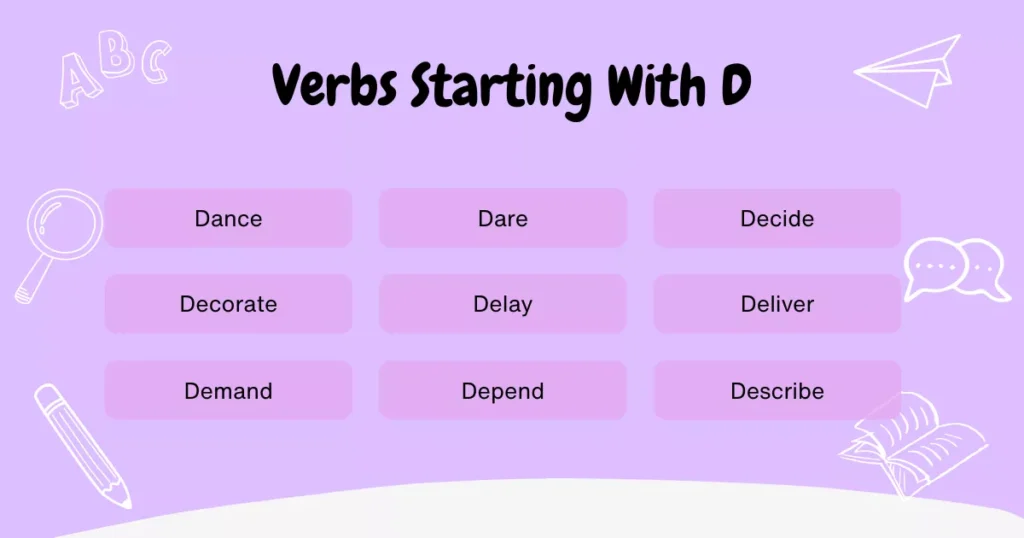
List of Common Verbs Starting With D
- Do – to perform an action
Example: I will do my homework now. - Drive – to control a vehicle
Example: She drives to work daily. - Dance – to move rhythmically to music
Example: They danced at the party. - Draw – to create a picture
Example: He draws beautiful sketches. - Drink – to consume liquid
Example: I drink water every hour. - Drop – to let something fall
Example: She dropped her phone. - Decide – to make a choice
Example: We decided to travel. - Deliver – to bring something to someone
Example: The courier delivers packages. - Develop – to grow or improve
Example: She developed new skills. - Describe – to explain something
Example: He described the scene clearly. - Discover – to find something new
Example: Scientists discovered a new planet. - Demand – to ask firmly
Example: They demanded justice. - Destroy – to ruin completely
Example: The storm destroyed houses. - Discuss – to talk about something
Example: We discussed the plan. - Divide – to separate into parts
Example: Divide the cake equally. - Depend – to rely on
Example: Success depends on effort. - Deny – to refuse or reject
Example: He denied the accusation. - Dig – to break ground
Example: They dig holes for planting. - Deal – to handle a situation
Example: She deals with problems calmly. - Design – to plan or create
Example: He designs websites. - Delay – to postpone
Example: The train was delayed. - Direct – to guide or control
Example: She directs the team well. - Dress – to wear clothes
Example: Dress warmly in winter. - Doubt – to feel uncertain
Example: I doubt his story. - Dare – to have courage
Example: He dared to speak up. - Drag – to pull along
Example: She dragged the bag. - Defend – to protect
Example: Soldiers defend the country. - Declare – to announce
Example: They declared the results. - Detach – to separate
Example: Detach the cover carefully. - Dislike – to not like
Example: I dislike loud noise.
You May Also Like: Verbs That Start With A
Action Verbs That Start With D
- Dash – to run quickly
Example: He dashed across the street. - Dive – to jump into water
Example: She dived into the pool. - Drag – to pull something
Example: They dragged the box. - Drill – to make a hole
Example: He drilled the wall. - Dump – to throw away
Example: She dumped the trash. - Dig – to break soil
Example: They dig in the garden. - Drive – to operate a vehicle
Example: He drives fast. - Deliver – to carry and give
Example: He delivered the parcel. - Drop – to let fall
Example: She dropped the keys. - Draw – to sketch
Example: He draws cartoons. - Dance – to move to music
Example: They danced happily. - Destroy – to ruin
Example: Fire destroyed the building. - Defend – to protect
Example: He defended his friend. - Detect – to discover
Example: Police detected the error. - Deliver – to hand over
Example: She delivered the speech. - Direct – to guide
Example: He directed traffic. - Dodge – to avoid quickly
Example: He dodged the ball. - Dive – to go underwater
Example: They dived deep. - Drift – to move slowly
Example: The boat drifted away. - Dropkick – to kick (sports)
Example: He dropkicked the ball.
Positive and Motivational Verbs With D
- Develop – to improve
Example: Develop your skills daily. - Dream – to imagine goals
Example: Dream big and work hard. - Dare – to be brave
Example: Dare to try new things. - Deliver – to achieve results
Example: She delivers excellent work. - Discover – to find new things
Example: Discover your potential. - Dedicate – to commit fully
Example: Dedicate time to learning. - Drive – to motivate
Example: Passion drives success. - Decide – to make firm choices
Example: Decide your future wisely. - Design – to create plans
Example: Design your life goals. - Demonstrate – to show clearly
Example: Demonstrate your skills. - Delight – to bring joy
Example: Her words delight everyone. - Defend – to stand up for
Example: Defend what is right. - Deliver – to fulfill promises
Example: He delivered on his promise. - Dazzle – to impress
Example: She dazzled the audience. - Differentiate – to stand out
Example: Differentiate yourself from others. - Direct – to lead
Example: Direct your energy wisely. - Discipline – to control oneself
Example: Discipline leads to success. - Dwell – to focus on
Example: Don’t dwell on failures. - Devote – to give time/energy
Example: Devote time to growth. - Deepen – to make stronger
Example: Deepen your knowledge.
Regular and Irregular Verbs Starting With D
- Dance – danced – danced
Example: She danced beautifully. - Deliver – delivered – delivered
Example: He delivered the package. - Develop – developed – developed
Example: They developed a plan. - Describe – described – described
Example: She described the event. - Decide – decided – decided
Example: We decided early. - Destroy – destroyed – destroyed
Example: Fire destroyed the house. - Discuss – discussed – discussed
Example: We discussed ideas. - Divide – divided – divided
Example: Divide the work. - Design – designed – designed
Example: He designed a logo. - Demand – demanded – demanded
Example: They demanded answers. - Delay – delayed – delayed
Example: The flight was delayed. - Direct – directed – directed
Example: She directed the show. - Dress – dressed – dressed
Example: He dressed quickly. - Doubt – doubted – doubted
Example: I doubted him. - Detach – detached – detached
Example: She detached the part. - Do – did – done
Example: I did my work.
You May Also Like: Verbs That Start With B
- Drink – drank – drunk
Example: She drank juice. - Drive – drove – driven
Example: He drove home. - Draw – drew – drawn
Example: She drew a picture. - Dig – dug – dug
Example: They dug a hole. - Deal – dealt – dealt
Example: He dealt with stress. - Dare – dared/durst – dared
Example: He dared to speak. - Dive – dived/dove – dived
Example: She dove into water. - Doze – dozed – dozed (regular in modern use)
Example: He dozed off. - Dream – dreamed/dreamt – dreamed/dreamt
Example: She dreamt of success. - Dwell – dwelt – dwelt
Example: He dwelt in peace. - Drag – dragged – dragged (regular but commonly used)
Example: She dragged the chair. - Drift – drifted – drifted
Example: The boat drifted away. - Drop – dropped – dropped
Example: He dropped the glass. - Deal – dealt – dealt
Example: She dealt cards.
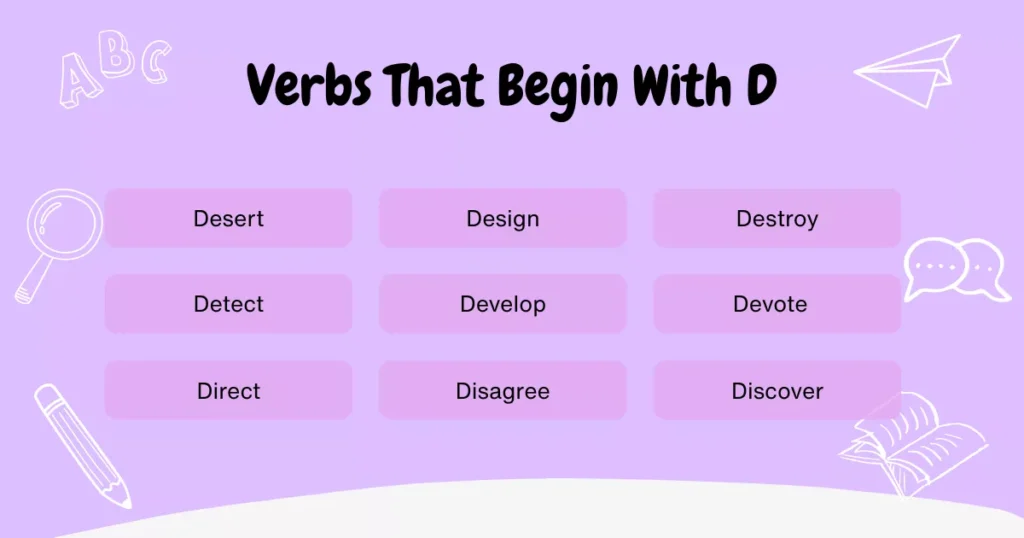
Phrasal Verbs That Start With D
| Verb | Meaning | Example |
|---|---|---|
| Deal with | to handle a situation | She deals with stress calmly. |
| Depend on | to rely on | Success depends on effort. |
| Die out | to become extinct | Many species are dying out. |
| Drop off | to leave someone/something | I dropped him off at school. |
| Drop out | to quit something | He dropped out of college. |
| Do away with | to eliminate | They did away with old rules. |
| Do over | to repeat | Please do the work over. |
| Draw up | to prepare a document | They drew up a contract. |
| Draw out | to prolong | The meeting was drawn out. |
| Drive away | to force to leave | The noise drove them away. |
| Drive off | to leave quickly | He drove off angrily. |
| Drift apart | to become distant | Friends drift apart over time. |
| Dress up | to wear formal clothes | She dressed up for the party. |
| Dress down | to scold | The boss dressed him down. |
| Drop by | to visit briefly | Drop by anytime. |
| Dig into | to start eating or investigating | Let’s dig into the meal. |
| Dig up | to uncover information | He dug up old records. |
| Dawn on | to become clear | The truth dawned on me. |
| Double back | to return the same way | We doubled back home. |
| Do without | to manage without | I can do without sugar. |
| Die down | to become quieter | The noise died down. |
| Dive into | to start eagerly | She dived into her work. |
| Drop behind | to fall back | He dropped behind in class. |
| Drag on | to continue too long | The meeting dragged on. |
| Drive through | to pass without stopping | We drove through the city. |
Professional, Academic, and Technical D Verbs
- Develop – to improve or create
Example: Scientists develop new methods. - Demonstrate – to show clearly
Example: The study demonstrates results. - Design – to plan or create
Example: Engineers design systems. - Define – to explain meaning
Example: The teacher defined the term. - Determine – to decide or conclude
Example: Data determines outcomes. - Diagnose – to identify a problem
Example: Doctors diagnose diseases. - Document – to record information
Example: Researchers document findings. - Differentiate – to show differences
Example: The model differentiates variables. - Distribute – to give out
Example: The company distributes products. - Draft – to prepare a document
Example: He drafted a report. - Delegate – to assign tasks
Example: Managers delegate work. - Derive – to obtain from a source
Example: Results derive from data. - Detect – to discover
Example: Sensors detect motion. - Deliver – to present formally
Example: She delivered a lecture. - Disclose – to reveal information
Example: They disclosed the facts. - Discuss – to talk about
Example: The team discussed strategies. - Debate – to argue formally
Example: Students debated the issue. - Decline – to decrease
Example: Sales declined this year. - Deduce – to conclude logically
Example: He deduced the answer. - Devise – to create a plan
Example: They devised a solution. - Deploy – to position resources
Example: Troops were deployed. - Disseminate – to spread information
Example: The agency disseminates data. - Disrupt – to interrupt
Example: Technology disrupts markets. - Diversify – to expand variety
Example: Investors diversify portfolios. - Distinguish – to recognize differences
Example: It distinguishes key factors.
Emotional, Creative, and Descriptive D Verbs
- Dream – to imagine
Example: She dreams of success. - Desire – to strongly want
Example: He desires peace. - Delight – to bring joy
Example: The gift delighted her. - Dazzle – to impress
Example: The show dazzled the audience. - Depict – to represent
Example: The painting depicts nature. - Describe – to explain vividly
Example: He described the scene. - Decorate – to beautify
Example: They decorated the room. - Drift – to move gently
Example: Clouds drift across the sky. - Dance – to move rhythmically
Example: She danced gracefully. - Draw – to sketch
Example: He draws portraits. - Devote – to give time/emotion
Example: She devoted herself to art. - Dwell – to think deeply
Example: Don’t dwell on sadness. - Dislike – to not enjoy
Example: I dislike noise. - Despair – to lose hope
Example: He despaired after failure. - Distract – to divert attention
Example: Noise distracts me. - Dramatize – to make dramatic
Example: She dramatized the story. - Deserve – to be worthy
Example: You deserve happiness. - Doubt – to feel uncertain
Example: I doubt his claim. - Deepen – to make stronger
Example: Their friendship deepened. - Diminish – to reduce
Example: His fear diminished. - Discover – to find creatively
Example: She discovered her talent. - Differentiate – to stand out
Example: His style differentiates him. - Disguise – to hide appearance
Example: He disguised himself. - Disarm – to reduce tension
Example: Her smile disarmed him. - Disturb – to upset
Example: The news disturbed her.
You May Also Like: Verbs That Start With C
Rare, Unique, and Advanced Verbs That Start With D
- Delineate – to describe precisely
Example: The report delineates the process. - Denounce – to publicly condemn
Example: They denounced corruption. - Defer – to postpone
Example: The decision was deferred. - Deplete – to reduce greatly
Example: Resources are depleted quickly. - Derogate – to belittle
Example: He derogated her efforts. - Detract – to reduce value
Example: Errors detract from quality. - Disavow – to deny responsibility
Example: He disavowed the claim. - Disentangle – to free from confusion
Example: She disentangled the wires. - Disperse – to scatter
Example: The crowd dispersed quickly. - Dissect – to analyze in detail
Example: Scientists dissect specimens. - Distill – to purify or extract
Example: They distilled the liquid. - Divulge – to reveal secrets
Example: He refused to divulge details. - Dormer (rare use: to add a dormer) – to modify structure
Example: They dormered the roof. - Dwindle – to decrease gradually
Example: Supplies dwindled over time. - Disparage – to criticize unfairly
Example: He disparaged her work. - Dislodge – to remove forcefully
Example: The storm dislodged tiles. - Debilitate – to weaken
Example: Illness debilitated him. - Decipher – to interpret
Example: She deciphered the code. - Delve – to investigate deeply
Example: He delved into history. - Deprecate – to express disapproval
Example: The policy was deprecated. - Desist – to stop
Example: They were asked to desist. - Disconcert – to unsettle
Example: His tone disconcerted me. - Disembark – to leave a vehicle
Example: Passengers disembarked safely. - Disfigure – to spoil appearance
Example: The fire disfigured the wall. - Disorient – to confuse direction
Example: The map disoriented us.
Common Mistakes When Using D Verbs
- Confusing Similar Verbs (e.g., do vs make)
Many learners say “make homework” instead of “do homework.”
Correct: I do my homework every day. - Using the Wrong Verb Form
Irregular verbs like drive–drove–driven are often misused.
Incorrect: He has drove fast
Correct: He has driven fast. - Overusing Simple Verbs Like “Do”
Using do too often makes sentences less powerful.
Correct: Use specific verbs like develop, design, or deliver instead. - Incorrect Phrasal Verb Usage
Phrases like drop off and drop out have different meanings.
Correct: She dropped off the package vs He dropped out of school. - Wrong Prepositions with Verbs
Some verbs require specific prepositions.
Incorrect: Depend of
Correct: Depend on.
Fun Facts About Verbs That Begin With D
- “Do” is one of the most important verbs in English
It’s used for questions, negatives, and emphasis (Do you like it?). - Many D verbs are action-packed
Words like dash, dive, and drag describe strong physical movement. - D verbs are common in daily conversation
Verbs like drive, drink, and decide are used every day. - Some D verbs have multiple meanings
Draw can mean sketching, pulling, or attracting attention. - D verbs are popular in motivational language
Words like dream, dare, and develop inspire positive thinking.
FAQs
Conclusion
Verbs that start with the letter “D” add depth, clarity, and energy to English communication. From everyday actions like do and drive to more advanced and expressive words like develop, discover, and delineate, these verbs help speakers and writers express ideas more precisely. Whether you are a beginner, a student, or someone looking to sharpen your vocabulary for writing or games like Scrabble, learning “D” verbs is both practical and rewarding. By understanding their meanings, forms, and usage, you can communicate more confidently and creatively in any situation.