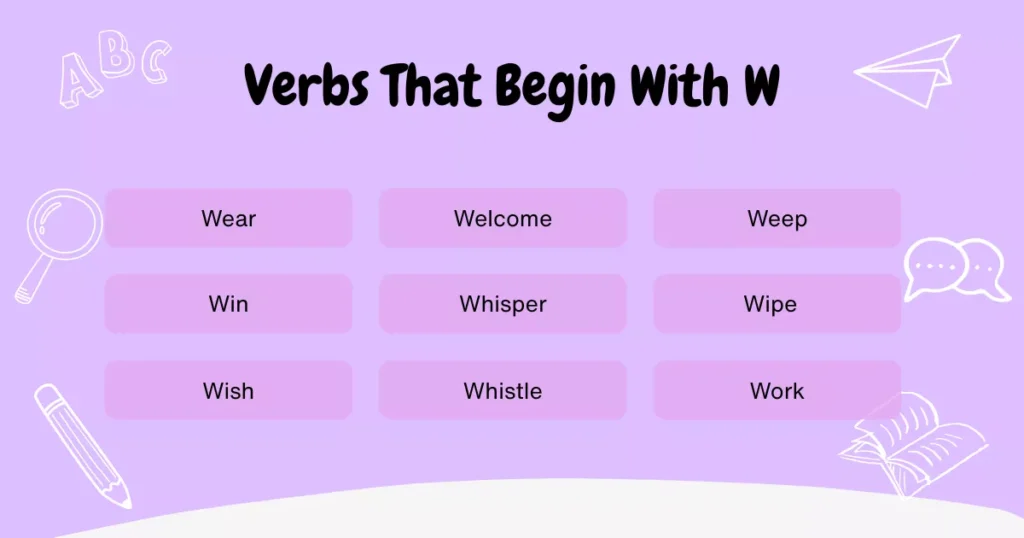
The letter W may sit near the end of the alphabet, but it opens the door to a wide range of powerful and expressive verbs that bring language to life. From everyday actions like walk, work, and watch to more descriptive choices like whisper, wander, and withstand, verbs that start with W help convey movement, emotion, intention, and communication with clarity and style. Since verbs are essential for expressing actions and ideas, strengthening your understanding of W verbs is a smart way to enrich your vocabulary, improve fluency, and avoid repetition in both speaking and writing.
Understanding Verbs That Start With Letter W
Verbs that start with the letter W are action or state words that help describe what someone does, feels, or experiences. These verbs cover a wide range of uses, from simple daily actions like walk and work to more expressive or descriptive actions like whisper, wander, and worry. Understanding W verbs helps improve sentence variety, making both writing and speaking more clear and engaging. By learning their meanings and correct usage, you can communicate ideas more effectively and add depth to your vocabulary.
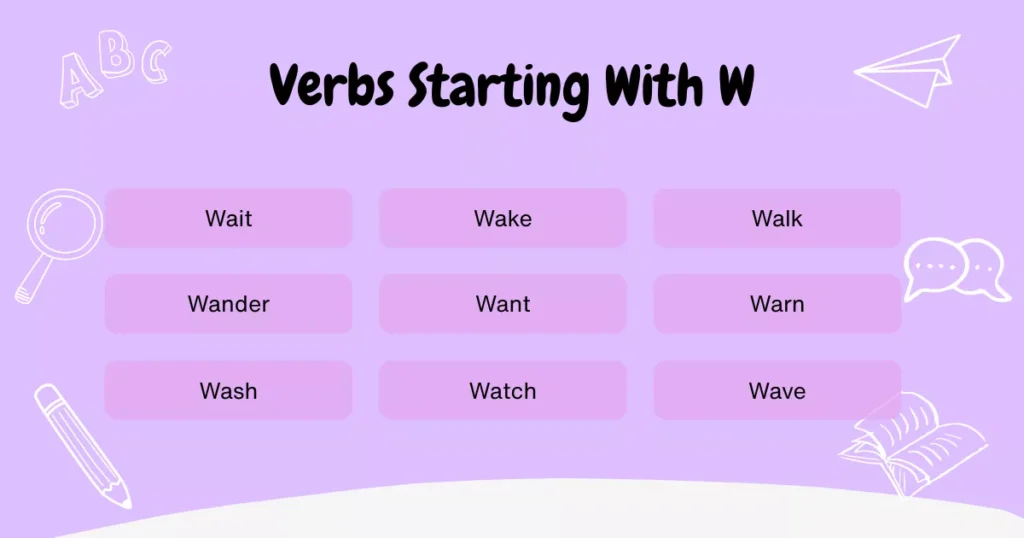
List of Common Verbs Starting With W
- Walk – to move on foot
Example: I walk to school every day. - Want – to desire something
Example: She wants a new phone. - Watch – to look at something carefully
Example: We watched a movie last night. - Work – to do a job or task
Example: He works in a bank. - Wait – to stay until something happens
Example: Please wait here for a moment. - Wake – to stop sleeping
Example: I wake up early every morning. - Wash – to clean with water
Example: She washes her hands before eating. - Wear – to have clothes on your body
Example: He wears a blue shirt. - Win – to achieve victory
Example: They won the match yesterday. - Write – to form words on paper
Example: I write in my diary daily. - Worry – to feel anxious
Example: Don’t worry about the test. - Wonder – to think about something curiously
Example: I wonder what will happen next. - Welcome – to greet someone warmly
Example: They welcomed us with smiles. - Whisper – to speak softly
Example: She whispered a secret to me. - Wish – to hope for something
Example: I wish for success. - Wipe – to clean or remove something
Example: He wiped the table. - Wrap – to cover something
Example: She wrapped the gift nicely. - Wave – to move your hand in greeting
Example: He waved goodbye. - Weigh – to measure weight
Example: The doctor weighed the baby. - Whistle – to make a sound with lips
Example: He whistled a tune. - Wander – to move without direction
Example: They wandered through the park. - Withdraw – to take something back
Example: She withdrew money from the bank. - Waste – to use carelessly
Example: Don’t waste your time. - Warn – to give caution
Example: He warned us about the storm. - Win over – to gain support
Example: She won over the audience. - Work out – to exercise or solve
Example: I work out every morning. - Wind – to twist or turn
Example: He wound the rope tightly. - Weave – to make fabric
Example: They weave beautiful carpets. - Worsen – to become worse
Example: The situation worsened quickly. - Worship – to show devotion
Example: They worship at the temple.
You May Also Like: Verbs That Start With T
Action Verbs That Start With W
- Walk – to move by foot
Example: She walks to the market. - Wave – to move hand or object
Example: He waved at his friend. - Write – to put words on paper
Example: I write letters often. - Wash – to clean
Example: Wash your hands properly. - Wipe – to clean by rubbing
Example: She wiped the window. - Wrap – to cover
Example: He wrapped the parcel. - Whisper – to speak softly
Example: They whispered quietly. - Whistle – to make a sound
Example: He whistles while working. - Weigh – to measure
Example: Please weigh the bag. - Wander – to move aimlessly
Example: He wandered around the city. - Work – to perform tasks
Example: She works hard. - Win – to succeed
Example: Our team will win. - Wear – to dress
Example: She wears a uniform. - Watch – to observe
Example: I watched the game. - Wake – to stop sleeping
Example: Wake up early. - Wait – to stay
Example: Wait for me. - Withdraw – to take back
Example: He withdrew cash. - Wrestle – to fight physically
Example: They wrestled for fun. - Weld – to join metal
Example: He welded the parts together. - Wind – to twist
Example: Wind the thread carefully.
Positive and Motivational Verbs With W
- Win – to achieve success
Example: Believe in yourself and win. - Welcome – to greet warmly
Example: They welcomed new ideas. - Wish – to hope
Example: I wish you success. - Work – to put in effort
Example: Work hard for your dreams. - Widen – to expand
Example: Reading widens your knowledge. - Wisdom (verb form: “wise up”) – to become wise
Example: You need to wise up quickly. - Win over – to gain support
Example: She won over the crowd. - Warm – to make comfortable
Example: Kind words warm hearts. - Wake up – to become aware
Example: Wake up to your potential. - Worship – to show respect/devotion
Example: They worship truth and honesty. - Wonder – to think positively
Example: Wonder about new possibilities. - Will – to show determination
Example: I will achieve my goals. - Withstand – to stay strong
Example: She withstood all challenges. - Work out – to improve
Example: Things will work out. - Win through – to succeed despite difficulty
Example: He won through hard times. - Write – to express ideas
Example: Write your dreams down. - Wander – to explore freely
Example: Wander and discover new paths. - Weave – to create
Example: She weaves beautiful stories. - Watch over – to protect
Example: Parents watch over their children. - Willpower (verb usage: “will”) – to control actions
Example: You must will yourself to succeed.
Regular and Irregular Verbs Starting With W
- Walk – walked – to move by foot
Example: He walked home. - Want – wanted – to desire
Example: She wanted help. - Wash – washed – to clean
Example: I washed my car. - Wait – waited – to stay
Example: They waited outside. - Watch – watched – to observe
Example: We watched TV. - Worry – worried – to feel anxious
Example: She worried a lot. - Welcome – welcomed – to greet
Example: They welcomed guests. - Whisper – whispered – to speak softly
Example: He whispered quietly. - Wipe – wiped – to clean
Example: She wiped the table. - Wrap – wrapped – to cover
Example: He wrapped the box. - Wave – waved – to greet
Example: She waved at me. - Weigh – weighed – to measure
Example: They weighed the fruits. - Wander – wandered – to roam
Example: He wandered alone. - Worsen – worsened – to become worse
Example: The pain worsened. - Warn – warned – to caution
Example: He warned us. - Wake – woke – woken – to stop sleeping
Example: I woke up early. - Wear – wore – worn – to dress
Example: She wore a jacket. - Win – won – won – to succeed
Example: They won the match. - Write – wrote – written – to form words
Example: He wrote a letter. - Weep – wept – wept – to cry
Example: She wept silently. - Wind – wound – wound – to twist
Example: He wound the clock. - Withdraw – withdrew – withdrawn – to take back
Example: She withdrew money. - Withstand – withstood – withstood – to resist
Example: The building withstood the storm. - Wring – wrung – wrung – to twist
Example: She wrung the cloth. - Write off – wrote off – written off – to cancel
Example: They wrote off the loss. - Wake up – woke up – woken up – to become aware
Example: He woke up late. - Wear out – wore out – worn out – to exhaust
Example: The work wore me out. - Win over – won over – won over – to persuade
Example: She won over the team. - Work (irregular nuance in phrases) – worked – worked
Example: It worked well. - Withhold – withheld – withheld – to hold back
Example: They withheld information.
Phrasal Verbs That Start With W
| Verb | Meaning | Example |
|---|---|---|
| Wake up | to stop sleeping | I wake up at 6 AM daily. |
| Warm up | to prepare for activity | Athletes warm up before a game. |
| Walk away | to leave a situation | He walked away from the argument. |
| Walk into | to enter or face unexpectedly | She walked into a surprise party. |
| Walk out | to leave suddenly | He walked out of the meeting. |
| Work out | to exercise or solve | They worked out the problem. |
| Work on | to focus on something | I am working on my project. |
| Work through | to deal with something step by step | She worked through her fears. |
| Work up | to build or develop | He worked up the courage to speak. |
| Write down | to note something | Please write down your name. |
| Write up | to prepare a report | She wrote up the findings. |
| Wind up | to end or finish | Let’s wind up the meeting. |
| Wear out | to become exhausted | The long trip wore me out. |
| Wear off | to fade away | The pain will wear off soon. |
| Watch out | to be careful | Watch out for traffic. |
| Wait on | to serve someone | The waiter waited on us politely. |
| Wait for | to expect or stay for | I am waiting for the bus. |
| Walk over | to go across | Let’s walk over to the park. |
| Weigh up | to consider carefully | She weighed up her options. |
| Whip up | to prepare quickly | He whipped up a meal in minutes. |
| Wipe out | to destroy or remove | The storm wiped out crops. |
| Wade through | to deal with something difficult | I waded through the documents. |
| Warm to | to begin to like | She warmed to the idea. |
| Win over | to gain support | He won over the audience. |
| Walk back | to reverse a statement | The company walked back its claim. |
You May Also Like: Verbs That Start With U
Professional, Academic, and Technical W Verbs
- Analyze (write) – to present ideas in written form
Example: Students write essays on research topics. - Weigh – to evaluate carefully
Example: Scientists weigh the evidence. - Warrant – to justify
Example: The results warrant further study. - Withhold – to hold back information
Example: The company withheld data. - Withdraw – to remove formally
Example: He withdrew his application. - Work – to function or operate
Example: The system works efficiently. - Widen – to expand scope
Example: The study widens our understanding. - Wire – to connect electronically
Example: Engineers wired the device. - Weld – to join materials
Example: Workers weld metal parts. - Wrap – to enclose or finalize
Example: They wrapped the project. - Write – to compose formally
Example: She writes academic papers. - Watch – to monitor closely
Example: Technicians watch the system. - Warn – to notify of risk
Example: Experts warn about climate change. - Work through – to process systematically
Example: Researchers work through the data. - Win – to secure success
Example: The company won the contract. - Wield – to use effectively
Example: Leaders wield influence wisely. - Withstand – to resist pressure
Example: The structure withstands stress. - Wireframe – to design a layout
Example: Designers wireframe websites. - Whitelist – to approve access
Example: Admins whitelist trusted users. - Workflow – (verb usage) to organize tasks
Example: Teams workflow projects efficiently. - Workshop – to develop ideas collaboratively
Example: They workshopped the proposal. - Watermark – to mark ownership
Example: The file was watermarked. - Write off – to cancel financially
Example: The firm wrote off losses. - Work out – to calculate
Example: Analysts worked out the cost. - Widen out – to broaden results
Example: The survey widened out conclusions.
Emotional, Creative, and Descriptive W Verbs
- Wonder – to feel curiosity
Example: I wonder about the future. - Worry – to feel anxious
Example: She worries too much. - Wish – to hope for something
Example: I wish for happiness. - Weep – to cry deeply
Example: He wept with joy. - Whisper – to speak softly
Example: She whispered gently. - Wander – to move freely
Example: His mind wandered during class. - Waver – to hesitate
Example: She wavered before deciding. - Warm – to show kindness
Example: Her smile warmed my heart. - Welcome – to receive kindly
Example: They welcomed the guests. - Wince – to show pain
Example: He winced at the noise. - Worship – to adore deeply
Example: They worship their heroes. - Woo – to seek affection
Example: He wooed her with poems. - Writhe – to twist in pain
Example: The patient writhed in agony. - Wail – to cry loudly
Example: The child wailed loudly. - Whine – to complain
Example: Stop whining about problems. - Wonder at – to feel amazed
Example: She wondered at the beauty. - Wake – to become aware
Example: He woke to reality. - Wither – to fade emotionally
Example: Hope withered away. - Worsen – to become worse
Example: His mood worsened. - Wrestle – to struggle mentally
Example: She wrestled with her thoughts. - Widen – to expand emotionally
Example: The story widened my perspective. - Weave – to create stories
Example: She weaves magical tales. - Watch over – to care for
Example: Parents watch over children. - Whirl – to spin with emotion
Example: Thoughts whirled in his mind. - Wander off – to drift away mentally
Example: His attention wandered off.
Rare, Unique, and Advanced Verbs That Start With W
- Wane – to decrease gradually
Example: Her interest waned over time. - Wax – to increase
Example: His enthusiasm waxed. - Wend – to go in a direction
Example: They wended their way home. - Whet – to sharpen or stimulate
Example: The book whetted my curiosity. - Winnow – to separate useful from useless
Example: They winnowed the data. - Winsome (verb-like usage: “winsomely attract”) – to charm
Example: She winsomely attracted attention. - Wreathe – to surround
Example: Mist wreathed the hills. - Waggle – to move lightly
Example: The dog waggled its tail. - Wamble – to feel uneasy
Example: His stomach wambled. - Wizen – to shrink with age
Example: The fruit wizened quickly. - Wreak – to cause harm
Example: The storm wreaked havoc. - Wheedle – to persuade gently
Example: He wheedled her into agreeing. - Whittle – to carve slowly
Example: He whittled the wood. - Whisk – to move quickly
Example: She whisked away the papers. - Whelm – to engulf
Example: Waves whelmed the boat. - Winkle – to extract cleverly
Example: He winkled out the truth. - Worm – to move sneakily
Example: He wormed his way in. - Wallow – to indulge
Example: Don’t wallow in sadness. - Waffle – to speak indecisively
Example: He waffled during the speech. - Wist (archaic) – to know
Example: He wist the truth. - Worship (advanced nuance) – to idolize
Example: Fans worship celebrities. - Wreathe around – to encircle
Example: Smoke wreathed around the room. - Winter – to spend winter
Example: Birds winter in warm regions. - Wiretap – to secretly monitor
Example: Authorities wiretapped the calls. - Waylay – to stop unexpectedly
Example: Bandits waylaid travelers.
Common Mistakes When Using W Verbs
- Confusing similar verbs (e.g., wander vs wonder)
Many learners mix up words that look alike but have very different meanings.
Tip: Wander = move aimlessly, wonder = feel curious. - Using incorrect verb forms (irregular verbs)
Mistakes like “I writed a letter” instead of “I wrote a letter” are common.
Tip: Memorize irregular forms like write–wrote–written, win–won–won. - Overusing basic verbs like “work” or “want”
Repeating simple verbs makes writing dull.
Tip: Replace with richer options like wish, strive, pursue, or accomplish. - Incorrect use of phrasal verbs
Learners often misuse combinations like work out, wear off, or wind up.
Tip: Learn meanings in context, not word-by-word. - Using the wrong context (formal vs informal)
Some W verbs like whine or waffle may sound too informal in professional writing.
Tip: Choose verbs based on tone and audience.
You May Also Like: Verbs That Start With V
Fun Facts About Verbs That Begin With W
- “W” verbs often express movement
Words like walk, wander, weave, and whirl vividly describe motion. - Many W verbs are sound-based (onomatopoeia)
Verbs like whisper, whistle, whine, and wail imitate real sounds. - “Write” is one of the most irregular verbs in English
It changes completely: write → wrote → written. - Old English roots influence many W verbs
Words like wield, wend, and worship come from ancient language forms. - W verbs are powerful in storytelling
Verbs like wander, wonder, and wither add emotion and imagery to writing.
FAQs
Conclusion
Verbs that start with the letter W offer a wide and dynamic range of expression, from simple everyday actions like walk and work to more descriptive and impactful verbs like whisper, withstand, and wither. Learning these verbs not only strengthens your vocabulary but also enhances your ability to communicate clearly, creatively, and effectively. By exploring different categories you gain the flexibility to use the right word in the right context. Whether you’re a student, writer, or language learner, mastering W verbs is a smart step toward more fluent and engaging English.