Verbs are the driving force of language because they help us describe actions, express thoughts, and bring our ideas to life. When learning English, especially for kids and beginners, building a strong collection of everyday verbs is one of the most effective ways to improve communication skills. Among these, verbs that start with the letter C are incredibly useful, covering everything from simple daily actions like call and cook to more expressive words like create, care, and connect. Whether you’re a parent, a teacher, or a learner aiming to sound more natural, this collection will help you understand how these verbs describe actions and emotions.
Understanding Verbs That Start With Letter C
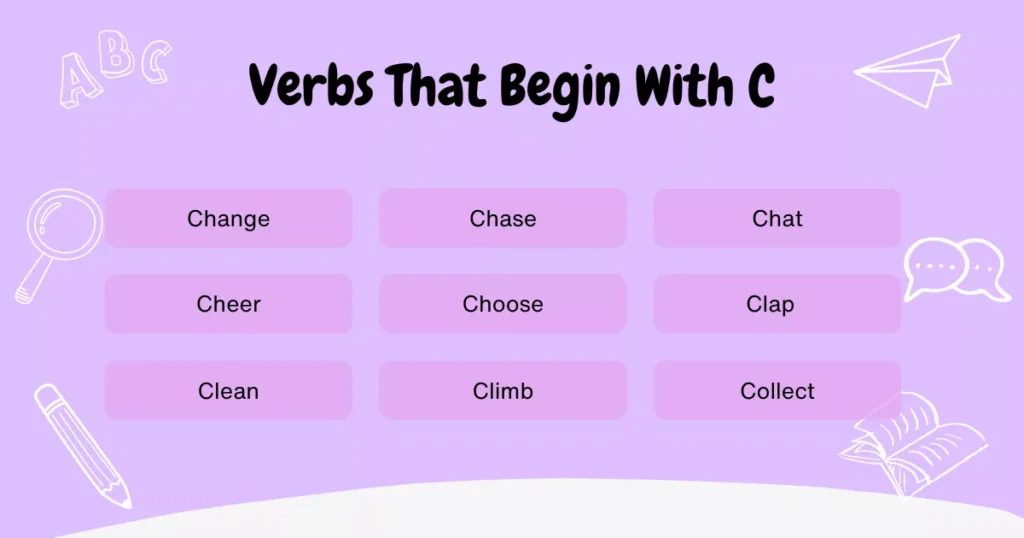
Verbs that start with the letter C are action words that help describe what someone or something is doing, feeling, or becoming. These verbs cover a wide range of everyday situations, such as communication (call, chat), movement (climb, come), thinking (consider, calculate), and creation (create, build). Learning these verbs helps improve both speaking and writing by making sentences more clear, expressive, and engaging. From simple words used by kids to more advanced verbs used in formal English, “C” verbs play an important role in building a strong and versatile vocabulary.
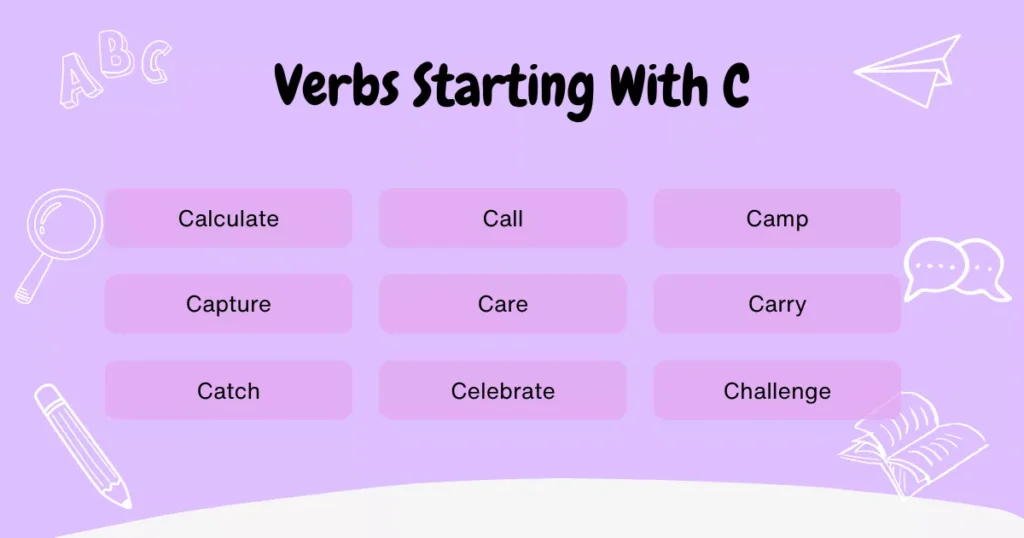
List of Common Verbs Starting With C
- Call – to speak to someone by phone
Example: I will call you later. - Come – to move toward something
Example: Please come here. - Carry – to hold and move something
Example: She carries her bag to school. - Catch – to grab something moving
Example: He caught the ball. - Clean – to make something tidy
Example: I clean my room daily. - Cook – to prepare food
Example: My mother cooks dinner. - Close – to shut something
Example: Close the door. - Cut – to divide with a sharp tool
Example: He cuts the paper. - Choose – to select something
Example: Choose your favorite color. - Check – to examine
Example: Check your answers. - Change – to make or become different
Example: She changed her dress. - Climb – to go up
Example: They climb the hill. - Cry – to shed tears
Example: The baby cried loudly. - Create – to make something new
Example: She creates art. - Care – to feel concern
Example: I care about my friends. - Continue – to keep going
Example: Continue your work. - Count – to add numbers
Example: Count from one to ten. - Compare – to find differences
Example: Compare the two pictures. - Collect – to gather
Example: He collects stamps. - Cover – to place something over
Example: Cover the food. - Cancel – to stop something
Example: They canceled the meeting. - Control – to manage
Example: Control your emotions. - Copy – to make a duplicate
Example: Copy this sentence. - Communicate – to share information
Example: We communicate daily. - Connect – to join together
Example: Connect the wires. - Confirm – to make sure
Example: Please confirm your booking. - Celebrate – to enjoy an event
Example: We celebrate birthdays. - Challenge – to test ability
Example: This game challenges me. - Charge – to ask for payment
Example: They charge a fee. - Cheer – to shout in support
Example: Fans cheer loudly.
Action Verbs That Start With C
- Clap – to strike hands together
Example: They clap after the show. - Chase – to run after
Example: The dog chased the cat. - Climb – to go upward
Example: He climbs trees. - Carry – to hold and move
Example: She carries books. - Catch – to grab
Example: Catch the ball! - Cook – to prepare food
Example: I cook rice. - Cut – to divide
Example: Cut the cake. - Clean – to tidy up
Example: Clean your desk. - Close – to shut
Example: Close the window. - Call – to contact
Example: Call your friend. - Climb – to move upward
Example: The boy climbs fast. - Create – to make
Example: They create a model. - Collect – to gather
Example: Collect the papers. - Catch – to capture
Example: He caught a fish. - Crack – to break
Example: Crack the egg. - Cover – to place over
Example: Cover your head. - Crawl – to move on hands/knees
Example: The baby crawls. - Clap – to applaud
Example: We clap for them. - Chop – to cut into pieces
Example: Chop the vegetables. - Cycle – to ride a bicycle
Example: He cycles daily.
You May Also Like: Verbs That Start With A
Positive and Motivational Verbs With C
- Create – to bring something new
Example: Create your future. - Care – to show kindness
Example: Care for others. - Celebrate – to enjoy success
Example: Celebrate your wins. - Contribute – to give or help
Example: Contribute ideas. - Connect – to build relationships
Example: Connect with people. - Change – to improve
Example: Change your habits. - Challenge – to push yourself
Example: Challenge your limits. - Commit – to dedicate yourself
Example: Commit to your goals. - Continue – to keep going
Example: Continue learning. - Conquer – to overcome
Example: Conquer your fears. - Communicate – to express clearly
Example: Communicate openly. - Comfort – to make someone feel better
Example: Comfort a friend. - Care for – to look after
Example: Care for your health. - Cultivate – to develop
Example: Cultivate good habits. - Collaborate – to work together
Example: Collaborate with others. - Clarify – to make clear
Example: Clarify your ideas. - Coach – to guide
Example: She coaches students. - Complete – to finish
Example: Complete your task. - Construct – to build
Example: Construct your dreams. - Carefully plan – to prepare wisely
Example: Carefully plan your future.
Regular and Irregular Verbs Starting With C
- Call (Regular) – to phone
Example: I called him yesterday. - Carry (Regular) – to hold
Example: She carried the bag. - Clean (Regular) – to tidy
Example: He cleaned the room. - Cook (Regular) – to prepare food
Example: She cooked dinner. - Close (Regular) – to shut
Example: He closed the shop. - Change (Regular) – to become different
Example: She changed her style. - Check (Regular) – to examine
Example: I checked the answer. - Collect (Regular) – to gather
Example: They collected coins. - Compare (Regular) – to examine differences
Example: She compared prices. - Control (Regular) – to manage
Example: He controlled the car. - Copy (Regular) – to duplicate
Example: I copied the notes. - Confirm (Regular) – to verify
Example: He confirmed the booking. - Cancel (Regular) – to stop
Example: They canceled the trip. - Continue (Regular) – to go on
Example: She continued working. - Celebrate (Regular) – to enjoy
Example: We celebrated success. - Climb (Regular) – to go up
Example: He climbed a mountain. - Cry (Regular) – to weep
Example: The baby cried. - Create (Regular) – to make
Example: She created a design. - Cook (Regular) – to prepare
Example: He cooked rice. - Care (Regular) – to show concern
Example: She cared for him. - Come (Irregular) – to move toward
Example: He came late. - Cut (Irregular) – to divide
Example: She cut the paper. - Catch (Irregular) – to grab
Example: He caught the ball. - Choose (Irregular) – to select
Example: She chose a dress. - Cost (Irregular) – to have a price
Example: It cost a lot. - Cast (Irregular) – to throw
Example: He cast the net. - Creep (Irregular) – to move slowly
Example: The cat crept quietly. - Cling (Irregular) – to hold tightly
Example: The child clung to her. - Come (Irregular) – to arrive
Example: They came early. - Cut (Irregular) – to slice
Example: He cut the rope.
Phrasal Verbs That Start With C
| Verb | Meaning | Example |
|---|---|---|
| Call off | cancel something | They called off the meeting. |
| Call back | return a phone call | I will call you back later. |
| Call out | shout or criticize | She called out his mistake. |
| Call up | phone someone | He called up his friend. |
| Calm down | relax | Calm down and listen. |
| Carry on | continue | Carry on with your work. |
| Carry out | complete a task | They carried out the plan. |
| Carry over | transfer to later | The work carried over. |
| Catch up | reach the same level | I need to catch up on homework. |
| Catch on | understand | She quickly caught on. |
| Catch up with | meet after time | I caught up with an old friend. |
| Check in | arrive/register | We checked in at the hotel. |
| Check out | leave or examine | Check out this book. |
| Check over | review carefully | Check over your answers. |
| Check up on | monitor | The doctor checked up on him. |
| Cheer up | become happier | This song will cheer you up. |
| Chip in | contribute | Everyone chipped in money. |
| Clean up | tidy completely | Clean up your room. |
| Clear out | remove everything | They cleared out the house. |
| Clear up | solve or tidy | Clear up the confusion. |
| Come across | find by chance | I came across an old photo. |
| Come back | return | She came back home. |
| Come in | enter | Please come in. |
| Come up with | think of an idea | He came up with a solution. |
| Cut down | reduce | Cut down on sugar. |
Professional, Academic, and Technical C Verbs
- Calculate – compute numbers
Example: Calculate the total cost. - Classify – group into categories
Example: Classify the data. - Compile – collect information
Example: Compile a report. - Conduct – carry out research
Example: Scientists conduct experiments. - Construct – build or form
Example: Engineers construct bridges. - Consult – seek advice
Example: Consult a doctor. - Coordinate – organize activities
Example: She coordinates the team. - Correlate – show relationship
Example: Results correlate strongly. - Critique – analyze carefully
Example: Critique the article. - Cite – quote a source
Example: Cite your references. - Collaborate – work together
Example: They collaborate on projects. - Communicate – share information
Example: Communicate clearly. - Conceptualize – form an idea
Example: Conceptualize the plan. - Configure – set up systems
Example: Configure the software. - Calibrate – adjust accurately
Example: Calibrate the device. - Control – manage processes
Example: Control the system. - Compute – calculate data
Example: The system computes values. - Code – write programming instructions
Example: He codes in Python. - Compile (tech) – convert code
Example: Compile the program. - Conclude – reach a decision
Example: The study concludes clearly. - Compare – examine differences
Example: Compare the results. - Confirm – verify accuracy
Example: Confirm the findings. - Categorize – arrange in groups
Example: Categorize the entries. - Correct – fix errors
Example: Correct the mistakes. - Convert – change form
Example: Convert the file.
You May Also Like: Verbs That Start With B
Emotional, Creative, and Descriptive C Verbs
- Care – feel concern
Example: I care about you. - Cherish – value deeply
Example: Cherish your memories. - Comfort – ease sadness
Example: She comforted him. - Celebrate – show joy
Example: They celebrated success. - Connect – bond emotionally
Example: We connect easily. - Create – make something new
Example: She creates art. - Craft – make with skill
Example: He crafted a story. - Capture – express or record
Example: The photo captures beauty. - Color – add visual effect
Example: Color the picture. - Compose – create music/writing
Example: She composed a song. - Contemplate – think deeply
Example: He contemplated life. - Confess – admit feelings
Example: She confessed her love. - Console – comfort someone
Example: He consoled his friend. - Charm – attract delightfully
Example: She charmed everyone. - Calm – make peaceful
Example: This music calms me. - Crave – strongly desire
Example: I crave chocolate. - Care for – love or support
Example: She cares for animals. - Communicate – express feelings
Example: Communicate honestly. - Confuse – cause uncertainty
Example: The question confused me. - Captivate – attract strongly
Example: The story captivated readers. - Console – give emotional support
Example: She consoled the child. - Convey – express meaning
Example: Words convey emotions. - Celebrate – express happiness
Example: Celebrate small wins. - Connect with – relate emotionally
Example: I connect with this song. - Create – bring ideas to life
Example: Artists create beauty.
Rare, Unique, and Advanced Verbs That Start With C
- Coalesce – come together
Example: Ideas coalesce into plans. - Commiserate – express sympathy
Example: She commiserated with him. - Consolidate – combine into one
Example: Consolidate your notes. - Conflate – mix ideas incorrectly
Example: Don’t conflate facts. - Capitulate – surrender
Example: They capitulated quickly. - Circumvent – avoid cleverly
Example: He circumvented the rules. - Corroborate – confirm with evidence
Example: Evidence corroborates the claim. - Cajole – persuade gently
Example: She cajoled him to help. - Castigate – criticize harshly
Example: The teacher castigated him. - Conjecture – guess based on evidence
Example: He conjectured the outcome. - Condone – accept wrongdoing
Example: They condone bad behavior. - Constrain – limit
Example: Rules constrain freedom. - Converge – come together
Example: Paths converge here. - Collate – gather and arrange
Example: Collate the documents. - Confer – discuss formally
Example: Leaders conferred privately. - Contend – argue
Example: He contended his point. - Convoke – call together
Example: They convoked a meeting. - Conspire – plan secretly
Example: They conspired together. - Contrive – create cleverly
Example: He contrived a plan. - Crystallize – become clear
Example: Ideas crystallized suddenly. - Censure – criticize officially
Example: The board censured him. - Circumscribe – limit strictly
Example: Laws circumscribe actions. - Counteract – reduce effect
Example: This will counteract damage. - Convalesce – recover health
Example: She convalesced at home. - Condescend – act superior
Example: Don’t condescend to others.
Common Mistakes When Using C Verbs
- Confusing Similar Verbs (e.g., Come vs Go)
Many learners mix up direction-based verbs.
Incorrect: I will go to your house (when speaking from there).
Correct: I will come to your house. - Using the Wrong Verb Form
Some “C” verbs are irregular and don’t follow -ed rules.
Incorrect: He catched the ball.
Correct: He caught the ball. - Overusing Simple Verbs Like “Come” and “Call”
Relying too much on basic verbs can make speech repetitive.
Tip: Use variety like arrive, contact, communicate. - Misusing Phrasal Verbs
Phrasal verbs can change meaning completely.
Incorrect: I called him off (instead of canceling).
Correct: I called off the meeting. - Incorrect Preposition Usage
Some verbs require specific prepositions.
Incorrect: She cares him.
Correct: She cares about him.
Fun Facts About Verbs That Begin With C
- “C” Verbs Are Everywhere in Daily English
Words like come, call, check, and change are among the most commonly used verbs in conversations. - Many Powerful Positive Verbs Start With C
Verbs like create, care, connect, and celebrate add energy and positivity to language. - “C” Verbs Cover Almost Every Action Type
From thinking (consider) to movement (climb) to emotion (care), they cover a wide range. - A Lot of Academic Verbs Begin With C
Words like calculate, classify, conclude, and compare are widely used in studies and research. - Phrasal Verbs With C Are Extremely Common
Expressions like carry on, come across, and check out are essential for sounding natural.
FAQs
Conclusion
Verbs that start with the letter C are an essential part of building a strong and expressive English vocabulary. From simple everyday actions like call and come to more advanced and meaningful verbs like create, contribute, and conquer, these words help you describe actions, emotions, communication, and change more clearly. By learning and practicing different types of “C” verbs you can improve both your speaking and writing skills. Whether you are a beginner, a student, or a language enthusiast, mastering these verbs will make your English sound more natural, confident, and engaging.