
Verbs that start with the letter A play an important role in building strong and expressive English vocabulary. From simple everyday words like ask, add, and arrive to powerful positive verbs like achieve, appreciate, and advance, these action words help bring energy, clarity, and meaning to both speaking and writing. This learner-friendly guide is designed for students, kids, writers, and English learners who want a clear and well-organized list of A verbs with simple meanings and examples. Get ready to expand your vocabulary and make your communication more confident, creative, and engaging with verbs that begin with A.
Understanding Verbs That Start With Letter A
Verbs that start with the letter A are action or state words that describe what someone does, feels, or experiences, such as ask, arrive, accept, achieve, and allow. These verbs are commonly used in everyday English to express actions, decisions, emotions, and changes in different situations. Learning A verbs helps improve vocabulary, sentence structure, and communication skills, especially for students, writers, and English learners. By understanding their meanings and usage in simple sentences, learners can easily use these verbs in speaking, writing, and exams, making their language clearer, more natural, and more effective.
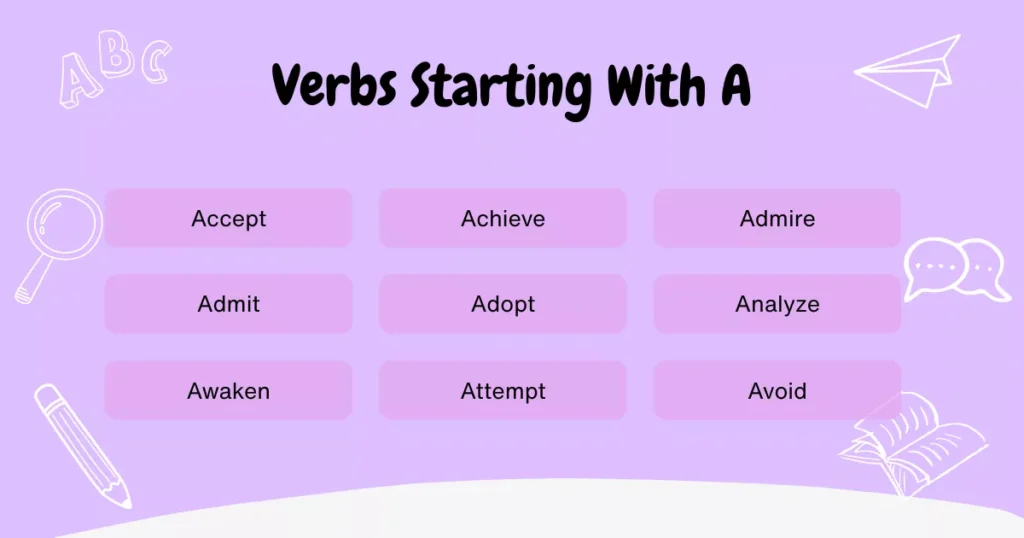
List of Common Verbs Starting With A
- Ask – to request information
Example: She asked a question in class. - Add – to join or combine
Example: Please add sugar to the tea. - Arrive – to reach a place
Example: They arrived on time. - Accept – to agree or receive
Example: He accepted the offer. - Allow – to permit
Example: The teacher allowed us to leave early. - Answer – to respond
Example: She answered the phone quickly. - Agree – to have the same opinion
Example: I agree with your idea. - Act – to do something
Example: He acted bravely. - Appear – to become visible
Example: A rainbow appeared in the sky. - Apply – to make a request
Example: She applied for the job. - Achieve – to reach a goal
Example: He achieved success through hard work. - Avoid – to stay away from
Example: Avoid bad habits. - Admire – to respect or like
Example: I admire her honesty. - Advise – to give suggestions
Example: The doctor advised rest. - Admit – to accept truth
Example: He admitted his mistake. - Adopt – to take as one’s own
Example: They adopted a child. - Announce – to make known
Example: She announced the results. - Arrange – to organize
Example: He arranged the books neatly. - Attach – to connect
Example: Attach the file to the email. - Attack – to try to harm
Example: The dog attacked the stranger. - Attempt – to try
Example: She attempted the question. - Attend – to be present
Example: He attends school daily. - Attract – to draw attention
Example: Bright colors attract children. - Appreciate – to value
Example: I appreciate your help. - Assume – to suppose
Example: I assume he is busy. - Assist – to help
Example: She assisted the teacher. - Annoy – to irritate
Example: Loud noise annoys me. - Amuse – to entertain
Example: The clown amused the kids. - Awaken – to wake up
Example: He awakened early. - Argue – to disagree
Example: They argued over money.
Action Verbs That Start With A
- Act – to do something
Example: She acted quickly. - Add – to combine
Example: Add water to the mix. - Ask – to request
Example: Ask for help if needed. - Attack – to harm
Example: The tiger attacked its prey. - Arrange – to organize
Example: Arrange the chairs properly. - Assemble – to put together
Example: He assembled the table. - Adjust – to change slightly
Example: Adjust the volume. - Apply – to put to use
Example: Apply the cream gently. - Approach – to come near
Example: The car approached slowly. - Advance – to move forward
Example: The army advanced. - Achieve – to succeed
Example: She achieved her goal. - Assist – to help
Example: He assisted his friend. - Attach – to fasten
Example: Attach the label. - Announce – to declare
Example: They announced the winner. - Aim – to point or target
Example: Aim carefully before shooting. - Accept – to receive
Example: She accepted the gift. - Avoid – to stay away
Example: Avoid dangerous places. - Arrest – to catch legally
Example: The police arrested the thief. - Answer – to reply
Example: Answer the question. - Acquire – to gain
Example: He acquired new skills.
Positive and Motivational Verbs With A
- Achieve – to succeed
Example: Work hard to achieve your dreams. - Advance – to move forward
Example: She advanced in her career. - Appreciate – to value
Example: Appreciate every moment. - Admire – to respect
Example: I admire your courage. - Aspire – to aim high
Example: Aspire to greatness. - Accomplish – to complete successfully
Example: He accomplished his mission. - Assist – to help
Example: Always assist others. - Adopt – to accept
Example: Adopt good habits. - Adapt – to adjust
Example: Learn to adapt to change. - Acknowledge – to recognize
Example: Acknowledge your strengths. - Affirm – to confirm positively
Example: Affirm your goals daily. - Awaken – to become aware
Example: Awaken your potential. - Align – to bring into harmony
Example: Align your actions with goals. - Activate – to start
Example: Activate your energy. - Attract – to draw
Example: Positive thoughts attract success. - Ascend – to rise
Example: She ascended to success. - Authorize – to give permission
Example: The manager authorized the plan. - Applaud – to praise
Example: We applaud your effort. - Advocate – to support
Example: Advocate for change. - Amplify – to increase
Example: Amplify your voice.
Regular and Irregular Verbs Starting With A
- Accept (Regular) – accepted
Example: She accepted the gift. - Add (Regular) – added
Example: He added salt. - Ask (Regular) – asked
Example: She asked a question. - Allow (Regular) – allowed
Example: They allowed entry. - Answer (Regular) – answered
Example: He answered correctly. - Arrive (Regular) – arrived
Example: We arrived early. - Agree (Regular) – agreed
Example: They agreed quickly. - Admire (Regular) – admired
Example: I admired her work. - Advise (Regular) – advised
Example: He advised caution. - Adopt (Regular) – adopted
Example: They adopted a pet. - Announce (Regular) – announced
Example: She announced the news. - Arrange (Regular) – arranged
Example: He arranged everything. - Attack (Regular) – attacked
Example: The dog attacked. - Attempt (Regular) – attempted
Example: She attempted the task. - Attend (Regular) – attended
Example: He attended the meeting. - Attract (Regular) – attracted
Example: Lights attracted insects. - Avoid (Regular) – avoided
Example: He avoided trouble. - Amuse (Regular) – amused
Example: The show amused us. - Annoy (Regular) – annoyed
Example: The noise annoyed me. - Assist (Regular) – assisted
Example: She assisted him. - Awaken (Irregular) – awakened
Example: He awakened suddenly. - Arise (Irregular) – arose
Example: Problems arose quickly. - Awake (Irregular) – awoke
Example: She awoke early. - Abide (Irregular) – abode
Example: He abode by the rules. - Abide (Irregular) – abided
Example: She abided by the law. - Arise (Irregular) – arisen
Example: New issues have arisen. - Awake (Irregular) – awoken
Example: He has awoken late. - Abide (Irregular) – abided
Example: They abided peacefully. - Awaken (Irregular) – awoke
Example: She awoke at dawn. - Arise (Irregular) – arising
Example: Problems are arising.
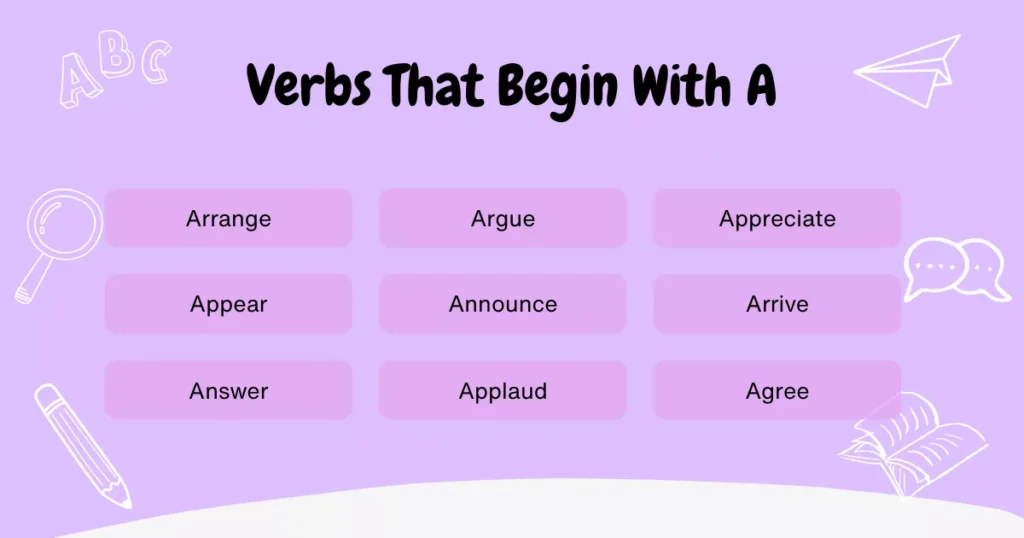
Phrasal Verbs That Start With A
| Verb | Meaning | Example |
|---|---|---|
| Act out | to express emotions through actions | The child acted out his anger. |
| Add up | to make sense or total | The numbers add up correctly. |
| Add up to | to result in | Small efforts add up to success. |
| Aim at | to target something | The program aims at helping students. |
| Allow for | to consider something | We must allow for delays. |
| Answer back | to reply rudely | Don’t answer back to your teacher. |
| Ask about | to inquire about something | She asked about your health. |
| Ask around | to ask many people | I asked around for directions. |
| Ask for | to request | He asked for help. |
| Ask out | to invite on a date | He asked her out for dinner. |
| Ask over | to invite home | She asked her friends over. |
| Act on | to take action | The company acted on the advice. |
| Agree with | to share opinion | I agree with your idea. |
| Agree on | to decide together | They agreed on the plan. |
| Agree to | to accept a proposal | She agreed to the terms. |
| Apply for | to request officially | He applied for a visa. |
| Apply to | to be relevant | This rule applies to everyone. |
| Add on | to include extra | They added on extra charges. |
| Act up | to behave badly | The machine is acting up. |
| Answer for | to be responsible | He must answer for his actions. |
| Aim for | to target a goal | Aim for success. |
| Add in | to include something | Add in some salt. |
| Act against | to oppose | The law acts against crime. |
| Attend to | to deal with | The nurse attended to the patient. |
| Act as | to perform a role | He acted as a leader. |
You May Also Like: Similes for Sad
Professional, Academic, and Technical A Verbs
- Analyze – to examine carefully
Example: Scientists analyze data daily. - Assess – to evaluate
Example: The teacher assessed the project. - Administer – to manage or control
Example: She administers the program. - Allocate – to distribute resources
Example: Funds were allocated to education. - Authorize – to give permission
Example: The manager authorized the payment. - Accumulate – to gather over time
Example: Data accumulated quickly. - Audit – to inspect accounts
Example: The company audited its finances. - Amend – to make changes
Example: They amended the policy. - Apply – to use knowledge
Example: Apply theory in practice. - Articulate – to express clearly
Example: She articulated her ideas well. - Adapt – to adjust
Example: Businesses adapt to change. - Activate – to start operation
Example: Activate the system now. - Access – to obtain data
Example: Students accessed online resources. - Archive – to store records
Example: The files were archived. - Acknowledge – to recognize
Example: The author acknowledged sources. - Accelerate – to speed up
Example: Technology accelerates growth. - Assemble – to put together
Example: Engineers assembled the machine. - Align – to bring into agreement
Example: Align goals with strategy. - Automate – to use machines
Example: Companies automate processes. - Approve – to accept officially
Example: The board approved the plan. - Annotate – to add notes
Example: Students annotate texts. - Authenticate – to verify identity
Example: The system authenticates users. - Aggregate – to collect data
Example: Researchers aggregate results. - Advocate – to support
Example: Scientists advocate research funding. - Administer – to organize operations
Example: He administers the department.
Emotional, Creative, and Descriptive A Verbs
- Adore – to love deeply
Example: She adores her family. - Appreciate – to value
Example: I appreciate your kindness. - Admire – to respect
Example: He admires her talent. - Amaze – to surprise greatly
Example: The magician amazed the crowd. - Amuse – to entertain
Example: The story amused us. - Anger – to make angry
Example: His words angered me. - Annoy – to irritate
Example: Noise annoys her. - Attract – to draw interest
Example: Art attracts visitors. - Awe – to inspire wonder
Example: Nature awes everyone. - Arouse – to awaken feelings
Example: The speech aroused emotions. - Adorn – to decorate
Example: Flowers adorned the hall. - Animate – to bring to life
Example: The artist animated the character. - Acknowledge – to show appreciation
Example: She acknowledged his effort. - Amplify – to increase effect
Example: Music amplifies emotions. - Absorb – to take in
Example: She absorbed the beauty. - Aspire – to dream big
Example: He aspires to greatness. - Awaken – to inspire awareness
Example: The film awakened feelings. - Ad-lib – to speak creatively
Example: The actor ad-libbed the dialogue. - Allure – to attract strongly
Example: The place allured tourists. - Appeal – to attract interest
Example: The design appeals to youth. - Astonish – to surprise
Example: The result astonished everyone. - Affect – to influence feelings
Example: Music affects mood. - Admit – to confess feelings
Example: He admitted his fear. - Appall – to shock
Example: The news appalled us. - Ache – to feel pain
Example: Her heart ached with sadness.
Rare, Unique, and Advanced Verbs That Start With A
- Abate – to reduce
Example: The storm abated at night. - Abdicate – to give up power
Example: The king abdicated the throne. - Abhor – to hate strongly
Example: She abhors violence. - Abstain – to avoid something
Example: He abstained from voting. - Absolve – to forgive
Example: The judge absolved him. - Accede – to agree formally
Example: They acceded to demands. - Acquiesce – to accept quietly
Example: She acquiesced to the decision. - Adjudicate – to judge officially
Example: The court adjudicated the case. - Admonish – to warn
Example: The teacher admonished students. - Adumbrate – to outline briefly
Example: He adumbrated his plan. - Abridge – to shorten
Example: The editor abridged the book. - Abrogate – to cancel law
Example: The government abrogated the rule. - Ablate – to remove
Example: Doctors ablated the tissue. - Abnegate – to deny oneself
Example: He abnegated luxury. - Accost – to approach boldly
Example: A stranger accosted him. - Adulate – to praise excessively
Example: Fans adulated the star. - Aggrandize – to increase power
Example: He aggrandized his image. - Alleviate – to reduce pain
Example: Medicine alleviates pain. - Ameliorate – to improve
Example: Efforts ameliorated conditions. - Annihilate – to destroy completely
Example: The army annihilated enemies. - Antagonize – to provoke
Example: He antagonized his boss. - Apprehend – to arrest or understand
Example: Police apprehended the thief. - Ascertain – to find out
Example: We ascertained the facts. - Ascribe – to attribute
Example: She ascribed success to hard work. - Augment – to increase
Example: The company augmented profits.
You May Also Like: Metaphors for Conflict
Common Mistakes When Using A Verbs
- Confusing Accept and Except
Mistake: Many learners use accept instead of except.
Example Mistake: Everyone accept Ali came to class.
Correct: Everyone except Ali came to class.
Tip: Accept means to receive, while except means to exclude. - Using Advise and Advice Incorrectly
Mistake: Using advice as a verb.
Example Mistake: He advice me to study.
Correct: He advised me to study.
Tip: Advise is a verb, advice is a noun. - Mixing Affect and Effect
Mistake: Using effect as a verb in simple sentences.
Example Mistake: The weather effects my mood.
Correct: The weather affects my mood.
Tip: Affect is usually a verb, effect is usually a noun. - Wrong Preposition with Agree
Mistake: Using incorrect prepositions.
Example Mistake: I agree to you.
Correct: I agree with you. - Overusing Ask Without Structure
Mistake: Incorrect sentence formation.
Example Mistake: She asked me go home.
Correct: She asked me to go home.
Tip: Use ask + someone + to + verb.
Fun Facts About Verbs That Begin With A
- Many Powerful English Verbs Start With A
Words like achieve, advance, adapt, and appreciate are widely used in motivational speaking and professional writing because they sound active and positive. - Several A Verbs Come from Latin and Greek
Verbs like analyze, assess, and allocate come from classical languages, which is why they are common in academic and technical English. - A Verbs Are Common in Daily Conversation
Simple verbs like ask, add, arrive, and answer are among the most frequently used verbs in everyday English communication. - Many A Verbs Express Positive Action
Verbs starting with A often carry encouraging meanings, such as achieve, assist, appreciate, and aspire, making them popular in self-improvement and business content. - Some Rare A Verbs Sound Advanced but Are Useful
Words like ameliorate, augment, and ascertain may sound complex, but they are commonly used in formal writing, academic essays, and professional communication.
FAQs
Conclusion
Verbs that start with the letter A are essential tools for effective communication, whether in daily conversation, academic writing, or professional contexts. From simple everyday verbs like ask, add, and arrive to powerful, motivational verbs like achieve, appreciate, and aspire, these words bring action, clarity, and energy to your language. By learning common, action, positive, phrasal, academic, creative, and even rare A verbs, you can improve your vocabulary, express emotions more vividly, and write or speak with confidence. Whether you are a student, teacher, writer, or language enthusiast, exploring these verbs will make your communication more precise, engaging, and inspiring.